This study focused on comparing the Pentacam AXL and IOLMaster 700 in terms of biometry and keratometry measurements, as well as IOL power calculation using the Haigis and SRK/T formulas. The results of this research could provide valuable insights for clinicians in selecting the most optimal approach for IOL calculation prior to cataract surgery in patients with implanted intracorneal rings.
Keratoconus is characterized by distinct corneal alterations that are evident in topographic and tomographic evaluations [15]. The presence of corneal astigmatism in keratoconus further exacerbates visual impairment, particularly when patients develop cataracts [15]. These patients often experience myopia, which is associated with an elevated risk of cataract development [16]. Studies indicate that individuals with keratoconus tend to develop cataracts at an earlier age compared to the general population [17].
However, the presence of a visually significant cataract in a keratoconus patient with ICRS poses a substantial challenge. Corneal curvature alterations induced by the implanted ring segments may complicate ocular biometry, affecting the accuracy of calculating IOL power calculations and surgical planning [8].
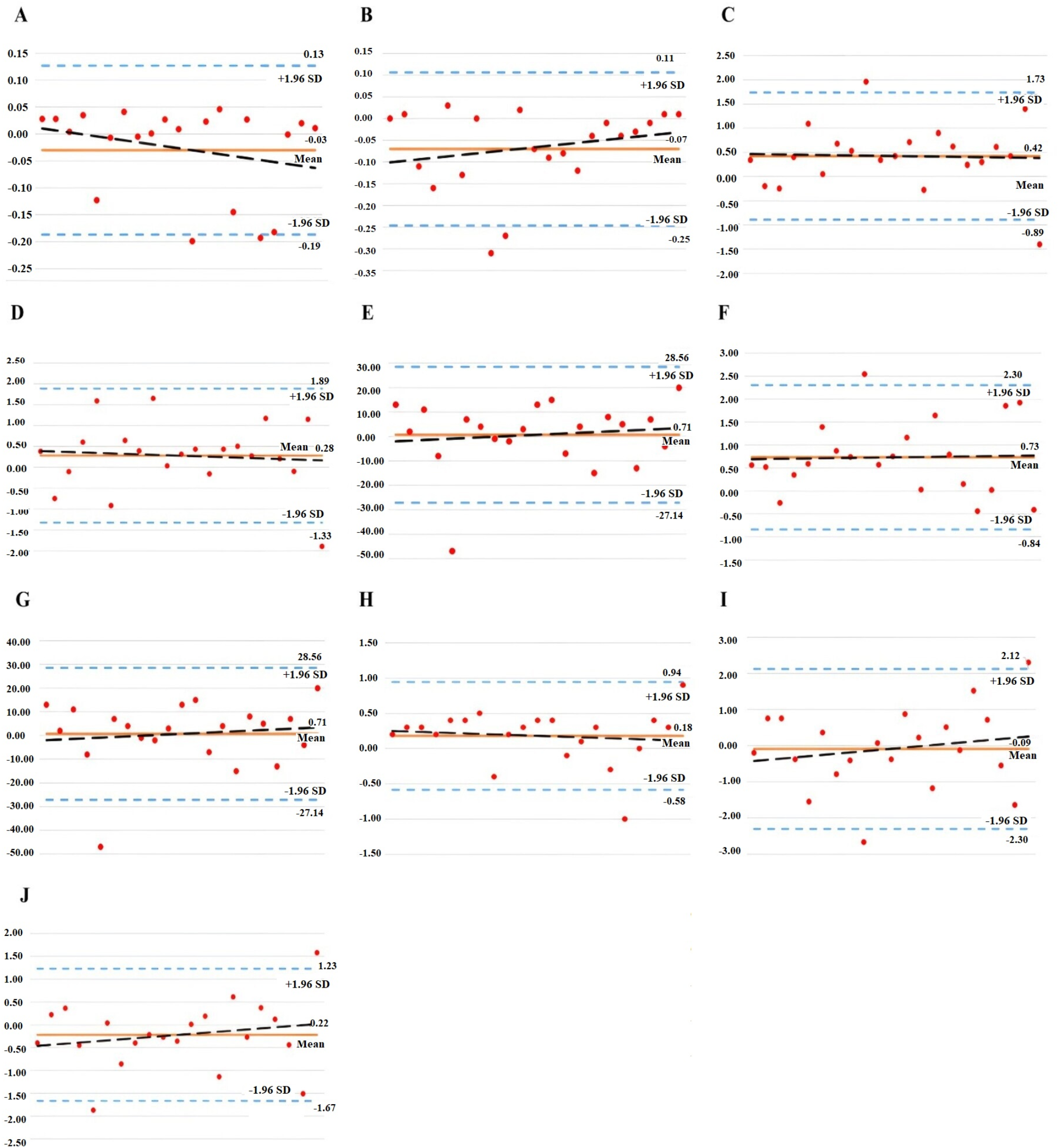
Accurate AL measurement is a critical factor in calculating IOL power. Ideally, this parameter should have a precision of within 0.1 mm, as even a small error of this magnitude can result in a post-operative refractive error of approximately 0.27 diopters [18]. Our study on the AL index revealed a minor discrepancy of 0.03, with no significant differences between the two devices. Similarly, the findings of Shajari et al. supported our results, showing negligible differences in AL measurements [19].
In addition, selecting the appropriate IOL power calculation formula based on AL is crucial for achieving precise refractive outcomes in cataract surgery [20]. Previous studies indicated that in hyperopic eyes with AL < 22.0 mm, Hoffer Q was recommended as the most accurate formula, yielding the lowest absolute error [21]. Additionally, SRK/T and Holladay 1 achieved high accuracy for medium-long eyes (24.50 ≤ AL ≤ 25.99 mm) [22], while in axial myopia (AL > 25.0 mm), Barrett Universal II and Kane formula have shown promising performance, with Barrett Universal II achieving the lowest mean absolute error [23]. Also, for extremely long eyes (AL > 30.00 mm), artificial intelligence-based formulas such as Hill-RBF 3.0 and Hoffer QST have demonstrated high accuracy [24].
On the other hand, several formulas have been proposed for IOL power calculation in keratoconus patients, including Barrett Universal II, Haigis, Hoffer Q, Holladay 1, and SRK/T. Among these, SRK/T has demonstrated the most reliable accuracy, particularly in the early stages of the disease. In our study, we utilized both SRK/T and Haigis formulas, aligning with prior research that highlights their efficacy for IOL power calculations in keratoconus patients [25].
Previous studies have demonstrated inconsistencies in ACD measurements between Pentacam AXL and IOL Master 700, indicating that these devices may not be interchangeable [26, 27]. Similarly, our study also demonstrated discrepancies in ACD measurements between the Pentacam AXL and IOL Master 700.
Accurate WTW measurement is essential for determining the size of implantable Collamer lenses [28]. Discrepancies between the Pentacam and IOLMaster 700 devices have been observed in a previous report by Salouti et al., with the IOLMaster 700 reporting larger WTW values [29]. Similarly, our findings align with their results, demonstrating notable discrepancies between the two devices in WTW measurements. These observations emphasize the need for caution when using these devices interchangeably, particularly in procedures where accurate WTW measurements are critical for clinical decision-making.
In summary, while certain measurements demonstrate potential interchangeability between Pentacam AXL and IOLMaster 700, caution is advised considering differences across specific parameters. The device selection may depend on the clinical context and the specific measurements required for accurate lens sizing and prescription.
The comparison of Pentacam AXL and IOLMaster 700 in keratoconus patients highlights key differences in biometric and keratometric parameters, impacting their clinical application. Chalkiadaki et al. [30] reported significant discrepancies in keratometric measurements, with the standard keratometry values (K1 and K2) measured by the IOLMaster 700 consistently higher than the equivalent keratometry readings (EKR K1 and EKR K2) measured by the Pentacam AXL. Furthermore, WTW distances measured by the IOLMaster 700 were significantly greater than those measured by the Pentacam AXL, whereas ACD measurements showed no significant differences.
In a similar study by Asawaworarit et al., the agreement between Pentacam AXL and IOLMaster 700 in keratoconic eyes was excellent for anterior corneal astigmatism, IOL power (SRK/T and Barrett Universal II), ACD, anterior and posterior keratometry, and total corneal power. However, the agreement for WTW was comparatively lower and was classified as good [14].
In another study, Güçlü et al. [31] reported that the IOLMaster 700 measured consistently higher values for ACD, WTW, CCT, and pupil diameter compared to the Pentacam in keratoconus patients. However, they found no significant differences in flat keratometry (Kf) and steep keratometry (Ks) measurements between the two devices. They concluded that while the Pentacam and IOLMaster 700 can be used interchangeably for keratometry values and axis measurements in both normal and keratoconus eyes, they are not interchangeable for measurements of ACD, WTW, corneal thickness (CCT), and pupil diameter.
In our study, significant differences were observed in ACD, KM, K2, and WTW measurements, which were consistent with prior research. Pentacam AXL provided higher ACD values, while IOLMaster 700 yielded greater WTW measurements. Despite these variations, both devices showed agreement in AL, K1, K1 meridian, K2 meridian, and IOL power calculations. These findings highlight the importance of parameter-specific considerations when using these devices in keratoconus management.
The limitations of this pilot study include a relatively small sample size of patients who underwent ICRS implantation. This limitation is attributed to the restricted availability of patient records and the high costs associated with such procedures. Another limitation is that this study focused solely on comparing biometric and keratometric measurements between the Pentacam AXL and IOLMaster 700 devices, without including data on postoperative clinical outcomes such as refractive changes and visual acuity. As a result, we are unable to assess the impact of the observed measurement discrepancies on clinical outcomes and this limitation may constrain our ability to fully analyze the effect of these factors on the final results. To address these limitations, future research should involve larger and more diverse samples, along with incorporating postoperative clinical assessments, to ensure more robust and generalizable conclusions.



Comments (0)