Madani A, Arnaout R, Mofrad M, Arnaout R. Fast and accurate view classification of echocardiograms using deep learning. NPJ Digit Med. 2018. https://doi.org/10.1038/s41746-017-0013-1.
Article
PubMed
PubMed Central
Google Scholar
Zhang J, Gajjala S, Agrawal P, et al. Fully automated echocardiogram interpretation in clinical practice. Circulation. 2018;138:1623–35.
Article
PubMed
PubMed Central
Google Scholar
Ouyang D, He B, Ghorbani A, et al. Video-based AI for beat-to-beat assessment of cardiac function. Nature. 2020;580:252–6.
Article
CAS
PubMed
PubMed Central
Google Scholar
Papadopoulou SL, Sachpekidis V, Kantartzi V, Styliadis I, Nihoyannopoulos P. Clinical validation of an artificial intelligence-assisted algorithm for automated quantification of left ventricular ejection fraction in real time by a novel handheld ultrasound device. Eur Heart J Digit Health. 2022;3:29–37.
Article
PubMed
PubMed Central
Google Scholar
Narang A, Bae R, Hong H, et al. Utility of a deep-learning algorithm to guide novices to acquire echocardiograms for limited diagnostic use. JAMA Cardiol. 2021;6:624–32.
Article
PubMed
Google Scholar
He B, Kwan AC, Cho JH, et al. Blinded, randomized trial of sonographer versus AI cardiac function assessment. Nature. 2023;616:520–4.
Article
CAS
PubMed
PubMed Central
Google Scholar
Tromp J, Bauer D, Claggett BL, et al. A formal validation of a deep learning-based automated workflow for the interpretation of the echocardiogram. Nat Commun. 2022;13:6776.
Article
CAS
PubMed
PubMed Central
Google Scholar
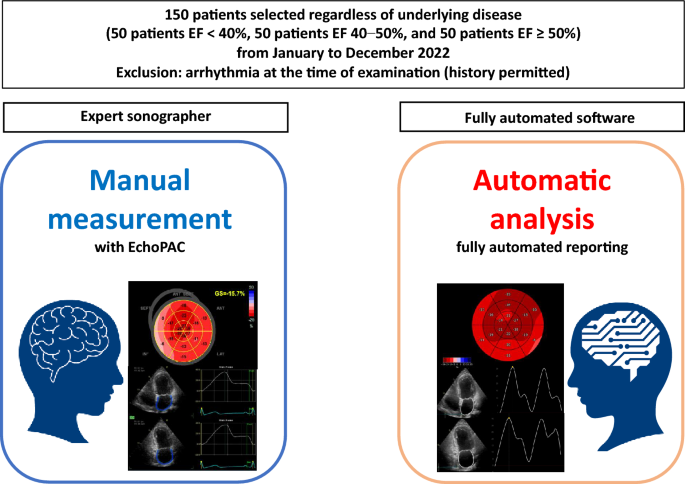
Hirata Y, Nomura Y, Saijo Y, Sata M, Kusunose K. Reducing echocardiographic examination time through routine use of fully automated software: a comparative study of measurement and report creation time. J Echocardiogr. 2024;22:162–70.
Article
PubMed
PubMed Central
Google Scholar
Bax JJ, K. ACCEL Lite: Artificial Intelligence-based Automated ECHOcardiographic Measurements and the Workflow of Sonographers (AI-ECHO): Randomized Crossover Trial. American College of Cardiology. 2025 https://www.acc.org/Latest-in-Cardiology/Articles/2025/02/11/16/30/accel-lite-11feb2025. Accessed 1 July 2025
Ludwig S, Coisne A, Hamzi K, et al. Phenotypic clustering analysis of patients rejected for mitral valve interventions: implications for future transcatheter technologies. Eur Heart J Cardiovasc Imaging. 2025. https://doi.org/10.1093/ehjci/jeaf141.
Article
PubMed
Google Scholar
Shah R, Tokodi M, Jamthikar A, et al. A deep patient-similarity learning framework for the assessment of diastolic dysfunction in elderly patients. Eur Heart J Cardiovasc Imaging. 2024;25:937–46.
Article
PubMed
Google Scholar
Casaclang-Verzosa G, Shrestha S, Khalil MJ, et al. Network tomography for understanding phenotypic presentations in aortic stenosis. JACC Cardiovasc Imaging. 2019;12:236–48.
Article
PubMed
Google Scholar
Lancaster MC, Salem Omar AM, Narula S, Kulkarni H, Narula J, Sengupta PP. Phenotypic clustering of left ventricular diastolic function parameters: patterns and prognostic relevance. JACC Cardiovasc Imaging. 2019;12:1149–61.
Article
PubMed
Google Scholar
Kagiyama N, Shrestha S, Cho JS, et al. A low-cost texture-based pipeline for predicting myocardial tissue remodeling and fibrosis using cardiac ultrasound. EBioMedicine. 2020;54: 102726.
Article
PubMed
PubMed Central
Google Scholar
Kusunose K, Abe T, Haga A, et al. A deep learning approach for assessment of regional wall motion abnormality from echocardiographic images. JACC Cardiovasc Imaging. 2020;13:374–81.
Article
PubMed
Google Scholar
Vrudhula A, Duffy G, Vukadinovic M, Liang D, Cheng S, Ouyang D. High-throughput deep learning detection of mitral regurgitation. Circulation. 2024;150:923–33.
Article
PubMed
PubMed Central
Google Scholar
Goto S, Mahara K, Beussink-Nelson L, et al. Artificial intelligence-enabled fully automated detection of cardiac amyloidosis using electrocardiograms and echocardiograms. Nat Commun. 2021;12:2726.
Article
CAS
PubMed
PubMed Central
Google Scholar
Goto S, Solanki D, John JE, et al. Multinational federated learning approach to train ECG and echocardiogram models for hypertrophic cardiomyopathy detection. Circulation. 2022;146:755–69.
Article
CAS
PubMed
PubMed Central
Google Scholar
Sahashi Y, Ouyang D, Okura H, Kagiyama N. AI-echocardiography: current status and future direction. J Cardiol. 2025. https://doi.org/10.1016/j.jjcc.2025.02.005.
Article
PubMed
Google Scholar
Radford A, Narasimhan K (2018) Improving language understanding by generative pre-training
Christensen M, Vukadinovic M, Yuan N, Ouyang D. Vision-language foundation model for echocardiogram interpretation. Nat Med. 2024;30:1481–8.
Article
CAS
PubMed
PubMed Central
Google Scholar
Kusunose K. Revolution of echocardiographic reporting: the new era of artificial intelligence and natural language processing. J Echocardiogr. 2023;21:99–104.
Article
PubMed
Google Scholar
Tamura Y, Nomura A, Kagiyama N, Mizuno A, Node K. Digitalomics, digital intervention, and designing future: the next frontier in cardiology. J Cardiol. 2024;83:318–22.
Article
PubMed
Google Scholar
Hori K, Suzuki S, Hirota N, et al. Performance of convolutional neural network-enhanced electrocardiography in detecting acute coronary syndrome: focusing on subtypes and reduced leads. J Cardiol. 2025. https://doi.org/10.1016/j.jjcc.2025.05.014.
Article
PubMed
Google Scholar
Alber DA, Yang Z, Alyakin A, et al. Medical large language models are vulnerable to data-poisoning attacks. Nat Med. 2025;31:618–26.
Article
CAS
PubMed
PubMed Central
Google Scholar
Perera Molligoda Arachchige AS, Stomeo N. Controversies surrounding AI-based reporting systems in echocardiography. J Echocardiogr. 2023;21(4):184–5.
Article
PubMed
Google Scholar
Haupt M, Maurer MH, Thomas RP. Explainable artificial intelligence in radiological cardiovascular imaging-a systematic review. Diagnostics (Basel). 2025. https://doi.org/10.3390/diagnostics15111399.
Article
PubMed
Google Scholar
Ovsyannikova D, de Mello VO, Inzlicht M. Third-party evaluators perceive AI as more compassionate than expert humans. Commun Psychol. 2025;3:4.
Article
PubMed
PubMed Central
Google Scholar

Comments (0)