
Remember me

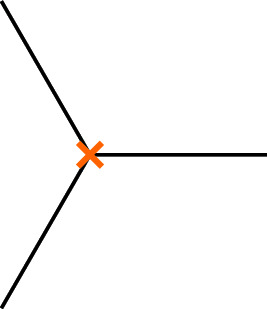

Following [17, Example 2.9], let \(\textsf\) be the DG operad generated by an element \(b \in \textsf(2)\) in degree 0 and an element \(u \in \textsf(0)\) in degree 1, which we represent graphically as trees

such that \(\textsfb = 0\), \(\textsfu=0\) and subject to three relations which we can represent most easily in graphical form as

where the numbers below the trees indicate input permutations. We shall refer to an algebra in \(\textsf_\mathbb \) over the DG operad \(\textsf\) as a unital DG Lie algebra. We let \(\textsf_\mathbb \,\,\textsf_}(\textsf_\mathbb )\) denote the category of unital DG Lie algebras. Explicitly, a unital DG Lie algebra L is described by a multifunctor \(\textsf\rightarrow \textsf_\mathbb ^\). More explicitly, such a multifunctor singles out an object \(L \in \textsf_\mathbb \) as the image of the single object of \(\textsf\) and closed linear maps \([\cdot , \cdot ]: L \otimes L \rightarrow L\) and \(\eta : \mathbb \rightarrow L\), of degrees 0 and 1, respectively, as the images of \(b \in \textsf(2)\) and \(u \in \textsf(0)\). In particular, the first two relations in (A.1) make L into a DG Lie algebra and the last relation says that the image of the unit \(\eta : \mathbb \rightarrow L\), which is closed in L, is also central in L.
1.1.1 Monoidal StructureFor any unital DG Lie algebras \(L, L' \in \textsf_\mathbb \), with respective units \(\eta : \mathbb \rightarrow L\) and \(\eta ': \mathbb \rightarrow L'\), we define the unital DG Lie algebra
$$\begin L }}\,}}L' \,\,(L \oplus L') \big / \,}}(\eta - \eta ') \end$$
where the quotient is by the image of the linear map \(\eta - \eta ': \mathbb \rightarrow L \oplus L'\), which is a DG Lie ideal of \(L \oplus L'\). The unit in \(L }}\,}}L'\) is the map induced by \(\eta : \mathbb \rightarrow L \oplus L'\), or equivalently by \(\eta ': \mathbb \rightarrow L \oplus L'\). The identity object for the monoidal product \(}}\,}}\) on \(\textsf_\mathbb \) is the trivial unital DG Lie algebra \(\mathbb [-1]\).
We will use the following universal property of the direct sum of unital DG Lie algebras.
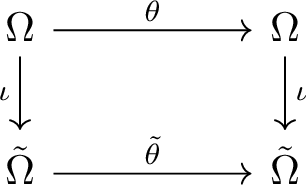
Lemma A.1Let \(f_i: L_i \rightarrow L\) for \(i \in I\) be any collection of morphisms of unital DG Lie algebras, with indexing set I, such that \([\,}}f_i, \,}}f_j] = 0\) for every \(i \ne j \in I\). There exists a unique morphism of unital DG Lie algebras \(\overline_ L_j \rightarrow L\) such that the diagram

is commutative for each \(i \in I\), where \(\iota _i: L_i \rightarrow \overline_ L_j\) is the canonical embedding.
Moreover, suppose \(f'_i: L'_i \rightarrow L'\) for \(i \in I\) is another collection of morphisms of unital DG Lie algebras such that \([\,}}f'_i, \,}}f'_j] = 0\) for every \(i \ne j \in I\) and suppose we are given morphisms of unital DG Lie algebras \(\phi : L \rightarrow L'\) and \(\phi _i: L_i \rightarrow L'_i\) for each \(i \in I\) such that \(\phi \circ f_i = f'_i \circ \phi _i\). Then, there exists a unique morphism of unital DG Lie algebras \(\overline_ \phi _j: \overline_ L_j \rightarrow \overline_ L'_j\) making the following diagram

commute for each \(i \in I\), where the vertical morphisms are defined as above.
ProofWe first define \(h: \bigoplus _ L_j \rightarrow L\) by \((\textsf_i)_ \mapsto \sum _ f_i(\textsf_i)\). This is well defined since the sum over \(i \in I\) is finite by virtue of \(\textsf_i\) being zero for all but finitely many \(i \in I\). And since \(f_i\) are morphisms of unital DG Lie algebras, we have \(f_i \circ \eta _i = \eta \) where \(\eta _i\) denotes the unit in each \(L_i\) and \(\eta \) the unity in L. It follows that h factors through a map \(\bar: \overline_ L_j \rightarrow L\), defined by \([(\textsf_i)_] \mapsto \sum _ f_i(\textsf_i)\) where \([(\textsf_i)_] \in \overline_ L_j\) is the class of \((\textsf_i)_ \in \bigoplus _ L_j\). In other words, \(\bar\big ( [(\textsf_i)_] \big ) = h\big ( (\textsf_i)_ \big )\). But we also have
$$\begin \big [ h ((\textsf_i)_), h((\textsf_i)_) \big ]&= \sum _ [f_i(\textsf_i), f_j(\textsf_j)] = \sum _ [f_i(\textsf_i), f_i(\textsf_i)]\\&= \sum _ f_i([\textsf_i, \textsf_i]) = h\big ( ([\textsf_i, \textsf_i])_ \big ) = h\big ( [(\textsf_i)_, (\textsf_i)_] \big ) \end$$
where the second step is by the assumption that \([\,}}f_i, \,}}f_j] = 0\) for \(i \ne j \in I\). The third step follows since each \(f_i\) is a morphism of unital DG Lie algebras and the last step uses the DG Lie algebra structure on \(\overline_ L_i\). So h is a morphism of DG Lie algebras and hence \(\bar\) is a morphism of unital DG Lie algebras. By construction, the latter is unique such that \(h \circ \iota _i = f_i\).
Let us consider now the second claim. Since \(\,}}(\iota '_i \circ \phi _i) \subset \,}}\iota '_i\), for each \(i \in I\) it follows that \([\,}}(\iota '_i \circ \phi _i), \,}}(\iota '_j \circ \phi _j)] = 0\) for each \(i \ne j \in I\). By the first part of the lemma applied to the morphisms of unital DG Lie algebras \(\iota '_i \circ \phi _i: L_i \rightarrow \overline_^n L'_j\) we thus have a unique morphism of unital DG Lie algebras \(\overline_ \phi _j: \overline_ L_j \rightarrow \overline_ L'_j\) which makes the bottom square of the second diagram in the statement commute. It remains to show that it also makes the square on the right of the diagram commute, i.e. that \(\bar' \circ \big ( \overline_ \phi _j \big ) = \phi \circ \bar\) where \(\bar\) and \(\bar'\) are the two vertical morphisms defined as above.
Now, \(\phi \circ f_i = f'_i \circ \phi _i\) and \([\,}}f'_i, \,}}f'_j] = 0\) for every \(i \ne j \in I\) from which it follows that \([\,}}(\phi \circ f_i), \,}}(\phi \circ f_j)] = 0\) for every \(i \ne j \in I\). Therefore, applying the first part of the lemma to the collection of morphisms of unital DG Lie algebras \(\phi \circ f_i: L_i \rightarrow L'\) we obtain a unique morphism of unital DG Lie algebras \(g: \overline_^n L_j \rightarrow L'\) such that \(g \circ \iota _i = \phi \circ f_i\) for each \(i \in I\). Yet we have
$$\begin \bar' \circ \bigg ( \overline_ \phi _j \bigg ) \circ \iota _i = \bar' \circ \iota '_i \circ \phi _i = f'_i \circ \phi _i = \phi \circ f_i = \phi \circ \bar \circ \iota _i \end$$
from which we deduce that \(\bar' \circ \big ( \overline_ \phi _j \big ) = g = \phi \circ \bar\) by uniqueness of g, as required. \(\square \)
1.1.2 Chevalley–Eilenberg Functor for \(\textsf_\mathbb \)The homological Chevalley–Eilenberg functor is the symmetric monoidal functor
$$\begin \textrm_\bullet : (\textsf_\mathbb , \oplus )&\longrightarrow (\textsf_\mathbb , \otimes ) \nonumber \\ L&\longmapsto \textrm_\bullet (L) \,\,\Big ( \big ( \,}}(L[1]) \big )^\bullet , \textsf_} \Big ), \end$$
(A.2)
where \((\,}}V)^\bullet \,\,\bigoplus _ \,}}^n V\) is the free commutative graded algebra on a graded vector space V and \(\,}}^n V\) is its component of word length n. Here, \(L[1] \,\,\mathbb [1] \otimes L \in \textsf_\mathbb \) denotes the suspension of the DG vector space L where \(\mathbb [1]\) is the DG vector space with \(\mathbb \) placed in degree \(-1\). For any element \(v \in V\) of a DG vector space V we let \(sv \,\,1 \otimes v \in V[1]\) denote its suspension, and we use the notation \(s^ v \,\,1 \otimes v \in V[-1] \,\,\mathbb [-1] \otimes V\) to denote its inverse suspension. The product in \((\,}}V)^\bullet \) is denoted by concatenation. The differential on \(\textrm_\bullet (L)\) is \(\textsf_\textrm\,\,\textsf_ + \textsf_\) where \(\textsf_: L[1] \rightarrow L[1]\) is induced by the differential \(\textsf_L: L \rightarrow L\) of the DG Lie algebra L and \(\textsf_: ( \,}}(L[1]) )^\bullet \rightarrow ( \,}}(L[1]) )^\bullet \) is the unique coderivation of the graded coalgebra \(( \,}}(L[1]) )^\bullet \) extending the degree 1 map \(\,}}^2 (L[1]) \rightarrow L[1]\), where \(\,}}^2 (L[1])\) is the graded symmetric tensor square, induced by the Lie bracket \([\cdot , \cdot ]: L \otimes L \rightarrow L\), see, for instance, [34, Lemma 22.2]. Explicitly, \(\,}}^2 (L[1]) \rightarrow L[1]\) is given by \(s\textsf \, s\textsf \mapsto (-1)^|+1} s[\textsf, \textsf]\) for any homogeneous \(\textsf, \textsf \in L\). This is well defined since \(s\textsf \, s\textsf = (-1)^| |\textsf| + |\textsf| + |\textsf| + 1} s\textsf \, s\textsf\) is sent to \((-1)^| |\textsf| + |\textsf| + |\textsf| + 1} (-1)^|+1} s[\textsf, \textsf] = (-1)^|+1} s[\textsf, \textsf]\) using the graded skew-symmetry of the Lie bracket, namely \([\textsf, \textsf] = - (-1)^| |\textsf|} [\textsf, \textsf]\). Note that \(\textsf_ \textsf_ = - \textsf_ \textsf_\) and \(\textsf_^2 = 0\).
We shall need a variant of the functor (A.2) for unital DG Lie algebras defined in the next proposition. Let \(I^i_L \,\,\ \, s(\eta (1)) - \mathcal \,|\, \mathcal \in \textrm_i(L) \}\) for every \(i \in \mathbb \). This is a subspace of \(\textrm_i(L)\) since \(\eta (1)\) is of degree 1. Moreover, since \(\eta (1)\) is a cocycle, i.e. \(\textsf_L \eta (1) = 0\), and is central in L, it follows that \(I^\bullet _L\) is a DG vector subspace of \(\textrm_\bullet (L)\).
Proposition A.2We have a symmetric monoidal functor
$$\begin \overline}_\bullet : (\textsf_\mathbb , }}\,}})&\longrightarrow (\textsf_\mathbb , \otimes ) \nonumber \\ L&\longmapsto \overline}_\bullet (L) \,\,\textrm_\bullet (L) \big / I^\bullet _L \end$$
(A.3)
which preserves quasi-isomorphisms.
ProofFor any morphism of unital DG Lie algebras \(f: L \rightarrow L'\), the morphism of DG vector spaces \(\textrm_\bullet (f): \textrm_\bullet (L) \rightarrow \textrm_\bullet (L')\) is given in degree \(i \in \mathbb \) by \(\textrm_i(f) = \big ( \,}}f[1] \big )^i\), where the morphism of DG vector spaces \(f[1]: L[1] \rightarrow L'[1]\) is the suspension of \(f: L \rightarrow L'\). Since \(f(\eta (1)) = \eta '(1)\), it follows that \(\textrm_\bullet (f)(I^\bullet _L) \subset I^\bullet _\) and therefore \(\textrm_\bullet (f)\) induces a morphism of DG vector spaces \(\overline}_\bullet (f): \overline}_\bullet (L) \rightarrow \overline}_\bullet (L')\).
Since the functor (A.2) preserves quasi-isomorphisms, if  is a quasi-isomorphism, then so is
  . Now, the morphism \(\overline}_\bullet (f): \overline}_\bullet (L) \rightarrow \overline}_\bullet (L')\) is a retract of the latter since we have a commutative diagram

where \(q_L: \textrm_\bullet (L) \rightarrow \overline}_\bullet (L)\) is the canonical map and \(i_L: \overline}_\bullet (L) \rightarrow \textrm_\bullet (L)\) is given by taking the representative with no factors of \(s(\eta (1))\) so that we clearly have \(q_L \circ i_L = \,}}_}_\bullet (L)}\) and similarly \(q_ \circ i_ = \,}}_}_\bullet (L')}\). Hence  is a quasi-isomorphism.
It remains to show that the functor \(\overline}_\bullet \) is symmetric monoidal. In particular, we must show that given any unital DG Lie algebras \(L, L' \in \textsf_\mathbb \) we have a canonical isomorphism of DG vector spaces
$$\begin \overline}_\bullet (L }}\,}}L') \cong \overline}_\bullet (L) \otimes \overline}_\bullet (L'). \end$$
To see this, let \(J^i \,\,\ \, s(\eta (1)) - \mathcal \, s(\eta '(1)) \,|\, \mathcal \in \textrm_i(L \oplus L') \}\) for every \(i \in \mathbb \). Since \(\eta (1)\) and \(\eta '(1)\), thought of as elements in \(L \oplus L'\), are both central cocycles of degree 1, it follows that \(J^\bullet \) is a DG vector subspace of \(\textrm_\bullet (L \oplus L')\). Moreover, we have a canonical isomorphism of DG vector spaces \(\textrm_\bullet (L }}\,}}L') \cong \textrm_\bullet (L \oplus L') / J^\bullet \). Also, introducing the DG vector subspace \(K^\bullet \) of \(\textrm_\bullet (L \oplus L')\) with components \(K^i \,\,\ \, s(\eta (1)) - \mathcal + \mathcal ' \, s(\eta '(1)) - \mathcal ' \,|\, \mathcal , \mathcal ' \in \textrm_i(L \oplus L') \}\) for every \(i \in \mathbb \), of which \(J^\bullet \) is an obvious DG vector subspace, we have a canonical isomorphism \(I^\bullet _}}\,}}L'} \cong K^\bullet / J^\bullet \). We therefore have
$$\begin&\overline}_\bullet (L }}\,}}L') = \textrm_\bullet (L }}\,}}L') / I^\bullet _}}\,}}L'} \cong \big ( \textrm_\bullet (L \oplus L') / J^\bullet \big ) \big / \big ( K^\bullet / J^\bullet \big ) \cong \textrm_\bullet (L \oplus L') / K^\bullet \\&\quad \cong \big ( \textrm_\bullet (L) \otimes \textrm_\bullet (L') \big ) / \big ( I^\bullet _L \otimes \textrm_\bullet (L') + \textrm_\bullet (L) \otimes I^\bullet _ \big ) = \overline}_\bullet (L) \otimes \overline}_\bullet (L'), \end$$
where in the first isomorphism we made use of the two isomorphisms stated above. The next isomorphism is by the third isomorphism theorem and the last isomorphism uses the fact that the homological Chevalley–Eilenberg functor \(\textrm_\bullet \) is symmetric monoidal.
Also, the result of applying the functor \(\overline}_\bullet \) to the identity object \(\mathbb [-1]\) of the symmetric monoidal product \(}}\,}}\) on \(\textsf_\mathbb \) is isomorphic to \(\mathbb [0]\), i.e. the identity object of the symmetric monoidal product \(\otimes \) on \(\textsf_\mathbb \). Hence, \(\overline}_\bullet \) is a symmetric monoidal functor. \(\square \)
It will be useful to also introduce, mainly for the purpose of proving part of Proposition 3.4, the category of pointed DG vector spaces, denoted \(\textsf_\mathbb \), whose objects are vector spaces V equipped with a degree 1 map \(\eta : \mathbb \rightarrow V\) and whose morphisms preserve this structure. We also introduce the symmetric monoidal functor
$$\begin }\,}}_\bullet : (\textsf_\mathbb , }}\,}})&\longrightarrow (\textsf_\mathbb , \otimes ) \nonumber \\ V&\longmapsto }\,}}_\bullet (V) \,\,\big ( \,}}(V[1]) \big )^\bullet \big / J^\bullet _V \end$$
(A.4)
where the differential on \(\big ( \,}}(V[1]) \big )^\bullet \) is the one induced from \(\textsf_: V[1] \rightarrow V[1]\) and we set \(J^i_V \,\,\\, s(\eta (1)) - \mathcal \,|\, \mathcal \in (\,}}(V[1]))^i \}\) for each \(i \in \mathbb \), which is a subspace of \((\,}}(V[1]))^i\) since \(\eta (1)\) has degree 1. Moreover, since \(\eta (1)\) is a cocycle, namely \(\textsf_V \eta (1) = 0\), these form a DG vector subspace \(J^\bullet _V\) of \(\big ( \,}}(V[1]) \big )^\bullet \). The proof that (A.4) is symmetric monoidal is completely analogous to that of Proposition A.2.
1.2 Unital Local Lie AlgebrasLet \(\mathcal \) be a precosheaf of unital DG Lie algebras on a manifold D, with extension morphisms denoted by \(\,}}_: \mathcal (U) \rightarrow \mathcal (V)\) for any inclusion of subsets \(U \subset V\) in D. We say that \(\mathcal \) is a unital local Lie algebra on D if for any finite collection \(\_^n\) of disjoint open subsets \(U_i \subset V\) of an open subset \(V \subset D\) we have
$$\begin \big [ \,}}\big ( \! \,}}_ \! \big ), \,}}\big (\! \,}}_ \! \big ) \big ] = 0, \end$$
(A.5)
for every \(i \ne j\). We denote by \(\textsf_\mathbb (D)\) the category of unital local Lie algebras on D, where a morphism of unital local Lie algebras is defined as a morphism of the underlying precosheaves of unital DG Lie algebras.
Proposition A.3We have a canonical functor
$$\begin \textsf_\mathbb (D) \longrightarrow \textsf(D, \textsf_\mathbb ^}}\,}}}). \end$$
More explicitly, any \(\mathcal \in \textsf_\mathbb (D)\) defines an object in \(\textsf(D, \textsf_\mathbb ^}}\,}}})\) which by a slight abuse of notation we also denote by \(\mathcal \). Moreover, every morphism \(\mathcal \rightarrow \mathcal '\) of \(\textsf_\mathbb (D)\) induces a morphism of \(\textsf(D, \textsf_\mathbb ^}}\,}}})\) which we also denote \(\mathcal \rightarrow \mathcal '\).
ProofLet \(\mathcal \in \textsf_\mathbb (D)\). Given any open subsets \(\sqcup _^n U_i \subset V\), by Lemma A.1 we obtain a unique morphism of DG Lie algebras \(m^\mathcal _: \overline_^n \mathcal (U_j) \rightarrow \mathcal (V)\) such that the diagram

commutes. The composition property of these morphisms, required in order for \(\mathcal \) to define a prefactorisation algebra, then follows from their uniqueness property. Explicitly, we have the following commutative diagram

where the two small commutative triangles are given by the universal property in Lemma A.1. The square on the bottom right of the diagram is commutative by definition of the morphism of unital DG Lie algebras \(\overline_^n m^\mathcal _), V_i}\), in the second part of Lemma A.1. The extra morphism from the bottom right to the top right is given by the universal property from Lemma A.1 applied to the big outside triangle. Its uniqueness implies the required composition property. It follows that \(\mathcal \) defines an element of \(\textsf(D, \textsf_\mathbb ^}}\,}}})\), as required.
Let \(\phi : \mathcal \rightarrow \mathcal '\) be a morphism of \(\textsf_\mathbb (D)\). By using the second part of Lemma A.1, we have a morphism \(\overline_^n \phi _: \overline_^n \mathcal (U_j) \rightarrow \overline_^n \mathcal '(U_j)\) making the following diagram

commutative. In particular, the commutativity of the right-hand square is equivalent to the statement that \(\phi : \mathcal \rightarrow \mathcal '\) is a morphism of \(\textsf(D, \textsf_\mathbb ^}}\,}}})\), as required. \(\square \)
Viewing any \(\mathcal \in \textsf_\mathbb (D)\) as a multifunctor \(\textsf(D)^\sqcup \rightarrow \textsf_\mathbb ^}}\,}}}\), by Proposition A.3, we can consider its post-composition with the symmetric monoidal functor (A.3) from Proposition A.2 to obtain a prefactorisation algebra \(\overline}_\bullet \, \mathcal \in \textsf(D, \textsf_\mathbb ^)\). Post-composing the latter with the lax monoidal \(0^\textrm\) cohomology functor \(H^0: \textsf_\mathbb \rightarrow \textsf_\mathbb \) then yields the twisted prefactorisation envelope of the unital local Lie algebra \(\mathcal \), denoted
$$\begin \mathcal \mathcal \,\,H^0 \, \overline}_\bullet \, \mathcal \in \textsf(D, \textsf_\mathbb ^). \end$$
(A.6)
Comments (0)