
Remember me


Our next example is the d-dimensional de Sitter space \(\text _d\). De Sitter space is an important example of a non-stationary spacetime and one of the simplest examples to model a universe with an accelerated expansion. It exhibits a particularly rich structure and, being a symmetric space, all its invariant propagators can be given explicitly in terms of special functions.
We will describe four different approaches to investigate propagators on \(\text _d\). The first is based on Wick rotation (analytic continuation) from the sphere \(\mathbb ^d\). One obtains the so-called Euclidean state, considered to be the most physical invariant state on \(\text _d\). The second approach is the off-shell approach based on the resolvent of the d’Alembertian on \(L^2(\text _d)\). Somewhat surprisingly, it leads to non-physical two-point functions. The third approach is the on-shell approach based on \(}}_\textrm\). It leads to the well-known family of de Sitter invariant two-point functions corresponding to the so-called \(\alpha \)-vacua. One can then compute invariant correlation functions between two different \(\alpha \)-vacua. Finally, we may interpret \(\text _d\) as a special case of a FLRW spacetime and apply the methods of Sect. 4.
Note that the first three approaches directly lead to simple expressions for invariant propagators. The last approach breaks manifest de Sitter invariance, and to obtain invariant expressions, one needs to sum over all modes using rather complicated addition formulas for special functions.
There is a very large literature about propagators on de Sitter space. Particularly useful for our considerations were [2, 4, 6, 14, 17, 19, 21, 22, 29, 32, 47, 48, 58,59,60, 66, 67, 78, 80, 81]. In these references, one finds different approaches to investigate propagators on de Sitter space.
Many of them use mode sums to construct propagators—sometimes explicitly like in [2, 17, 48, 68], sometimes abstractly like in [4]. Papers [19, 21, 22] have an axiomatic approach much in the spirit of Gårding and Wightman. Only reference [78] uses the operator-theoretic approach to define the Feynman propagator in \(d=4\) dimensions.
5.1 Geometry of de Sitter SpaceThe d-dimensional de Sitter space \(\text _d\) is defined by an embedding into \(d+1\)-dimensional Minkowski space \(}^\). Let \([\cdot |\cdot ]\) denote the pseudo-scalar product on \(}^\) defined by
$$\begin [x|x'] = -x^0 ^0 + \sum _^d x^i ^i. \end$$
(5.1)
Then the d-dimensional de Sitter space is the one-sheeted hyperboloid
$$\begin \text _d := \}^\;|\; [x|x]=1\}. \end$$
(5.2)
Let us introduce some notation that will frequently appear throughout this section. For \(x,x' \in \text _d \hookrightarrow }^\), we define

(5.3)
While t and \(t^A\) are two independent variables, we have \(Z(x^A,x') = -Z(x,x')=-Z\).
De Sitter space has various regions:
$$\begin&Z>1:&\quad x \text x' \text \text \text&\nonumber \\ &Z=1:&\quad x \text x' \text \text \text \text \text&\nonumber \\ &Z<1:&\quad x \text x' \text \text \text \text \text \text \text&\end$$
(5.4)
The last region includes the subregions
$$\begin&Z=-1:&\quad x^A \text x' \text \text \text \text \text,&\nonumber \\ &Z<-1:&\quad x^A \text x' \text \text \text.&\end$$
(5.5)
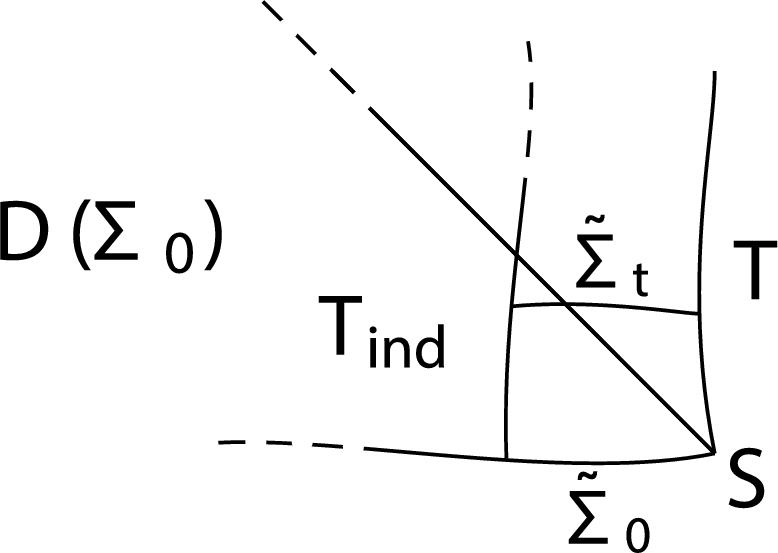
One may further divide the regions \(Z>1\) and \(Z<-1\) into future and past dependent on whether t, resp. \(t^A\) are positive or negative. Thus, if we fix a point \(x'\in \text _d\), then we can partition \(\text _d\) into 5 regions:
$$\begin \text _d=V^+\cup V^-\cup A^+\cup A^-\cup S \end$$
(5.6)
as depicted in Fig. 1.
Fig. 1
Conformal diagram of de Sitter space with the reference point x and the regions \(V^ := \\), \(A^ := \\) and \(S :=\\). The left and right sides of the diagram are glued together, and each point represents a \(d-2\)-sphere
The de Sitter space possesses a global system of coordinates
$$\begin&x^0 = \sinh \tau , \quad x^i=\cosh \tau \; \Omega ^i,\;i=1,\dots ,d, \nonumber \\ &\text\quad \tau \in },\;\Omega \in \mathbb ^\hookrightarrow }^.\end$$
(5.7)
In these coordinates, we have \(\text s^2=-\text \tau ^2+\cosh ^2(\tau )\text \Omega ^2\) and
$$\begin Z = -\sinh \tau \sinh \tau ' +\cosh \tau \cosh \tau '\cos \theta , \end$$
(5.8)
where \(\theta \) is the angle between \(\Omega \) and \(\Omega '\). If \(x=(0,1,0\dots )\), then \(Z=\cosh \tau '\cos \theta \).
Both the (full) de Sitter group O(1, d) and the restricted de Sitter group \(SO_0(1,d)\), that is, the connected component of the identity in O(1, d), act on \(\text _d\). The Klein–Gordon equation restricted to invariant solutions and written in terms of Z reduces to the Gegenbauer equation, a form of the hypergeometric equation [4, 12, 29, 49, 68, 80] whose properties we discuss in Appendix B.
In the literature, one often restricts analysis to subsets of \(\text _d\), such as the Poincaré patch or the static patch, which allow for coordinate systems with special properties. In our paper, we consider only the “global patch,” that is the full de Sitter space. Otherwise, we would have to consider boundary conditions for the d’Alembertian at the boundary of our patch (which would break the de Sitter invariance and presumably be non-physical).
For more information about de Sitter space, consult the overviews [67, 81].
5.2 The sphereThe de Sitter space can be viewed as a Wick-rotated sphere. Therefore, in this subsection we recall some facts about the sphere and the Green function of the spherical Laplacian.
Consider the \(d+1\) dimensional Euclidean space equipped with the scalar product
$$\begin (x|x')=\sum _^x^ix^.\end$$
(5.9)
The d-dimensional (unit) sphere is defined as
$$\begin \mathbb ^d := \}^\;|\; (x|x)=1\}. \end$$
(5.10)
For \(\,}}(\nu )>0\) or \(\nu \in \text }_\setminus \text \big ( \tfrac+\mathbb _0\big )\), let us consider the resolvent of the spherical Laplacian \(G^\text (-\nu ^2):=(-\Delta ^\text +(\frac)^2+\nu ^2)^\). Its integral kernel \(G^\text (-\nu ^2;x,x')\) can be expressed in terms of the invariant quantity \((x|x')\) (see, e.g., [36, 37], and [31, 82], where Legendre functions are used) as:
$$\begin G^\text (-\nu ^2;x,x') =C_ \textbf_,\text \nu }\big (-(x|x')\big ), \end$$
(5.11)
where
$$\begin C_:= \frac+\text \nu \big ) \Gamma \big (\tfrac-\text \nu \big ) }}}, \end$$
(5.12)
and \(\textbf_(z)\) is the Gegenbauer function described in Appendix B.
5.3 Propagators Related to the Euclidean StateWe now turn to the d-dimensional de Sitter space for \(d\ge 2\). We will analyze bi- and fundamental solutions of the Klein–Gordon equation
$$\begin (-\Box +m^2)\phi (x)=0\end$$
(5.13)
in de Sitter space, which are invariant under the full or restricted de Sitter group. Note that m might contain a coupling to the scalar curvature. Hence, it is sometimes called effective mass. Anyway, we prefer to use the parameter \(\nu \) defined by
$$\begin \nu := \sqrt\big )^2}\in \mathbb . \end$$
(5.14)
Thus, (5.13) is replaced with
$$\begin \Big (-\Box +\big (\tfrac\big )^2+\nu ^2\Big )\phi (x)=0. \end$$
(5.15)
We will allow for complex \(\nu ^2\), choosing the principal sheet of the square root, that is \(\nu \in \\,}}(\nu )>0\}\). The case of positive \(\nu ^2\) has analogous properties to that of positive \(m^2\) in Minkowski space. In the case \(\nu ^2<0\), we assume that \(\nu \in \text }_\). It is more intricate than the case \(\,}}(\nu )>0\) and contains various subcases with different exotic properties. It is somewhat analogous to the tachyonic case in Minkowski space.
On a generic spacetime the concept of the Wick rotation is not uniquely defined. However, on the de Sitter space embedded in \(\mathbb ^\) there is a natural kind of a Wick rotation, which we will use: the replacement of \(x^\) with \(\pm \text x^0\). We note first that
$$\begin (x|x') = 1-\frac \quad \text \quad x,x' \in \mathbb ^d. \end$$
(5.16)
The replacement of \(x^-^\) with \( (x^0-^0) \text ^\phi }\), \(\phi \in [0,\tfrac]\), yields
$$\begin&(x^-x'^)^2 \rightarrow (x^0-x'^0 )^2 \text ^\phi } \limits ^}} -(x^0-x'^0 )^2\pm \text 0 \nonumber \\&\quad \Rightarrow \; (x|x') \rightarrow [x|x']\mp \text 0. \end$$
(5.17)
Moreover, we need to insert a prefactor \(\pm \text \) coming from the change of the integral measure.
Let \(\,}}(\nu )>0\) or \(\nu \in \text }_\setminus \text \big ( \tfrac+\mathbb _0\big )\). The Feynman and anti-Feynman propagators in the d-dimensional de Sitter space obtained by Wick rotation of the Green function (5.11) on the sphere are given by
$$\begin G^/\overline}}_(x,x')&= \pm \text C_\; \textbf_-1,\text \nu }\big (-Z\pm \text 0\big ), \end$$
(5.18)
where \(C_\) is given by (5.12) and \(Z:= [x|x'].\) We easily check that (5.18) are Green functions of the Klein–Gordon equation on \(\text _d\).
The sum of the Euclidean Feynman and anti-Feynman propagator has a causal support for \(\textbf_(z)\) is holomorphic on \(\mathbb \setminus ]-\infty ,-1]\), and therefore,
$$\begin G^}_ + G^}}_ = \text C_\;\Big ( \textbf_-1,\text \nu }\big (-Z+\text 0\big ) -\textbf_-1,\text \nu }\big (-Z-\text 0\big )\Big ) \end$$
(5.19)
vanishes for \(Z<1\).
As we will see later, \(G^}_\) and \(G^}}_\) are not the operator-theoretic Feynman and anti-Feynman propagators. However, we can still apply to them the procedure described in Sect. 2.9. This leads to the classical propagators
$$\begin&G^ (x,x') \nonumber \\ &\quad = \text\theta \big (\pm t\big ) C_\; \Big ( }_-1,\text\nu }\big (-Z+\text0 \big ) -}_-1,\text\nu }\big (-Z-\text0 \big ) \Big ) , \end$$
(5.20)
$$\begin&G^} (x,x')\nonumber \\ &\quad =\text\,}} (t) C_ \Big ( }_-1,\text\nu }\big (-Z+\text0 \big ) -}_-1,\text\nu }\big (-Z-\text0 \big ) \Big ),\end$$
(5.21)
as well as to the positive/negative frequency solutions
$$\begin G^_ (x,x')&= C_\; }_-1,\text\nu }\Big ( -Z\pm \text0 \,}} (t)\Big ). \end$$
(5.22)
\( G^_ \) have the Hadamard property and are two-point functions of a state called the Euclidean state \(\Omega _0\) (sometimes also called the Bunch–Davies state) [4, 25, 29, 49, 68, 80].
Note that the propagators associated with the Euclidean vacuum satisfy all relations (2.39) with \(\alpha =\beta =0\). The classical propagators (5.20) and (5.21) are universal: they do not depend on the Euclidean vacuum; therefore, we do not decorate them with the subscript 0.
5.4 Bisolutions and Green FunctionsThe family of invariant propagators on the de Sitter space is quite rich and is not limited to those related to the Euclidean state, discussed in the previous subsection. In order to prepare for their analysis, in this subsection we will describe invariant solutions of the Klein–Gordon equation on de Sitter space.
From the analysis of previous subsection, we easily see that the following functions are bisolutions invariant with respect to the full de Sitter group:
$$\begin G^\textrm_(x,x') :=&\; G^_(x,x') + G^_(x,x') \nonumber \\ =&\; C_ \Big ( \textbf_-1,\text \nu }\big (-Z+\text 0 \big ) +\textbf_-1,\text \nu }\big (-Z-\text 0 \big ) \Big ),\end$$
(5.23)
$$\begin G^,A}_(x,x') :=&G^\text _(x^A,x')=G^\text _(x,x^)\nonumber \\ =&\; C_ \Big ( }_-1,\text\nu }\big (Z+\text0 \big ) +}_-1,\text\nu }\big (Z-\text0 \big ) \Big ). \end$$
(5.24)
The following functions are bisolutions invariant with respect to the restricted de Sitter group:
$$\begin G^} (x,x'):=&\text \big ( G^_(x,x') - G^_(x,x') \big ) \nonumber \\ =&\text \,}}\big (t\big ) C_ \Big ( \textbf_-1,\text \nu }\big (-Z+\text 0 \big ) -\textbf_-1,\text \nu }\big (-Z-\text 0 \big ) \Big ), \end$$
(5.25)
$$\begin G^,A} (x,x') :=&G^} (x^A,x') =- G^} (x,x^) \nonumber \\ =&\text \,}}\big (t^A\big ) C_ \Big ( \textbf_-1,\text \nu }\big (Z+\text 0 \big ) -\textbf_-1,\text \nu }\big (Z-\text 0 \big ) \Big ). \end$$
(5.26)
Indeed, we already know that \(G_0^\) are bisolutions, hence so are (5.23) and (5.25). It is also clear that replacing x with \(x^A\), used in (5.24) and (5.26) leads to invariant bisolutions. We expect that the following is true:
Conjecture 5.1For any \(\nu \in \mathbb \) such that \(\tfrac\pm \text \nu \notin \\), \(\},G_0^,A}\}\) is a basis of the space of fully de Sitter invariant bisolutions, and \(\},G_0^,A},G^\text ,G^,A}\}\) is a basis of the space of bisolutions invariant under the restricted de Sitter group.
Note that the Gegenbauer function \(\textbf_-1,\text \nu }(w)\) is an entire function of \(\nu \). If we were only interested in bisolutions, we could drop the restriction \(\tfrac\pm \text \nu \notin \\) in Thm. 5.1, which is only necessary due to the poles of the prefactor \(C_\) at such \(\nu \). However, we eventually want to relate bisolutions to Green functions by time-ordering, and therefore, we normalize them properly.
Functions invariant with respect to the full de Sitter group can always be written in terms of the invariant quantity Z alone. The Klein–Gordon equation restricted to invariant solutions and written in terms of Z reduces to the Gegenbauer equation (cf., e.g., [4, 17, 49])
$$\begin \Big ((1-Z^2)\partial _Z^2 - d Z \partial _Z - \nu ^2 - \big (\tfrac\big )^2\Big ) f(Z)=0. \end$$
(5.27)
Therefore, all bisolutions and Green functions invariant wrt the full de Sitter group can be expressed in terms of Gegenbauer functions.
If we only demand invariance under the restricted de Sitter group, the regions \(V^+\) and \(V^-\) as well as \(A^+\) and \(A^-\) need to be treated as independent. Hence, for \(|Z|>1\), propagators invariant under the restricted de Sitter group may depend on \(\,}}(t)\) resp. \(\,}}(t^A)\).
Assuming the validity of Conjecture 5.1, the general bisolution is
$$\begin G^}_} = :=&\, \text a_1 G_0^\textrm+ a_2 G^\text + \text a_3 G_0^,A} + a_4 G^A}\nonumber \\ =&\, \text C_\Big ( \big (a_1 + a_2\,}}(t)\big ) \textbf_,\text \nu }(-Z+\text 0) \nonumber \\&\qquad +\big (a_1 - a_2\,}}(t)\big ) \textbf_,\text \nu }(-Z-\text 0) \nonumber \\ &\qquad + \big (a_3 - a_4\,}}(t^A) \big ) \textbf_,\text \nu }(Z+\text 0) \nonumber \\&\qquad + \big (a_3 + a_4\,}}(t^A) \big ) \textbf_,\text \nu }(Z-\text 0) \Big ) \end$$
(5.28)
and the general fundamental solution is
$$\begin G_} :=&\, G^}_ + G^}_} = \text C_ \textbf_,\text \nu }(-Z+\text 0) + G^}_} . \end$$
(5.29)
5.5 Resolvent of the d’Alembertian and Operator-Theoretic PropagatorsThe d’Alembertian \(-\Box \) is essentially self-adjoint on \(C_\textrm^\infty (\text _d)\) in the sense of \(L^2(\text _d)\). This follows from a general theory of invariant differential operators on symmetric spaces [10, 77] and the fact that de Sitter space can be seen as the quotient of Lie groups \(O(1,d)/O(1,d-1)\). In this subsection, we will compute its resolvent and operator-theoretic Feynman and anti-Feynman propagators. In the four-dimensional case, this has been studied [78].
Outside of the spectrum of \(-\Box +\big (\tfrac\big )^2\), its resolvent (Green operator) will be denoted by
$$\begin G(-\nu ^2):=\Big (-\Box +\big (\tfrac\big )^2+\nu ^2\Big )^. \end$$
(5.30)
We will write \(G(-\nu ^2;x,x')\) for its integral kernel.
In the following statement, we will compute \(G(-\nu ^2;x,x')\). This computation, short and, we believe, quite elegant, is based on Conjecture 5.1, which does not have a complete proof in our paper. Therefore, strictly speaking, all statements in this subsection are not fully proven in our paper, even if we call them “theorems.”
One can justify Thm. 5.2 independently, following the (rather complicated) arguments of [48] involving global coordinates and summation formulas for Gegenbauer functions. We will not discuss these arguments in this paper.
Theorem 5.2Let \(\,}}\nu >0\).
Odd d. The resolvent is given by
$$\begin G(-\nu ^2;x,x')&= \frac\pm \text \nu \big )}\nu } (2\pi )^}\sinh \pi \nu } \nonumber \\ &\quad \times \Big (}_,\pm \text \nu }(-Z-\text 0) -}_,\pm \text \nu }(-Z+\text 0) \Big ),\; \,}}\nu \lessgtr 0. \end$$
(5.31)
Therefore, for \(\nu >0\), the Feynman and anti-Feynman propagators are
$$\begin G^/\overline}}_}(x,x')&= \frac\pm \text \nu \big )}\nu } (2\pi )^}\sinh \pi \nu } \nonumber \\ &\quad \times \Big (}_,\pm \text \nu }(-Z-\text 0) -}_,\pm \text \nu }(-Z+\text 0) \Big ). \end$$
(5.32)
Even d. The resolvent is given by
$$\begin G (-\nu ^2;x,x')&= -\frac\pm \text \nu \big ) }\nu }(2\pi )^} \cosh \pi \nu } \nonumber \\ &\quad \times \Big (}_,\pm \text \nu }(-Z+\text 0) +}_,\pm \text \nu }(-Z-\text 0) \Big ),\; \,}}\nu \lessgtr 0. \end$$
(5.33)
Therefore, for \(\nu >0\), the operator-theoretic Feynman and anti-Feynman propagators are
$$\begin G^/\overline}}_} (x,x')&= -\frac\pm \text \nu \big ) }\nu }(2\pi )^} \cosh \pi \nu } \nonumber \\ &\quad \times \Big (}_,\pm \text \nu }(-Z+\text 0) +}_,\pm \text \nu }(-Z-\text 0) \Big ). \end$$
(5.34)
Proof (assuming the validity of Conj. 5.1)Let us first compute the Green operator \(G(-\nu ^2)\) for \(\nu ^2\in \mathbb \setminus \mathbb \). Clearly, its integral kernel is a Green function invariant under the full de Sitter group. Its integral kernel (as the integral kernel of a bounded operator) must not grow too fast as \(Z\rightarrow \pm \infty \). By Conjecture 5.1, the formula (5.29) describes the family of all fully de Sitter invariant Green functions.
To start, we thus use the connection formula (B.11) to write the general fundamental solution (5.29) in terms of the Gegenbauer functions \(\textbf_(-Z\pm \text 0)\), which have a determined behavior as \(|Z|\rightarrow \infty \). Since we require invariance under the full de Sitter group, we must have \(a_2=a_4=0\). This yields
$$\begin&\frac}\sqrt C_} G_} = \frac\nu }}+\text \nu \big )} \textbf_,-\text \nu }(-Z+\text 0) \Big ( 1+a_1 +a_3\text ^\pi \big (\tfrac-\text \nu \big )} \Big ) \nonumber \\&\quad + \frac\nu }}+\text \nu \big )} \textbf_,-\text \nu }(-Z-\text 0) \Big (a_1 + a_3 \text ^\pi \big (\tfrac-\text \nu \big )}\Big ) -(\nu \leftrightarrow -\nu ). \end$$
(5.35)
We have \(\textbf_,\pm \text \nu }(Z) \sim c Z^\mp \text \nu }\) as \(|Z|\rightarrow \infty \), while the measure on \(L^2(\text _d,\sqrt)\) behaves as \(cZ^\) as \(|Z|\rightarrow \infty \).Footnote 3 Thus, the resolvent should, for \(|Z|>1\), only contain
$$\begin \textbf_,\text \nu }(|Z|) \quad \text \quad \,}}(\nu )<0 \quad \text \quad \textbf_,-\text \nu }(|Z|) \quad \text \quad \,}}(\nu )>0, \end$$
(5.36)
for otherwise it could not be the integral kernel of a bounded operator on \(L^2(\text _d,\sqrt)\). The parameters that correspond to such a decay behavior are different in even and odd dimensions:
Odd dimensions. In odd dimensions, \(\tfrac\) is an integer, and we obtain
$$\begin&\text \sim }_,\pm \text\nu }(Z) \text |Z|>1: \nonumber \\ &\quad a_1 = \frac^}, \quad a_3= \frac}}.\end$$
(5.37)
Even dimensions. In even dimensions, \(\tfrac\) is a half-integer but not an integer. We obtain
$$\begin&\text \sim }_,\pm \text\nu }(Z) \text |Z|>1:\nonumber \\ &\quad a_1= -\frac^}, \quad a_3 = - \text\frac}}.\end$$
(5.38)
These values of \(a_1\) and \(a_3\) yield the formulas for the resolvents. The operator-theoretic Feynman and anti-Feynman propagators are the limits of the resolvents on the spectrum from below resp. above. \(\square \)
We will give an interpretation of the operator-theoretic (anti-)Feynman propagators in terms of time-ordered two-point functions between two states in Sect. 5.7. However, from their formulas, we can already see the surprising fact that they are different from the propagators in the Euclidean state \(\Omega _0\), which is the only de Sitter-invariant Hadamard state.
One can ask when the Klein–Gordon operator on de Sitter space is special. The situation is quite remarkable:
Theorem 5.3Let \(\nu >0\). Then
$$\begin G^}_} + G^}}_}&= G^ + G^, \quad \text \,d;\end$$
(5.39)
$$\begin \quad \text\quad G^}_} + G^}}_}&\ne G^ + G^, \quad \text \,d.\end$$
(5.40)
ProofWe use the connection formula (B.10) to rewrite \(G^}_}\) and \(G^}}_}\) in terms of \(\textbf_,\pm \text \nu }(\cdot )\) and compare to the formulas (5.20). Actually, in odd dimensions, the result follows immediately if one uses (B.11) instead of (B.10). \(\square \)
Let us finally consider the “tachyonic” region of parameters in the de Sitter space. Instead of the parameter \(\nu \), it will be convenient to use \(\mu :=-\text \nu \).
Theorem 5.4 1.Odd d. The spectrum of \(-\Box +\big (\tfrac\big )^2\) equals
$$\begin ]-\infty ,0]\cup \big \_0\}, \end$$
(5.41)
and for \(\mu \in [0,\infty [\setminus \mathbb _0\), the resolvent is given by
$$\begin&G (\mu ^2;x,x') \nonumber \\&\quad = -\text \frac+\mu \big )} (2\pi )^}\sin \pi \mu } \Big (\textbf_,\mu }(-Z+\text 0) -\textbf_,\mu }(-Z-\text 0) \Big ). \end$$
(5.42)
2.Even d . The spectrum of \(-\Box +\big (\tfrac\big )^2\) equals
$$\begin ]-\infty ,0]\cup \big \_0+\tfrac\}, \end$$
(5.43)
and for \(\mu \in [0,\infty [\setminus \big (\mathbb _0+\tfrac\big )\), the resolvent is given by
$$\begin&G (\mu ^2;x,x') \nonumber \\&\quad = -\frac+\mu \big ) }(2\pi )^} \cos \pi \mu } \Big (\textbf_,\mu }(-Z+\text 0) +\textbf_,\mu }(-Z-\text 0) \Big ). \end$$
(5.44)
ProofLet \(\mu >0\). If the limits of (5.31) as \(\nu \) approaches the imaginary line exist, they coincide:
$$\begin \lim _ G((-(\text \mu +\epsilon )^2;x,x') = \lim _ G((-(-\text \mu +\epsilon )^2;x,x'). \end$$
(5.45)
The results of these limits are the integral kernels of the resolvents in the “tachyonic” case (5.42). Similar for (5.33) and (5.44).
For even d, the limit diverges for \(\mu \in \mathbb _0+\tfrac\) due to the presence of \(\cos \pi \mu \) in the denominator of (5.44). This is not a removable singularity. For \(Z<-1\), we have
$$\begin&}_,\mu }(-Z+\text0) -}_,\mu }(-Z-\text0) \nonumber \\ &\quad = \frac\,}}(Z) 2^}}+\mu \big ) (1-Z^2)^}} }_,\mu }(-Z).\end$$
(5.46)
and this does not vanish identically.
For odd d, the limit diverges for \(\mu \in \mathbb _0\) due to the presence of
Comments (0)