
Remember me
The discovery of lncRNAs came as an unexpected genomic revolution [1]. Long considered mere secondary products of the genome, lncRNAs have attracted considerable attention in the past few years, owing to an increasing number of publications reporting the dynamic expression and biological functions of these transcripts in many biological contexts. LncRNAs are defined as transcripts longer than 200 bp with no or low coding potential, but common features with mRNAs [2]. These transcripts are expressed in a cell-type and tissue-specific manner, with low sequence conservation among species and associated with manifest phenotypes. Available data highlighted an unexpected complexity and defined the involvement of these molecules in all biological functions [3, 4].
While a wide variety of peculiar modes of action have been reported, it is becoming clear that lncRNAs primarily act as fine-tuning controllers of gene expression rather than master drivers [5, 6]. In this context, their primary function is to maintain the appropriate levels and spatial distribution of key regulatory factors acting as buffers to mitigate potential fluctuations. The observation that lncRNAs outnumber mRNA genes by at least an order of magnitude, coupled with their high cell- and context-specific expression, substantially contributes to the ability of these transcripts to exert precise regulatory effects on the expression of essential genes [7, 8]. This is strongly remarked by the growing amount of evidence that describes these molecules as engaged in decision-making processes like cell commitment and differentiation during embryonic development or in complex diseases like cancer [5, 6, 9,10,11]. Cancer is a dynamic ecosystem [12, 13]. Tumor cells can rapidly and reversibly switch between different phenotypic states to overcome selective pressures and/or increase fitness [14, 15]. Cell plasticity, the ability of cells to reprogram their fate and identity, is a central feature of cancer that substantially contributes to tumor growth, metastasis, and resistance to therapy [16, 17].
This adaptation relies on rapid changes in cancer cell molecular assets that lead to the acquisition of new competencies. Even if often underestimated and considered a secondary phase of gene expression, protein translation represents a primary nexus of the molecular rewiring that executes the plasticity program [18]. This is particularly important during the response to stress, when the ability to modulate the rate and type of translation allows cells to save energy while maintaining a high production of essential genes to overcome stress [19].
Although the complexity underlying the modulation of protein synthesis has just begun to be unveiled, it is becoming clear that lncRNAs play a fundamental role in every phase of the translational process. The non-coding transcripts are emerging not just as a central rheostat of coding genes expression, but also as pillar players in cancer cell plasticity regulation. In this review, we propose to resume the current knowledge about lncRNAs in translation regulation and discuss how this specific function may affect cancer plasticity and adaptation to stress.
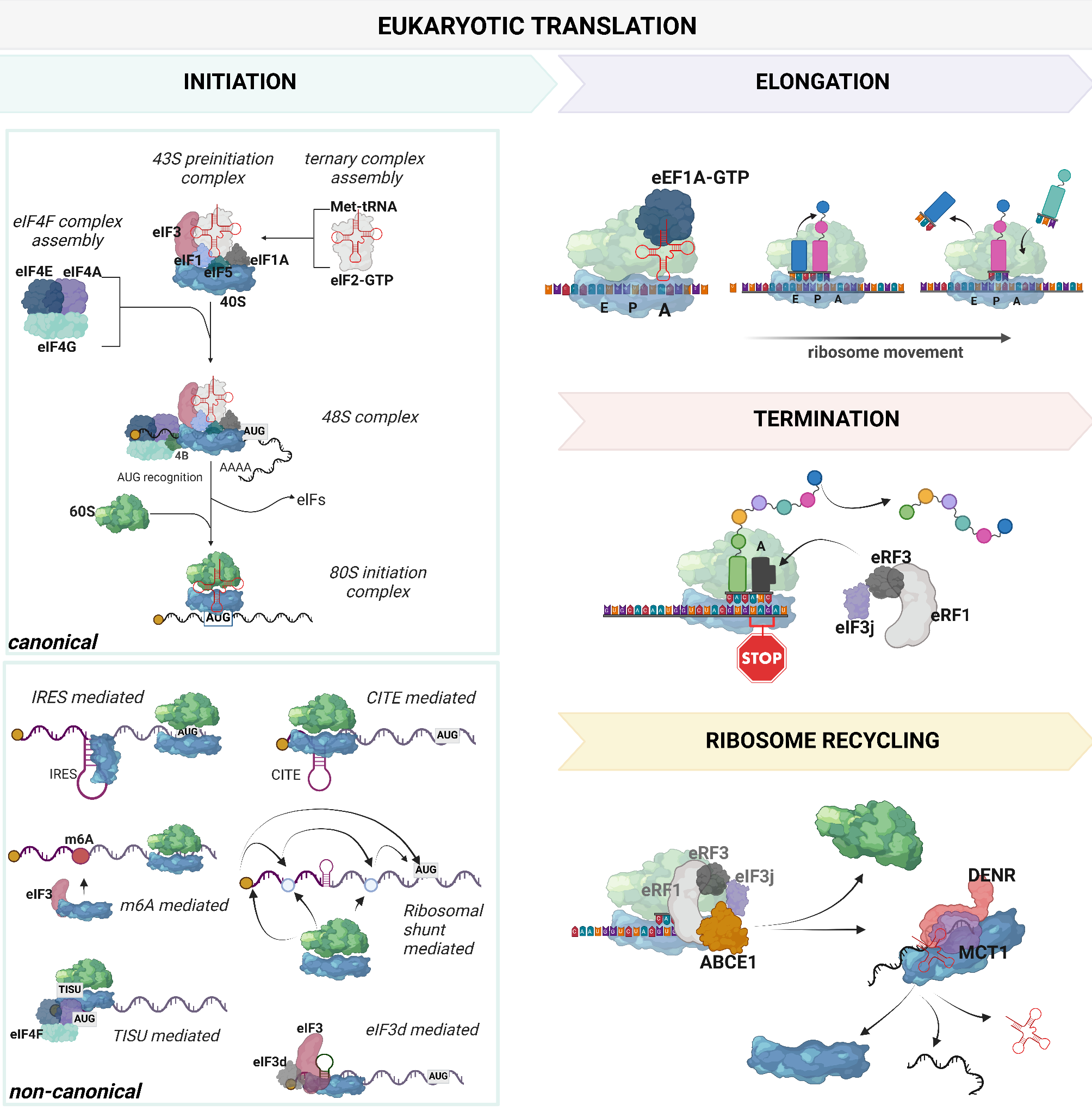
Deregulated translation meets the needs of stressed cancer cellsTranslation is an energetically demanding process that is tightly regulated to meet the constantly changing needs of the cell [18] (Fig. 1). Translation regulation is an immediate response to stimuli, such as oncogenic PI3K-AKT, mTOR, RAS-MAPK pathways, and signals from low oxygen or nutrient levels [20]. In cancer, global modulation of protein synthesis is of extreme importance, particularly in challenging conditions when changes in gene expression at the level of translation drive a swift and low-energy-cost adaptation process. Besides, modifying the cellular proteome in response to specific stimuli shapes cancer cells into specific phenotypes, driving progression and resistance to therapies or adverse conditions [21]. Despite this centrality, how the modulation and control of protein synthesis can be achieved has only recently begun to emerge.
Fig. 1
Simplified model of the phases of eukaryotic protein translation. Translation is a four-step process comprising initiation, elongation, termination and ribosome recycling [128]. INITIATION: The initiation phase is the rate-limiting step and mainly involves regulatory mechanisms. The molecular events are multiple and complex and the detailed mechanisms are still not completely understood [129]. Two kinds of translation initiation occur: i) canonical, which is the prevailing mechanism for translation initiation. ii) non-canonical, mainly activated under stress conditions to ensure the translation of essential mRNAs [130]. Canonical initiation begins with the assembly of the 43S pre-initiation complex, which includes the 40S small ribosomal subunit bound to the translation initiation factors eIF1, eIF1A, eIF3, and eIF5, and the ternary complex (TC) consisting of eIF2-GTP, and methionine initiator transfer RNA (Met-tRNAiMet) [131]. This complex binds to the heterotrimeric eIF4F initiation complex, composed of eIF4E (cap-binding), eIF4A (RNA helicase), and eIF4G (scaffold), which recruits the 5’ end of the mRNA to form the 48S complex [132]. The 48S complex then scans the mRNA 5’UTR until it identifies the start codon, which triggers the release of most eIFs and the recruitment of the 60S ribosomal large subunit to form the 80S elongation-competent full ribosome [133]. The 80S ribosome is assembled at the start codon of the mRNA, positioning the initiator tRNA at the P site and readying the A site for the first elongation cycle. Non-canonical translation initiation usually follows the downregulation of canonical translation during stress adaptation, and several mechanisms have been described [129, 134], among which: Internal Ribosome Entry Site (IRES) mediated [135], Cap-independent translation elements (CITE) mediated [136], N6-Methyladenosine-mediated [137], Ribosomal shunt mediated [138], Cap-dependent Translation initiator of short 5’UTR (TISU) mediated [139, 140], Cap-dependent eIF3d mediated [141]. ELONGATION, TERMINATION and RIBOSOME RECYCLING: Elongation is a conserved process that requires perfectly coordinated function of the mRNA template, tRNA, rRNA, ribosomes, and additional factors [142]. It starts when the complex eEF1A-GTP-tRNA binds to the A site of the 80S aligning tRNA’s anticodon with the mRNA [133]. Although it is influenced by external factors, elongation rate is primarily affected by mRNA features and amino acid sequence [143, 144]. In case of elongation is halted prematurely or ribosome stall, the ribosome-associated quality control (RQC) or the non-functional ribosomal decay (NRD) mechanisms intervene to ubiquitinate the nascent polypeptide chain or the ribosome, targeting them to degradation [145]. Translation termination occurs when a stop codon sequence on the mRNA enters the ribosome A site [146]. Two factors catalyze this process: eRF1 recognizes the stop codon and hydrolyses the tRNA, while eRF3 is a GTPase that promotes the dissociation of eRF1 from the post-termination complex. Additionally, eIF3j enhances the binding of eRF1-eRF3-GTP complex to the A-site [147]. After translation termination, ribosomes are recycled to restore the system for subsequent rounds of translation. This phase begins with the binding of the ATPase ABCE1 to eRF1, which catalyzes the separation of the 60S and 40S ribosome subunits. mRNA and deacylated tRNA are then released from the 40S subunit, putatively with the help of the eIF2D, MCT-1, and DENR proteins [148, 149]. Intriguingly, eIF1, eIF1A and eIF3j can promote this dissociation, suggesting that ribosome recycling and translation initiation are linked in a synchronized feedback loop [150]. This mechanism is still not completely understood and may take part to alternative ways in which cancer cells fuel translation of oncogenes during stress or represent an additional translation regulation layer [151]
Ribosome biogenesis represents one of the most important steps of protein synthesis and ribosomes production has been shown to increase in many cancers to an extent that is proportional to the rate of cell division [22,23,24]. Aberrant ribosome biogenesis is not just a side effect of increased cancer cell proliferation, but it represents a central process in oncogenesis [24,25,26] by affecting phenotypic adaptation, such as the maintenance of stem cell-like properties and epithelial-mesenchymal transition. Coherently, perturbation of ribosome biogenesis leads to stress response marked by nucleolar integrity loss, and subsequent G1-cell cycle arrest or cell death [23].
Aberrant expression [25, 27,28,29,30,31] or post-translational modifications of translation initiation factors (eIFs) (Fig. 1), are also frequently reported in cancer, associated with the activation of oncogenic signals (e.g. BRAF V600E) and correlated with poor patient prognosis. For instance, all components of the eIF4F complex (eIF4A, eIF4E and eIF4G) are known to be direct transcriptional targets of cMYC and their overexpression concurs to support the oncogene-associated cancer-promoting program [28, 32]. As well, phosphorylation of eIFs antagonists mediated by the activation of the mTOR signaling in response to changes in the availability of nutrients and growth factors, boosts translation initiation, thereby supporting aberrant translation and cancer aggressiveness [33,34,35].
Ternary Complex (TC) assembly is another key step in translation initiation that can be deregulated in cancer (Fig. 1). Augmented eIF2α phosphorylation and/or overexpression of its regulatory kinases (PKR, PERK, GCN2 and HRI), are pivotal for cells to resist stress, even if prolonged hyperphosphorylation of eIF2α leads to apoptosis [36, 37]. The phosphorylation of eIF2α leads to a reduction in the nucleotide exchange activity of its specific guanine nucleotide exchange factor eIF2B, triggering the integrated stress response (ISR) [38]. ISR mediates cellular adaptation to stress, leading to a general decrease in global protein synthesis, while selectively enhancing the non-canonical translation of mRNAs essential for survival [39].
Ribosome heterogeneity and specialization are considered exciting emerging areas in gene regulation [40]. Mammalian cells contain up to ten million ribosomes. Their specialization could result in hundreds of thousands of distinct ribosome variants, each potentially fine-tuning protein production in specific cellular contexts. A critical aspect of ribosome specialization is the potential for ribosome populations to change and adapt in response to specific conditions [41]. Upon stress sensing, ribosome biogenesis is often halted, which seems counterintuitive for a mechanism supposedly designed to adapt gene expression to changing conditions [42]. Context-specific post-transcriptional modifications of tRNAs can lead to their functional alteration impacting not only global protein synthesis but also the translation of selected mRNAs [43, 44]. Additionally, aberrant expression of rRNAs commonly occurs in cancer. Besides, rRNAs present primary sequence variants and post-transcriptional modifications that can dynamically change in response to various stimuli [45,46,47].
What we have learned about lncRNAs and translation controlThe majority of functionally annotated lncRNAs operate within the nucleus, influencing various aspects of transcriptional regulation (as reviewed in [5, 6]). Research on these transcripts has revealed that lncRNAs play diverse and complex roles in fine-tuning genome function, often defying simple classification or attribution to specific mechanisms of action.
Similarly, the contribution of lncRNAs to the regulation of protein translation is complex [48,49,50,51]. However, our understanding is limited by the scarcity and recency of available evidence.
Surely, the ability of lncRNAs to establish multiple and highly dynamic interactions with both proteins and transcripts makes these molecules particularly suitable to play important roles in mediating and scaffolding the assembly of the RNP complexes that act at all levels of the translational process [52,53,54].
Besides, the recent observation about the sub-stoichiometric action of lncRNAs, candidates these transcripts to be fundamental determinants of the global modulation of protein synthesis that occurs in cancer cells during the phenotypic transitions that execute adaptation [55].
By synthesizing the current knowledge, we derived several convergent aspects that explain how these molecules control translation, primarily affecting three levels (Fig. 2):
Fig. 2
Graphical representation of the contribution of lncRNAs to the protein translational regulation in cancer. Three are the main levels of regulation of the translation machinery. The first is the action on the mRNA (mRNA stability, degradation, and localization). The second is the action on the components of the machinery itself (ribosomes biogenesis, assembly and function, and translation initiation, elongation, and termination factors). The third is the spatial compartmentalization of RNAs and proteins, particularly during stress and in the formation of stress granules and P-bodies
1)the mRNA.
2)the components of the machinery itself.
3)the spatial compartmentalization of the machinery.
1) the mRNA: stability, alternative splicing and localizationBesides modulating their transcription, lncRNAs influence mRNAs post-transcriptionally at many levels with consequences on their translation.
lncRNAs and mRNA stabilitylncRNAs control mRNA stability. This occurs through either direct interaction between the lncRNA and the target mRNA by base pairing or by the formation of RNA duplex [56]. The modulation of mRNA stability can also be mediated by the recruitment of RBPs or RNAses by lncRNAs, which either protect the mRNA from or target it for degradation, thereby affecting the pool of mRNAs available for translation [57]. An interesting example is the modulation of Staufen 1(STAU1)-mediated mRNA decay (SMD). This system is involved in the selective degradation of some translationally active mRNAs containing extended double-stranded (ds) stretches at their 3’UTR. These secondary structural elements are recognized and bound by STAU1, which then targets the mRNAs to the degradation machinery. Cytoplasmic, polyadenylated lncRNAs are involved in this recognition by forming an imperfect base pairing with the double-stranded element in the 3’UTR of the target mRNA, forming a structure that affects STAU1 binding. This pairing can have a double and contrary effect. It can recruit STAU1, which recognizes the double-stranded RNA formed, and activates SMD [58,59,60]or the lncRNA binding can counteract SMD by stabilizing target mRNAs and impeding STAU1 binding, occupying its binding region [61] (Fig. 3A). LncRNAs can also act as competing endogenous RNAs (ceRNAs) for miRNAs. By sequestering these molecules, lncRNAs prevent their binding to target mRNAs, thereby restraining their inhibitory signals. Many functional lncRNA/miRNA/mRNA axes have been identified in cancer. For instance, lncRNA SNHG6-003 acts as a supporting factor in hepatocellular carcinoma. It functions as a miR-26a/b sponge, attenuating its suppressive effect on TAK1, thereby increasing the availability of TAK1 mRNA for translation [62]. Similarly, in gastric cancer, FOXD1-AS1 sponges miR-466, competing with PIK3CA mRNA and increasing its half-life. This results in the activation of the PI3K/mTOR pathway, which enhances the interaction between eIF4E and eIF4G, leading to increased FOXD1 expression and contributing to cancer progression [63].
Fig. 3
Graphical representation of specific examples of lncRNAs implicated in the regulation of translation in cancer. A) mRNA stability. SNHG5 binds to SPATS2 mRNA and protects it from STAU-mediated degradation [61]. SPRY4-IT1 [58] and linc00346 [59] lncRNAs are implicated in the downregulation of TCEB1 and ZNF655 mRNAs, respectively. The binding of lncRNAs and mRNA Alu sequences enables the recognition of the complex by STAU1 and STAU-mediated mRNA decay [
Comments (0)