
Remember me
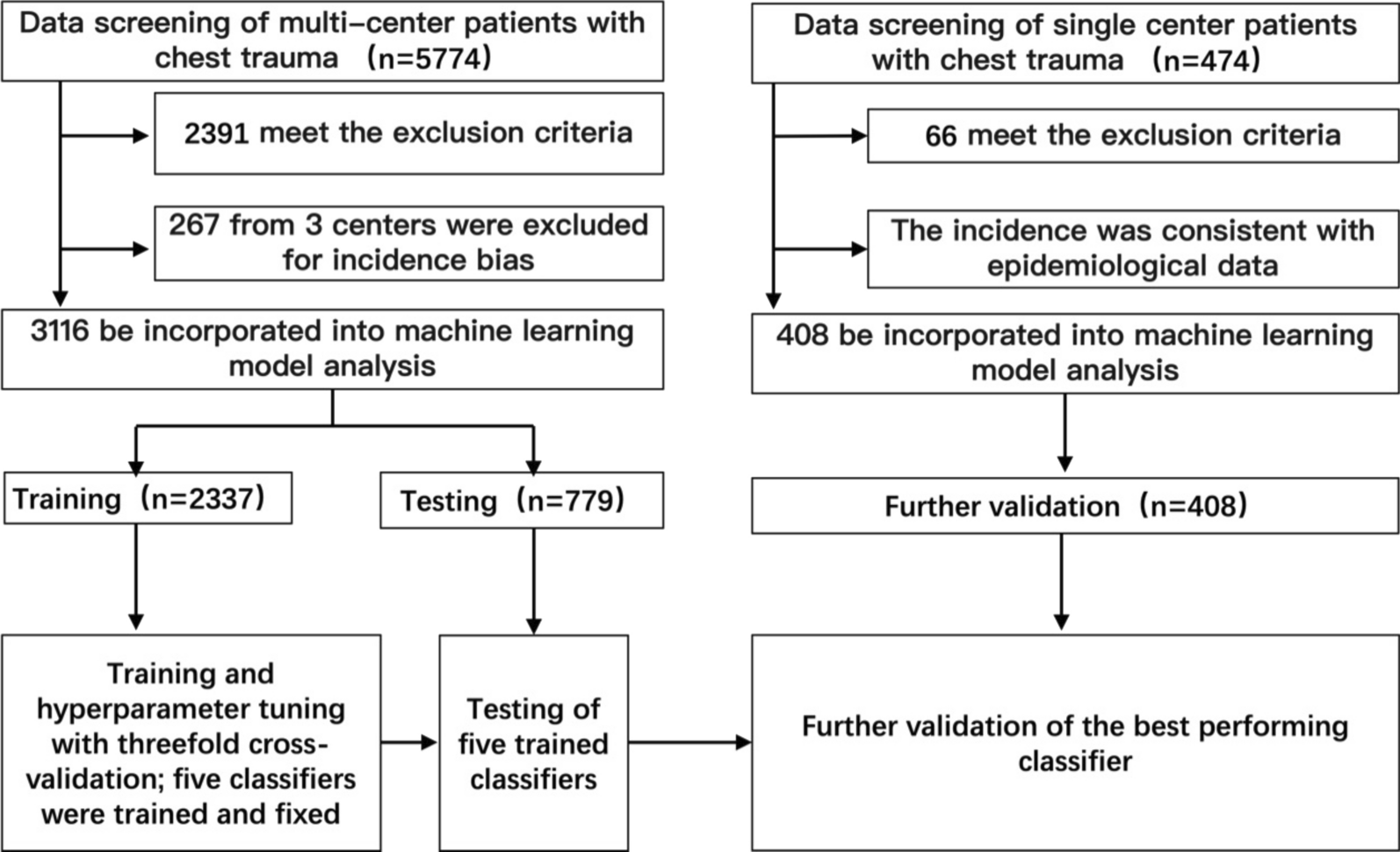



This study has the advantages of being a multicenter study with a large sample size and can better reflect the incidence of VTE in patients with thoracic trauma during hospitalization in most parts of China. The use of machine learning algorithms can ensure the rigor of research to the greatest extent possible and improve the accuracy and generalizability of prediction models. [26, 27]
In this model, the excluded features had little influence on the final prediction results, and if they were included together, the model would overfit [27]. Brain trauma, spinal fracture, pelvic fracture, abdominal injury, upper limb fracture, and surgery in other departments are known risk factors for VTE [18, 41], but they did not have a significant influence in this study. Only patients with simple thoracic trauma and severe thoracic trauma (independent AIS score ≥ 3) and patients with mild trauma (independent AIS score ≤ 3) were included in this study. Therefore, injuries to other parts of the body with minor injuries and surgeries had an insufficient influence on the final prediction results of the model and were not included in this model. Among the 12 features included in the model, the influence of different features on the final prediction results is shown in Fig. 3. Lower limb fracture, Hb24h, age, BMI, and the number of broken ends of the rib fracture had the highest correlation with the final prediction result. Tracheal intubation, PT24h, blood transfusion, D-D24h, multiple traumas, Plt24h, and rib surgery were also strongly correlated with the final prediction.
Lower extremity fracture, age, BMI, tracheal intubation, PT24h, D-D24h, and multiple traumas were positively correlated with VTE. Hb24h and Plt24h levels were negatively correlated with the occurrence of VTE, and blood transfusion was positively correlated with the occurrence of VTE. These results are consistent with previous findings (eText 2). [7, 18, 41,42,43,44]
The number of broken ends of rib fractures had a considerable influence on the final prediction results. In addition to the common risk factors for trauma, patients with thoracic trauma have their own characteristics [11, 14, 45]. Rib fracture, hemopneumothorax, pulmonary contusion directly caused by trauma, pneumonia, acute respiratory distress syndrome (ARDS), and respiratory failure indirectly caused by trauma are all risk factors for VTE, which may be caused by fractures, chest strap fixation, and prolonged bed rest [8, 41, 46, 47]. Patients with chest trauma, especially those with multiple rib fractures or flail chests, have limited breathing, poor sputum excretion, and an increased risk of respiratory infections. [46,47,48]
In the screening process of the machine learning models, the RF model showed obvious advantages over the other machine learning models in terms of the ROC curve, P-R curve, calibration curve, and DCA curve (Fig. 2). The highest AUC (0.879) and mAP (0.44) indicated that the RF model had the highest accuracy [27]. As shown in the calibration curve, the RF model had the highest degree of calibration. In the DCA curve, the RF model also showed the greatest net benefit, indicating that the RF model has the highest clinical value while meeting the actual needs of clinical decision-making [38]. When the incidence is low, the RF model has greater accuracy and clinical value. The overall incidence of VTE in this study (6·1%) was low and consistent with the incidence of VTE observed in clinical practice. [1, 2]
Fig. 2
Receiver operating characteristic curve (A), precision‒recall curve (B), calibration curve (C), and decision curve (D)
Trauma patients, especially those with multiple injuries, are critically ill and have poor underlying conditions [49]. Unnecessary examinations and transportation often result in unnecessary economic burdens and clinical risks to patients. In this study, a machine learning model was used to automatically generate an objective PRS score by inputting easily available hospitalization data and epidemiological information of hospitalized patients, which effectively removed subjective factors in clinical VTE screening. The negative predictive value was 0.976 (95% CI 0.958–0.993). This means that approximately 97·6% of patients with thoracic trauma can avoid unnecessary transport and invasive tests when the model is used to predict the probability of VTE.
Notably, although rib fracture surgery was positively associated with VTE in this study, it had a relatively weak effect. Figure 3(B) shows that not undergoing rib surgery had little effect on the occurrence of VTE, but the patient population that underwent surgery had both positive and negative effects. This may be due to the large differences in the degree of rib fracture in the patients with thoracic trauma included in this study and the different indications for rib surgery at each center. Recent studies have shown that rib surgery may have a protective effect on pulmonary complications and VTE in patients with severe rib fractures [47, 48, 50]. Studies have also reported that the incidence of VTE in patients who undergo surgery as soon as possible may be lower than that in delayed surgery patients [16]. This study could not determine whether rib surgery had a protective effect on VTE in patients at this time, which requires more targeted and standardized research.
Fig. 3
Mean SHAP value (A), SHAP value (B)
This study had several limitations. First, the incidence of VTE in patients with thoracic trauma in this study was lower than that reported in other studies [51]. Because of the differences in physicians’ clinical experience and because many asymptomatic PE cases occur without significant clinical manifestations, data from many patients with PE were not included in the study [12, 52]. In addition, only patients admitted within three days after trauma were included in this study. In a study of patients with acute trauma, up to 62% of VTE cases were reported after hospital discharge.8 This study also had problems such as insufficient sample size, imperfect inclusion and exclusion criteria, incomplete long-term follow-up, insufficient data homogeneity, and an insufficient external validation set. Further multicenter studies with larger sample sizes and improved internal and external consistency are needed. In addition, the fully automated clinical screening model developed in this study will require further regulatory review and approval to evaluate its performance, potential risks, and benefits for broad clinical applications.
In conclusion, we developed and tested a machine learning model to predict the probability of VTE in patients with thoracic trauma during the perioperative period. This convenient and automated screening method showed comparable diagnostic performance and prevented 97·6% of unnecessary lower-extremity vascular ultrasound or CTPA screening. The results of our study have the advantages of noninvasive examination, convenience, and high efficiency, which can significantly improve the efficiency of VTE prevention and treatment in patients with thoracic trauma and pave the way for better optimization of medical resources.
Comments (0)