Heavy school bags are a global problem, and several studies have addressed this problem in different countries. Musculoskeletal pain is a condition caused by the load of the musculoskeletal system over a more extended period. The most common health problem related to heavy school bags is back pain.
Several reviews have determined that schoolchildren’s most common cause of nonspecific back pain is schoolbag use and related factors. Some studies have demonstrated that heavy schoolbags and the wrong method of carrying heavy schoolbags during this critical period of life have adverse effects on the growth of the musculoskeletal system, resulting in back pain that has increased over time, predisposing children to mobility problems in adulthood [14].
The present study revealed that more than half (52.1%) of school-aged children suffered from back pain, which aligns with a study that reported a 55% prevalence of back pain [17].
Another study reported that approximately three-fourths of school children in the studied sample had suffered from back pain in the month prior to the study, which is greater than that reported in our study [4]. Moreover, our findings were lower than those of a study that revealed that the prevalence of back pain in children and youth aged 10–19 years living in southeastern Poland was 76% [15]. We reported a greater prevalence of back pain among primary school students than in other studies performed in Uganda and Saudi Arabia, which were 37.8% and 42%, respectively [18, 19]. This difference in the prevalence of back pain may be due to differences in age group, sex, sample size, and the children’s social environment.
Regarding gender, the present results showed that male students were four times more likely to suffer from back pain than female students. There was a significant statistical association between male sex and the occurrence of back pain among primary school students (P value = 0.000). This result was inconsistent with several studies showing that gender is a significant factor in the development of back pain among school children. Girls were more likely to report back pain than boys of the same age, which is in contrast to a study reporting that female sex is a predictor of back pain [4]. This may be related to physiological differences between the two sexes. Additionally, another study reported that the occurrence of back pain due to school bags was related to sex, which is inconsistent with our study, as it is common in males [20]. In Spain, a study concluded that girls presented a greater risk of back pain than boys did, in contrast to our study, in which back pain was joint in males [21].
Most of our respondents reported that the intensity of their back pain, according to the VAS score, was mild (64%), and only 2.5% of the students experienced severe back pain, which is consistent with a previous study reporting that mild pain is prevalent [15]. Another study reported that moderate pain is prevalent in their study, as more than half of responders stated that their pain is moderate, in contrast to our study, in which mild pain was expected [4].
Regarding impairment in daily activities, the results showed that all schoolchildren who suffered from pain reported that the pain prevented them from performing daily activities such as studying, participating in leisure activities, playing, and disturbing their sleep. However, another study revealed that one-fourth of students’ daily activities were affected [4].
Regarding students’ reactions to back pain, the present study revealed that approximately 70% of school children who experienced pain reported taking analgesics without doctor consultation, and only one-third sought medical advice. In contrast, in another study, approximately 14% of patients alleviated pain with analgesics without doctor consultation, and only 10% of patients used analgesics prescribed by doctors [4].
This study revealed a significant association between the presence of back pain and age (13–14 years, P value = 0.000); in contrast, another study revealed that back pain was not significantly associated with the age of children or adolescents [22]. In contrast, other studies have shown a significant association between age and the frequency of occurrence of back pain, with a significant increase in prevalence as age increases, which agrees with our study [15, 23]. The age group (13–14) included participants who had completed their last and most challenging work in two primary school classes, who had multiple books available for study, and who had longer stays at school, all of which may have contributed to the development of back pain and the cumulative presence of a bag for the previous study years. This age group seems to have impacted the development of their back pain.
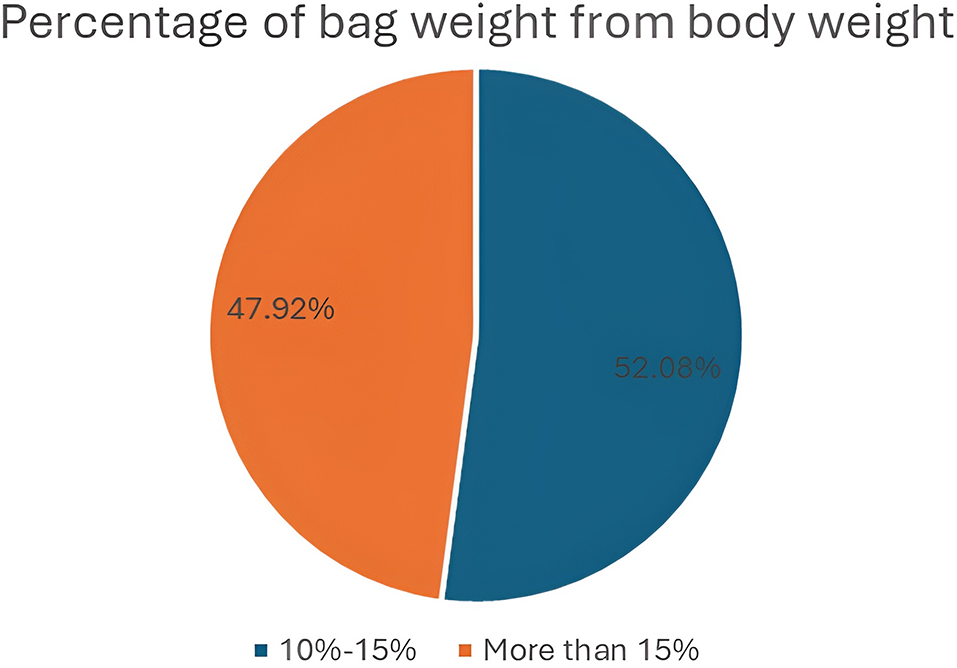
Concerning school bag weight as a percentage of body weight (% of BW), the present study showed that 52.3% of students carried a bag with a weight greater than 15% of their body weight, 184 (47.9%) of students carried a bag with a weight between 10% and 15% of their body weight, and no one who carried a bag with a weight less than 10% of their weight. Internationally accepted standard weights for students’ schoolbags should not exceed 10–15% of their body weight [19]. There was a significant statistical association between the presence of back pain and the presence of a bag with a weight greater than 15% of their body weight, P value (0.000). This finding is consistent with that of another study [4]. Additionally, a study reported that 72.46% of studied school children carried bags for more than 15% of their body weight, which is greater than that reported in our study [19]. In contrast, another study conducted among students revealed that 7.1% of the studied school children carried bags that weighed more than 15% of their body weight. This difference may be related to sociodemographic and cultural factors [22]. In contrast to our study, another study demonstrated no associations between back pain and the weight of school bags or between the weight of school bags and the percentage of body weight [24].
Our study revealed that carrying school bags on one shoulder or one hand increases the risk of back pain compared with carrying school bags on both shoulders (P value = 0.000). This finding was to the findings from review studies that showed that carrying schoolbags on one shoulder or by one hand causes asymmetry in muscle activity, encourages lateral spinal bending, and might lead to changes in shoulder level and the development of shoulder, neck, and lower back pain even if the bag weight constitutes 10% of the child’s weight [25]. One study reported a significant association between low back pain and bag carriage, consistent with ours [18]. In contrast, another study revealed no significant relationship between the method of carrying school bags and the prevalence of back pain [24].
Concerning the methods and times used to reach school, in the present study, we found a significant statistical association between the presence of back pain and the use of walking as a transportation tool to school and the use of 10–20 min of walking to reach school PV (0.000). This finding aligns with another study, but he reported more than 20 min [26].
Our study revealed significant associations between the presence of back pain and older student age, male sex, the ability to carry more than 15% of one’s body weight, the ability to carry one shoulder or side handbag, the ability to hold one shoulder or side handbag through a morning venue, and the ability to reach school by walking for 10–20 min.


Comments (0)