Diabetes is a global health challenge. According to the World Health Organization (WHO) announcement for the global health estimates (2020), diabetes was ranked as the 7th most common causes of disability and the 9th cause of mortality in Egypt. Yet, with the noticed rapid growing incidence of diabetes, the number of suffering patients is expected to increase dramatically every year [21, 22].
Among the various complications of diabetes, impaired postoperative wound healing is a serious nightmare for the surgeons and the patients. Wound healing is a cascade of three phases: inflammation, proliferation, and remodeling, all of which can be altered by diabetes. In several animal and clinical studies, topical insulin has shown promising results in treating different wound types, with significant improvement in the wound healing time and the percentage reduction in wound area [1]. However, the exact mechanistic pathway of this reported favorable insulin outcome is not fully understood. Moreover, the preferable insulin preparation and the method of application for better clinical implication is missed.
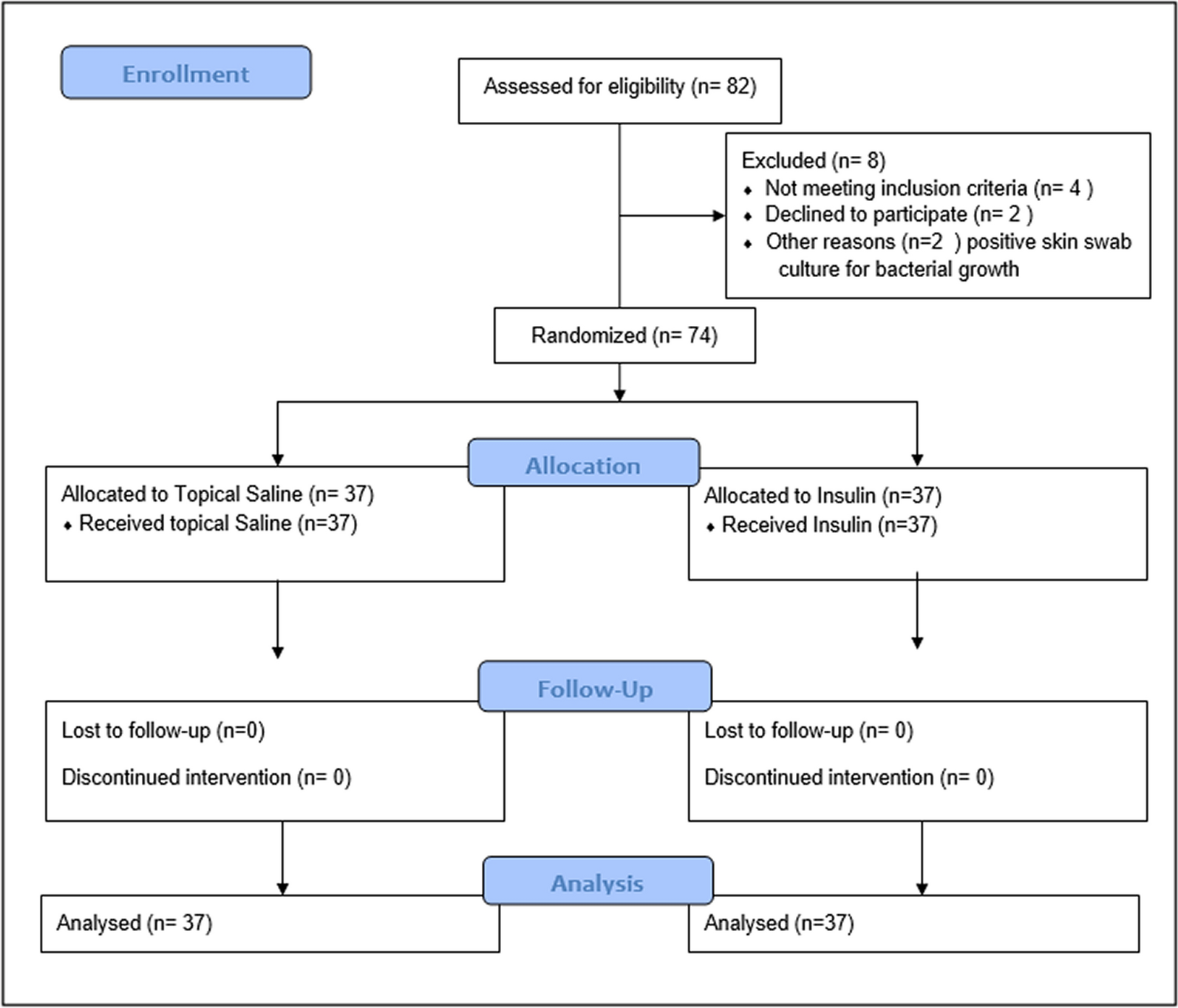
This study assessed the impact of applying regular insulin therapy twice daily as a topical treatment for postoperative wounds. To study the effect of topical insulin on the 3 phases of wound healing, we used markers of inflammation (IL-6 and 8-OHdG), markers of proliferation (collagen deposition, e-cadherin and Ki67), besides the histological assessment of the wound architecture, before and 7 days after treatment. All included patients had a baseline HbA1c ≤ 7.5% and ranging from 6.50% to 7.50, which aligns with the American Diabetes Association (ADA) Standards of Care 2025 for reasonable glycemic control targets in non-pregnant adults with type 2 diabetes [23].
According to Benko et al. [24], topical regular insulin is safe and effective in aiding to wound healing. In the current study, regardless the type of surgery, and with ensuring proper aseptic wound dressing technique, topical regular insulin showed significant reduction in the total healing days, percentage reduction in wound area, and UHT (p < 0.001, p < 0.001 and 0.001, respectively). Though the total healing days can be affected by many variables, such as: the initial wound size, the site and vascularity of the wound, and the ethnicity, we relied on other more accurate parameters, i.e., UHT and percentage reduction in wound area, for better judgment. As mentioned earlier, these results are in accordance to the results reported by Liu et al. [1] in their systematic review and meta-analysis, which were extracted from 2 clinical and 5 animal studies. Furthermore, in the pilot trial by Attia et al., which compared the effects of topical regular crystalline insulin and aqueous zinc solution on uncomplicated cutaneous wounds, insulin zinc enhanced wound healing compared to saline, with insulin showing superior efficacy. Notably, patients treated with topical insulin reported improved quality of life outcomes. These results align with our findings, reinforcing the potential of topical insulin as an effective treatment for wound healing [25].
During the inflammatory phase of wound repair, the migration and activation of immune cells drive the migration of fibroblasts and epithelial cells to the site of injury. Fibroblasts, then enhance the disposition of collagen. Simultaneously, the degradation of collagen releases fragments able to furtherly promote the proliferation of more fibroblasts and stimulate angiogenesis, as well as reepithelization. At the end, a balance between new extracellular matrix formation and degradation determines the status of wound healing [26]. E-cadherin-mediated cell adhesion plays an essential role to direct the migration of cell sheets. However, the overexpression of e-cadherin reduces the accumulation of actin around the healing wounds, thus slowing the wound closure [27].
In the current study, a significant increase in the positive stained cells for ki67 antigens was noted in group 2 insulin-treated, by day 7 compared to group 1 saline-treated. Betz et al. [28] has previously reported that positive ki67 staining indicates a wound age of more than 1.5 days. Similar findings were reported by Azevedo et al. [8] who studied the impact of topical insulin on burn-wound healing in diabetic rats. They reported significant increase in Ki67-positive staining in wound tissue sections at day 7 and day 14 after injury, indicating an active cellular repair process.
As regards the expression of e-cadherin in healing wounds, insulin treatment was found to regulate e-cadherin expression at day 7 evidenced by enhancing e-cadherin expression compared to the control normal skin, but with preventing the overshooting observed in the saline-treated group. This indicates the normalization of e-cadherin levels needed for proper wound repair.
The favorable anti-inflammatory potential of topical insulin was reported in the current study. Compared to saline, insulin succeeded to improve the initially elevated expression of IL-6 and the cellular oxidative stress marker, 8-OHdG by day 7, while both parameters showed continued significant elevation at day 7 in the saline-treated group compared to the other groups. The anti-inflammatory action of systemic insulin treatment was previously reported by Bhettani et al. [29] who reported that insulin action is mediated via the inhibition of: cytokine-induced neutrophil chemoattractant 1 (CINC-1), CINC-2i, and monocyte chemoattractant protein-1 (MCP-1). In-addition, by acting on the IGF-1 receptors, and via insulin mediated VEGF and TGF-β1 actions, insulin can enhance collagen formation and deposition, as reported by Azevedo et al. [7]. This was furtherly confirmed in the histological assessment of the skin sections in this study using the Masson’s trichrome staining that revealed increased optical density of collagen fibers type 1 and increased keratinocytes proliferation. These findings, also go in-line with results of Bhettani et al. [29] who reported that collagen aggregates can enhance keratinocyte proliferation and remodeling.
In the same context, neovascularization reported in the histological assessment of wound sections in insulin-treated group, demonstrated the potential of insulin to stimulate the formation of new micro-blood vessels. Similar results were obtained by Zhang et al. [30] and Li et al. [31]. The latter suggested that insulin facilitates vascular formation and maturation during wound healing by improving the expression of α-smooth muscle actin (α-SMA) and platelet-derived growth factor-B (PDGFR-β) and through inducing an enhanced expression of angiopoietin-1 (Ang-1). Ang-1, itself possesses an antiapoptotic effect, which could prevent H2O2-induced DNA damage in skin cells [32]. This key finding is in accordance with the current study results that showed lower expression of 8-OHdG in skin biopsies from insulin-treated group compared to the saline-treated group.
Topical insulin application was not found to affect the systemic blood glucose level, with no significant difference between both treated groups. This encourages the future research to possibly consider topical insulin in the management of different wounds in diabetic patients.


Comments (0)