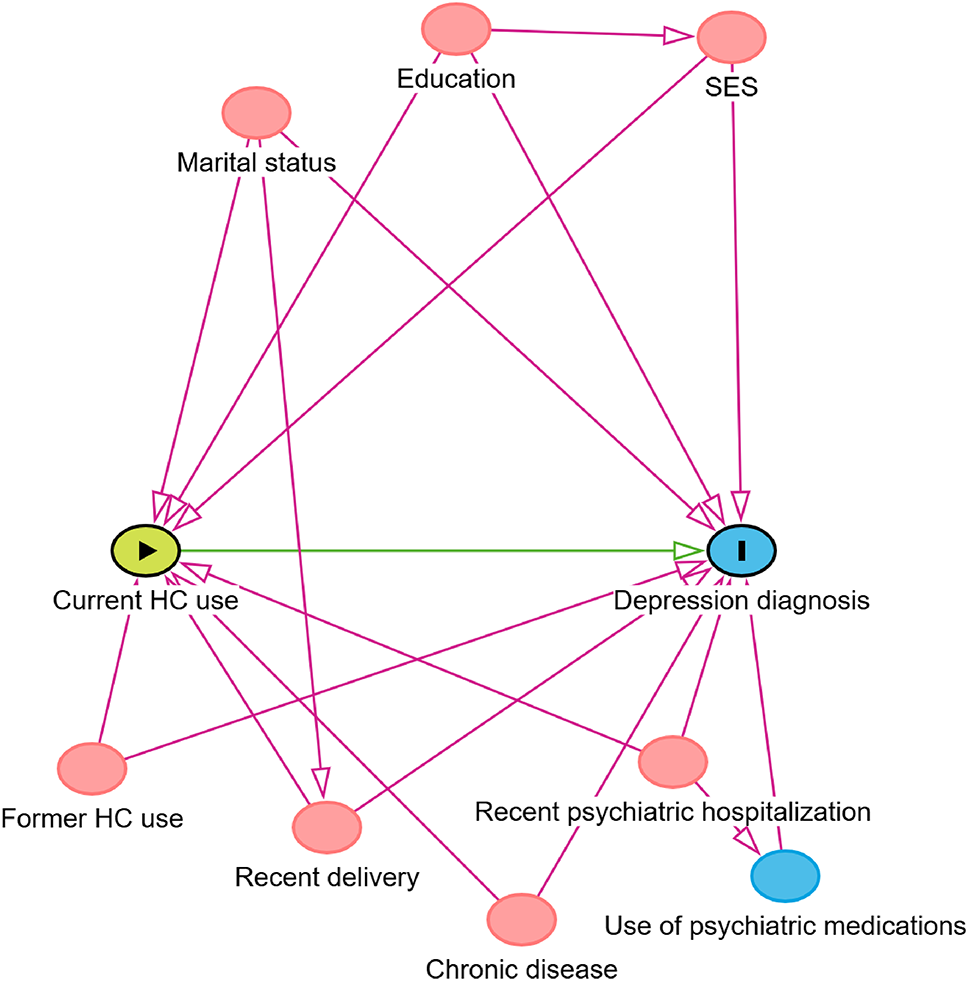
Our main finding was that current use of HC was not associated with an increased risk of depression in women of fertile age. Rather, the current use of CHCs, either EE- or estrogen containing preparations, was associated with a lower risk of depression compared to non-use of HC even after controlling for covariates, including former use of HC.
Previous register-based studies from the Nordic countries had reported findings opposite to ours. Our finding that the current use of HC is not associated with an increased risk of depression in fertile-aged women contrasts with results of a large Danish study, finding a higher risk of incident depression (first use of antidepressants and/or first diagnosis) in women aged 15–34 years who were currently or recently (within the previous six months) using either combined (namely, ethinylestradiol in combination with levonorgestrel, desogestrel, gestodene, drospirenone or cyproterone acetate, or natural estrogen in combination with dienogest) or progestin-only (oral norethisterone, levonorgestrel or desogestrel, as well as etonogestrel vaginal ring or norgestrolmin patch) hormonal contraception, when compared to never-users and former users (RR ranging between 1.1 and 2.0) [13]. Similar results were reported by a Swedish study of more than 800,000 women aged 12–30 years, finding higher odds for first use of psychotropic drug in HC users compared to non-users, being more pronounced for non-oral preparations. It is of note that in the Swedish study the association was strong (OR 3.46, 95% CI 3.04–3.94) in adolescent girls, but decreased to non-significance in those older than 20 years of age [14]. It has been found that many women, and up to 82% of teenagers who use OC, do use contraception primarily for reasons other than birth control, e.g., dysmenorrhea, irregular menstrual periods, or acne [25], which are themselves related to depression and anxiety symptoms and disorders [26, 27]. In addition, in the same study the authors found only marginal discriminatory accuracy of HC in identifying psychotropic drug users, suggesting possible residual confounding [14]. Moreover, previous studies found that mental health status, in particular depression in adolescent girls, may influence the choice of contraceptive methods. For example, adolescent girls with depressive symptoms are more likely to choose a long-acting reversible contraceptive (LARC) method than short-acting methods [28], which were not captured in total by our study, but partly captured by earlier studies. It is of note that in our study adolescent girls and young women had the lowest odds for depression in relation to HC use, with an inverse tendency in the older groups. These apparently contradictory findings support the possible role of unmeasured confounding.
It can be argued that our results of lower odds for depression in relation to HC use are in fact explained by a discontinuation bias, where women who develop mood symptoms as side effects of HC discontinue their contraceptive use, thus being categorized as non-users. However, when considering only one redeemed prescription as a definition of HC use (thus including those who possibly stopped using HC due to mood and other side effects), our results did not change. In addition, our adjusted models took a former user category into account. It is of note that, when applying a more stringent definition of depression, i.e., capturing only cases severe enough to receive a diagnosis in a specialized care setting, the associations lost their significance after controlling for a full set of covariates. In line with this observation, it must be acknowledged that the use of ICD and ICPC codes to define our outcome of interest may have caused cases not severe enough to reach a full depression diagnosis to be mistakenly classified as controls. Taken together, and based on these partly opposite findings, our results suggest that use of HC is rather safe in terms of severe mood disorders, although in a subgroup of vulnerable women, possibly those with a pre-existing severe mood condition or belonging to a hormone-sensitive subgroup [11, 12], it may in fact be related to adverse mood symptoms.
This study has some limitations as well. Because this is a register-based study, the definition of HC relied on the redeemed prescriptions rather than on its monitored use in clinical practice. However, because HC is not reimbursable by the Social Insurance Institution of Finland, it is likely that most women who had purchased the drug did use it as prescribed. Additionally, we lacked information on the precise contents of the contraceptive preparations used, which precluded any analyses on the effect of different doses of EE. Similarly, information regarding non-hormonal methods (e.g., copper intrauterine device, barrier methods, etc.) as well as contraceptives obtained free-of-charge as part of municipal programs, especially those for LARC methods, was not available. Furthermore, we cannot exclude that the associations we found are confounded by some external unaccounted factors, such as a relationship status variable accounting, for example, for those who were in a stable relationship but unmarried. Additionally, although we control part of the analyses for former HC use, results may still have been impacted by residual confounding related to former HC use.
Among the strengths of our study is the use of Finnish register data of proven high quality [29], and the identification of depression cases based on diagnostic codes. The nested case-control design produces unbiased estimates and is free from weaknesses of the ordinary case-control design. It uses correct sampling of controls that takes the follow-up time into account [30, 31]. In addition, the control women were matched by age. Thus, our study design provides results that are relatively free from confounding bias, although some residual confounding is always possible in observational studies.
Taken together, our results convey the reassuring message to fertile-aged women seeking contraception that HC use is not associated with an increased risk of severe depressive disorder. At the same time, they stress the importance of considering personalized choice of the best and safest contraceptive option for each woman.



Comments (0)