
Remember me

We first describe the sample and then introduce the findings of the quantitative analyses before turning to the qualitative data.
3.1 Descriptive details and quantitative analysesAmong the 1,615 respondents, 81.5% were NNES, with 62.8% of them reporting high English proficiency (C1–C2), followed by intermediate (14.2%), and low (4.4%) proficiency levels. Collectively, respondents spoke 80 native languages and resided in 68 countries. The five most common native languages were English (n = 298), Japanese (n = 163), German (n = 161), Chinese (n = 153), and Spanish (n = 121). The five most common countries of residence were the US (n = 231), Japan (n = 158), Germany (n = 139), the UK (n = 119), and Netherlands (n = 111).Footnote 10
Most respondents were male (56.9%, female = 37.5%), aged between 25–44 (63%), with either student (undergraduate to PhD = 40.8%) or professor positions (assistant to full professor = 40.8%), working in the analytic tradition (70.5%, continental tradition = 17.2%). Regarding specializations, philosophy of science (all subfields combined) was most common (14.3%) followed by social and political philosophy (10.9%), history of philosophy (10.4%), epistemology (9.1%), and applied ethics (5.8%). The distribution of these demographic features was similar between NNES and NES. For details, see the Appendix, Tables 5, 6, 7.
RQ1. Do NES and NNES differ in the number of philosophy publications in English and the time they need to complete a draft, read an article, or prepare a presentation in English?
We first asked respondents how many main-authored, peer-reviewed English philosophy articles they had written (for the proportions, see Appendix, Fig. 3).
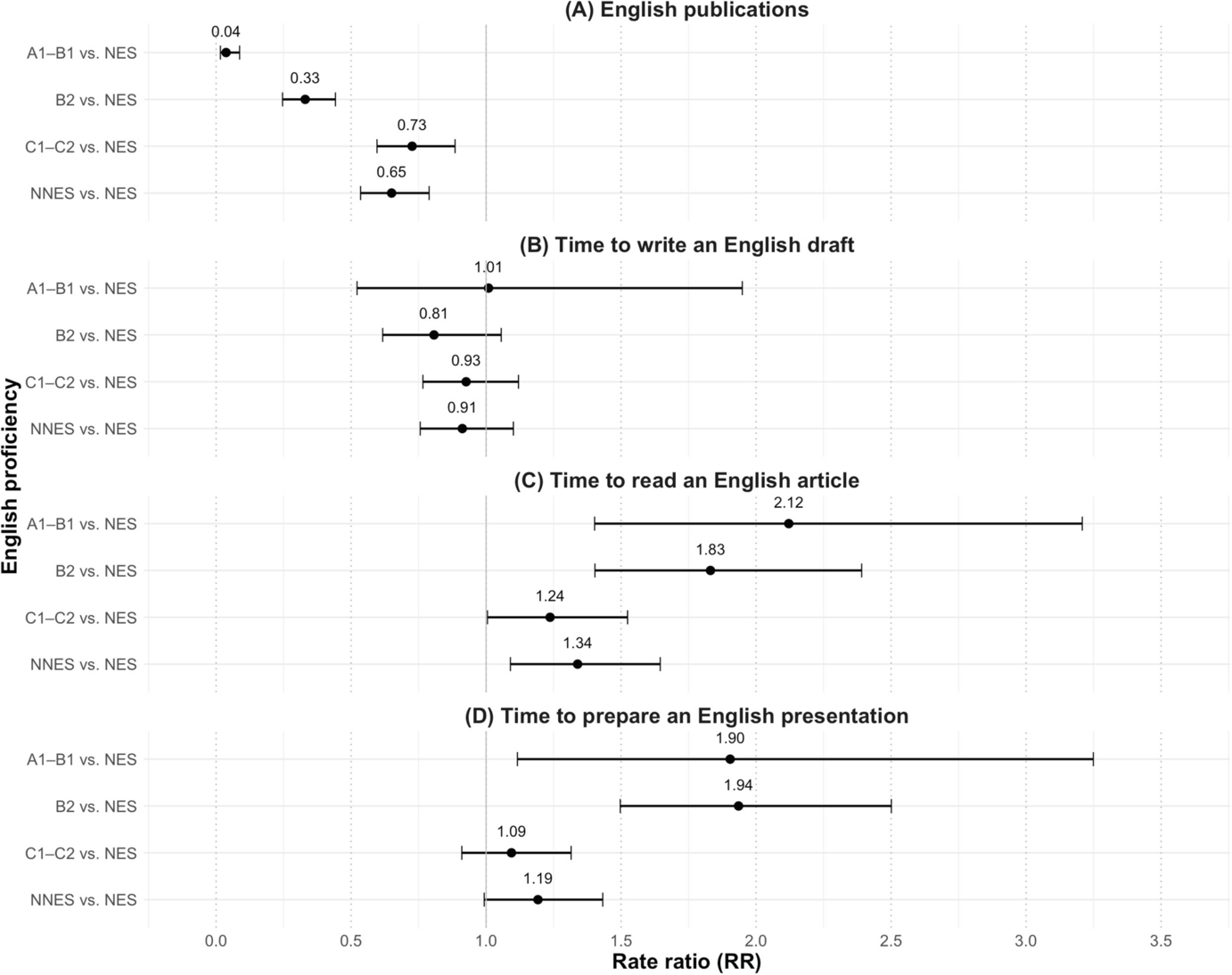
Overall, NNES (M = 3.02, SE = 0.23) had fewer publications than NES did (M = 4.65, SE = 0.55) (for proportions by paper count, see Appendix, Fig. 3).Footnote 11 Comparing NNES versus NES and controlling for academic position, native language importance, and country group, NES versus NNES status had a significant effect (χ²(1) = 19.02, p < 0.001), with NNES showing a 35.1% lower publication rate than NES. Analyses by English proficiency levels revealed that even C1–C2 level NNES still indicated 27% lower publication rates (Fig. 1, Table 1; for marginal means, see Table 2).
Fig. 1
Forest plot displaying rate ratios (RR) and 95% confidence intervals (CIs) from GLMs comparing NES and NNES (overall and by subgroup) across English use domains. An RR of 1 indicates NES as the baseline. (Wide CIs reflect uncertainty due to small samples.)
Table 1 GLM regression coefficients by speaker groups and English use domainTable 2 Differences between EPLs in means adjusted for academic position (student, professor, etc.), native language importance, and country groupTurning to the time needed to write in English, we asked respondents how long it took them (months) to complete the research and writing of the first draft of their most recent philosophy paper (incl. student essay) (12–15 pages) in English. While the adjusted means indicated NNES (all EPLs combined) (M = 4.78, SE = 0.30) needed slightly less time than NES (M = 5.24, SE = 0.56), controlling for academic position, country group, and native language importance, the difference between NNES and NES did not reach statistical significance (χ²(1) = 0.92, p = 0.34) (for details by months, see Appendix, Fig. 3). The analysis using EPL with the same controls also provided no evidence of a group difference (χ²(3) = 2.62, p = 0.45), though the means suggested that B2–C2 level NNES reported shorter times than NES (Table 1). We will revisit these surprising findings below.
We also asked participants how long it took them (hours) to read and understand the most recent philosophy article (10–15 pages) that they had read in English (without translation tools). With the same controls as before, overall, NNES (M = 2.02, SE = 0.14) needed longer than NES did (M = 1.51, SE = 0.18) (for details by hours, see Appendix, Fig. 3). The effect of NES versus NNES status was statistically significant (χ²(1) = 7.74, p = 0.005), with NNES, overall, reporting about 34% longer reading times, compared to NES. EPL analyses showed that all NNES levels needed significantly longer than NES. In A1–B1 level NNES, reading times rose to twice as long as those of NES (Fig. 1; for marginal means by group, see Table 2).
Next, we examined the time needed for working on English presentations, asking respondents about the hours they had spent preparing their most recent (30–45 min) talk. Overall, NNES (M = 7.96, SE = 0.50) needed longer than NES did (M = 6.67, SE = 0.69) (for details by hours, see Appendix, Fig. 3). Controlling for academic position, country group, and native language importance, the broad NES versus NNES difference did not reach statistical significance (χ²(1) = 3.56, p = 0.059). However, when using EPL as the main predictor instead, the overall difference was significant (χ²(3) = 34.06, p < 0.001). NNES at A1–B2 levels (versus NES) reported needing up to 94% more talk preparation time, though C1–C2 level NNES and NES did not statistically differ (Fig. 1).
The preceding analyses used either NES versus NNES status or EPL as main predictor. These analyses did not consider the effects of dissimilarity in, for instance, phonetics between native tongues and English, which can exacerbate difficulties with English. We therefore also conducted analyses using the EDS of respondents’ native language as the main predictor (Appendix, Table 8). We first tested the relationship between EDS and EPL, using a Spearman’s rank-order correlation. A strong negative correlation between EDS and EPL emerged (rs = − 0.66, p < 0.001): As a respondent’s native language became more distant to English, their reported EPL decreased. Given this correlation, to reduce multicollinearity, we conducted models only with EDS as main predictor, not also EPL.
Focusing on publication count, controlling for academic position, country group, and native language importance, EDS significantly predicted publication count (χ²(1) = 26.99, p < 0.001): for each unit EDS increase, the expected count decreased by 0.7% compared to NES (EDS baseline = 0) (B = −0.007, SE = 0.0013). For instance, Dutch (EDS = 21.8) native speakers experienced a decrease of 14.2% whereas Chinese (EDS = 91.13) speakers experienced a decrease of 47.2%.
Controlling for the same variables, there was no evidence that EDS significantly affected English draft completion time (χ²(1) = 0.063, p = 0.80). However, when focusing on the time needed to read an English article, EDS had a significant effect (χ²(1) = 24.18, p < 0.001). For each unit increase in EDS, reported reading time increased by 0.6% (e.g., Japanese native speakers (EDS = 87.2) indicated 68.7% more time than NES) (B = 0.006, SE = 0.0013). Similarly, EDS also significantly affected the time needed to prepare an English presentation (χ²(1) = 8.92, p = 0.003). For each unit increase in EDS, the time increased by 0.4% (e.g., for Spanish speakers (EDS = 59.3), the increase was 26.8%, compared to NES) (B = 0.004, SE = 0.0012).
RQ2. Do NES and NNES differ in how often they have faced (a) manuscript rejections from philosophy journals due to the standard of English in their manuscripts or (b) requests to improve their English writing?
Among all NNES,Footnote 12 22.4% reported having faced manuscript rejections from philosophy journals because of their English at least once to very often, compared to 6.8% of NES. Regarding requests to improve their English writing, the differences was between 66.9% (NNES) and 37.6% (NES). The differences remained stark even in the high proficiency NNES versus NES comparison (see Appendix, Fig. 4).
Controlling for English publication count and native language importance, NES versus NNES status significantly predicted the likelihood of having faced English manuscript rejections (χ²(1) = 27.48, p < 0.001). Overall, NNES had nearly five times the odds of rejection compared to NES (even C1–C2 level NNES had more than three times the odds) (Fig. 2, Table 3).
Fig. 2
Forest plot displaying odds ratios (OR) and 95% CIs from ordinal regressions comparing NES and NNES across English use domains. An OR of 1 indicates NES as the baseline. (Wide CIs reflect uncertainty due to small samples.)
Table 3 Ordinal regression results displayed by English speaker group and English use domain. Reference for Reduced native language ability is English use ‘rarely’NES versus NNES status was also a significant predictor of being asked to improve one’s English in manuscripts (papers, student essays, etc.), controlling for academic position, native language importance, and English publication count (χ²(1) = 71.37, p < 0.001). NNES were more than three times as likely as NES to have been asked to improve their English, and these odds increased up to 16 times as English proficiency decreased (Fig. 2, Table 3).
RQ3. Do NES and NNES differ in how often they have avoided (a) asking questions at philosophy events (workshops, lectures) or (b) attending such events due to lack of confidence in English?
Among all NNES combined, 65% reported having avoided asking questions at English philosophy events once or more often, compared to 16.2% of NES (for details on high proficiency NNES versus NES, see Appendix, Fig. 4). Controlling for academic position, native language importance, and English use frequency, NES versus NNES status significantly influenced the likelihood of having avoided asking questions (χ²(1) = 118.23, p < 0.001), with NNES, overall, being ten times more likely than NES to report having done so (Fig. 2).
Turning to event attendance, 34.6% of all NNES (and 25% of the highest EPL group) indicated having avoided attending philosophy events due to lack of confidence in English, compared to 5.1% of NES. Using the same control variables as before, NNES, overall, were about nine times more likely than NES to have avoided events for this reason (χ²(1) = 41.34, p < 0.001 (Fig. 2).
RQ4. Do NES and NNES differ in how often they have received negative feedback on their philosophy teaching in English, have felt ridiculed for their English proficiency, have struggled to understand NNES in philosophy, or use AI tools to comprehend philosophical texts?
Among NNES who have taught in English, 30% reported having received English-related negative feedback on their teaching by students or colleagues at least once or more often, compared to 18.5% of NES. This rate remained at 29% even among C1–C2 level NNES (see Appendix, Fig. 4). Furthermore, controlling for English use frequency, NES versus NNES status significantly predicted the likelihood of having received such feedback (χ²(1) = 10.19, p = 0.001), with NNES being about twice as likely as NES to have experienced this (Fig. 2).
Focusing on feelings of ridicule, we asked participants how often they had felt ridiculed, criticized, or taken less seriously in philosophy (e.g., by students, colleagues, etc.) because of their English (e.g., their accent, word choice, etc.), either currently or in the past. Even among C1–C2 level NNES, 49.8% still reported having had such feelings once or more often, compared to 29.2% of NES (Appendix, Fig. 4). Controlling for academic position and English use frequency, NES versus NNES status significantly influenced how often respondents have felt ridiculed due to their English proficiency (χ² (1) = 44.33, p < 0.001), with NNES being about three times more likely than NES to have felt that way.
When people give negative feedback on an NNES’s English, this might derive from difficulties in understanding them, which may vary between NES and NNES. Relatedly, when asked how often they have struggled to understand what a NNES said or wrote, controlling for English use frequency and native language importance, the two groups differed in this respect (χ²(1) = 17.69, p < 0.001), with NNES, overall, being nearly twice as likely as NES to have had difficulties understanding NNES (Fig. 2).
Finally, examining whether NES and NNES equally often use AI to understand English articles, controlling for academic position and native language importance, NES versus NNES status significantly predicted reported AI use (χ² (1) = 65.89, p < 0.001). Overall, NNES were about seven times more likely than NES to have used AI for this purpose.
RQ5. Do NNES ever feel their frequent use of or extensive exposure to English may reduce their ability to discuss philosophy in their native language(s)?
Frequent use of or extensive exposure to English likely reduces NNES’s difficulties with English. However, it may also lead to a decline in NNES proficiency in their native language, for instance, due to forgetting or not learning relevant terms – a phenomenon known as “native language attrition” (Schmid & Köpke 2017). Relatedly, we found that among NNES philosophers, 88% reported that they had experienced this at least once (Table 4).
Table 4 Proportions of NNES indicating whether frequent use of or extensive exposure to English reduced their native language ability to discuss philosophyControlling for EPL (excluding NES), NNES English use frequency predicted a reduction in native language ability to discuss philosophy (χ²(5) = 83.08, p < 0.001). Compared to NNES who rarely used English in everyday life, those who used English most frequently were about six times more likely to have experienced such effects (OR = 5.75, 95% CI [3.68, 9.01]). This likelihood decreased progressively as English use frequency diminished (Table 3). Declines in native language proficiency associated with increased English use also emerged as a recurring theme in our qualitative data. We now turn to them.
3.2 Qualitative analysisParticipants provided a total of 578 free responses on their personal experiences with academic English in philosophy. We categorized them into 20 topics (Appendix, Table 9), and will here briefly introduce comments on five themes that help further elucidate our quantitative findings. These themes are (1) psychological and cognitive costs, (2) linguistic bias, (3) networking disadvantages, (4) linguistic trade-offs, and (5) proofreading costs. We will limit our interpretation and let the comments speak for themselves. Readers are encouraged to explore the full set of free responses available on our OSF platform (https://osf.io/5kcvr/).
To begin with, many NNES noted that using English in academia sometimes affected their ability to contribute to philosophy by lowering their self-confidence, increasing their mental load, or causing interference from their native language:
“I think the most significant aspect for me is that it increases my lack of confidence, multiplying the ‘impostor syndrome’, so to say.” (300)Footnote 13
“When I’m among people who are native English speakers or extremely proficient, I’m self-conscious which takes a lot of my cognitive resources (so I’m less “smart” when it comes to the topic of the conversation, because I’m simultaneously thinking about the phrases I’m using, etc.).” (194)
“When my brain is in stress mode, it seems to want to return to my native language, and it becomes more difficult to think of the right English words, expressions, grammar structure etc., even though these normally come to me without much or even any effort.” (12)
Some confidence issues that NNES face may be natural aspects of language learning.
However, anxiety about using English can become amplified when one also encounters linguistic bias, ridicule, or inappropriate comments on how one uses English. Several respondents shared experiences of this kind, writing:
“A student once said I should apologize for my accent.” (19)
“When I started my undergrad (in the UK) I was ridiculed quite often for my Italian accent and whenever I brought it up, they would respond that they weren’t ridiculing me, they just thought it was ‘cute’ when I ‘tried’ to speak English.” (350)
“I get objectified because of my French accent; many senior male philosophers have told me they find it ‘sexy’.” (399)
Negative effects on confidence related to one’s English use in academia may also occur in NES. For instance, some NES reported psychological and cognitive costs of using academic English due to learning disabilities or mental health conditions:
“I am a native English speaker, but I am dyslexic, and I very much feel like I struggle to write like a ‘proper’ philosophy academic.” (161)
“Much of the trouble I have had with academic English has come from having learning disabilities (dyslexia, ADHD). My written English is below average in many respects for someone at my level […].” (34)
These concerns, too, remain largely unexplored in philosophy.
Respondents also frequently remarked on linguistic bias in paper reviewing, with some journal editors sharing:
“As an associate editor for journals, I have encountered several referees who recommend rejection of papers for stylistic reasons, which disproportionally affect papers written by non-native speakers.” (270)
“I noticed these barriers predominantly in my capacity as journal editor, as good papers which are however written in less fluent English have a harder time being accepted for publication.” (156)
Several participants, in fact, acknowledged being biased against NNES:
“I have realized that I often take more seriously or pay more attention to or agree more likely with people who are native speakers or who speak very good English.” (75)
“I definitely find myself having to deal with the impulse of taking less seriously (deeming less competent, less smart) non-native speakers who struggle to speak fluently in English, and I have to consciously correct that – despite being a non-native speaker myself.” (33)
Notably, some NES in our sample, too, highlighted similar linguistic biases against themselves, albeit based on social class or regional accents:
“While studying [in the UK], I often felt intimidated and ridiculed by the fact that I speak American English. Moreover, I am a first-generation college student from a working-class background. I have a thick regional accent that I have learned to hide because I have been told that my accent sounds ‘unintelligent’.” (38)
These responses (for more, see our OSF qualitative data sheet) again indicate that epistemic difficulties related to academic English (e.g., when contributing to knowledge exchange and production in the field) are not limited to NNES.
Linguistic bias (against ‘non-standard’ NES or NNES) can exacerbate yet another challenge in academia, namely forming international connections with colleagues, which can be crucial for advancing research. Many NNES touched on this problem, writing, for instance:
“Academic networking is also extremely hostile to non-native speakers because being a non-native speaker doesn’t just mean linguistic barrier but also (pop) cultural barrier, which is actually a much harder barrier to overcome than the pure linguistic barrier. Without a shared cultural reference point, networking is a daunting task, e.g., there is no way to join in many casual conversations in academic events.” (152)
“My use of academic English is better than my use of informal English, and this makes social interactions on the fringes of academic events – coffee breaks, dinners, etc. – more difficult.” (506)
Perhaps NNES can address these challenges by immersing themselves more in English and using it more frequently. However, consistent with our quantitative results, several respondents highlighted that this had the side-effect of decreasing their native language ability:
“After 20 years living in the US, I don’t have any problem expressing myself in writing or speaking in English. […] I suffer more from having lost my capacity to speak in French about my work.” (125)
“Because in South Africa we are taught in English from primary school (unless you are in the rural areas) we lose our command in our own native languages. Also, what is strikingly concerning is that we are not proficient in English, and we are worse in our native languages.” (236)
“I find it unfortunate that all of my professional technical vocabulary is in English. I recently went to a bilingual (French & English) conference, and I had to present in English because I have not written in French in over 15 years.” (162)
This linguistic trade-off may affect personal identity and risks diminishing the diversity of philosophical discourse, as native languages can convey distinctive concepts (for examples, see Glock 2018). To mitigate this, NNES may use English less frequently to maintain their native language proficiency. But doing so can, in turn, increase the likelihood of errors in English. In writing, NNES often attempt to address this issue by using proofreading services. Yet, this approach also presents disadvantages that NES may not face:
“Professional proofreading typically costs between 50,000 to 100,000 yen (around $710). I often feel it’s unfair that I have to pay native speakers to make my paper easier for them to read.” (76)
“I do feel pressured to enlist professional help by native speakers […] each and every time I submit a new or revised draft for anonymous review. This can cost up to 400E per paper, not including revisions, for papers that might not even result in publications.” (427)
Identifying an important additional epistemic cost, one NNES wrote:
“Professional proofreaders not only misunderstand the text but can even make grammatical errors in their proofreading. I find it highly unfair that native English speakers do not need to spend this time, money, and effort to submit their papers.” (330)
NNES may therefore often need to check proofread material, taking extra time not available for philosophical theorizing.
Comments (0)