
Remember me
The C-SENIoR trial was a pragmatic, multicentre, non-randomised two-arm controlled trial with 6-month follow-up in Portuguese primary care, involving community pharmacies and family health units (FHUs) to deprescribe PPIs in mainland Portugal. A random design was not feasible because the intervention was developed on the basis of the interest expressed by two FHUs in participating with pharmacies in the trial.
The study protocol has been previously published [20]. The Ethics Research Committee of Nova Medical School, NOVA University of Lisbon and the Ethics Committee from the Local Health Unit Alto Minho, Portugal approved the study. .
2.1 Pharmacies, Family Health Units and ParticipantsTwo intervention FHUs in two distinct municipalities were initially identified and recruited through a partnership with the Portuguese National Association of Pharmacies. A total of nine eligible intervention pharmacies were identified on the basis of the FHUs’ geographic location. These pharmacies needed to serve patients from the FHUs and use the Sifarma® dispensing software to enable data extraction. Owing to this small number of pharmacies and FHUs in these areas, which limited the feasibility of randomisation, a prospective geographic location-based matching method was employed to identify control municipalities while minimising contamination. First, three-dimensional normalised Euclidean distance—based on per capita purchasing power, aging ratio and illiteracy rate [21]—was calculated for each municipality in Mainland Portugal, using the two intervention municipalities as separate reference points. Potential best-match control municipalities were then ranked in ascending order from smallest to highest distance.
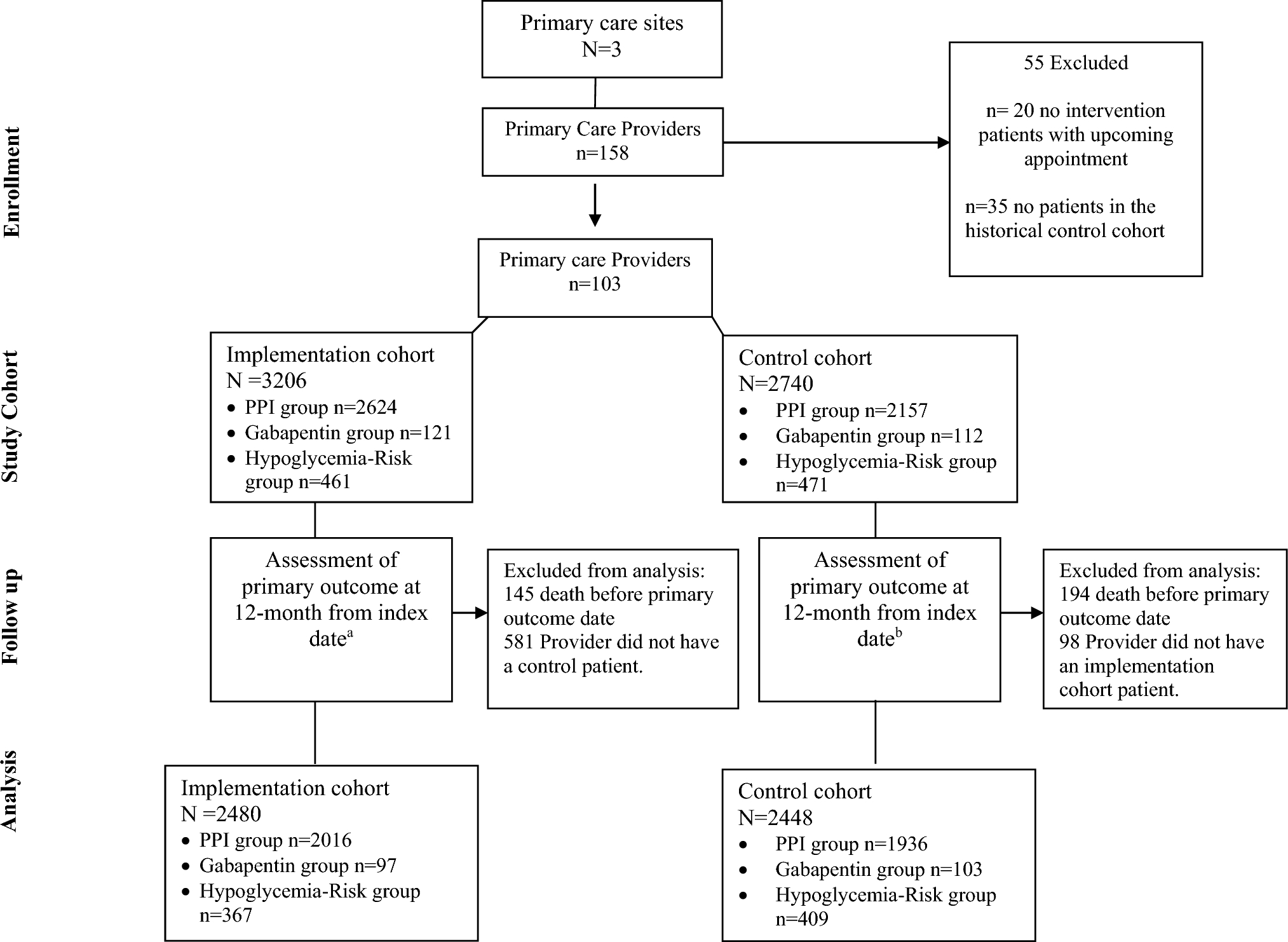
Second, within these best-matched municipalities, potential control FHUs were identified by first matching their contractual type with the National Health Service (type A or B, which differ essentially in financing models) and then aligning their PPI prescription rate, measured in defined daily doses per 1000 inhabitants per day [22] for the registered older adults, with that of the intervention FHUs, allowing a 20% variation. The matching process aimed to identify regions where patients had characteristics similar to those in the intervention group (IG) and received comparable care through primary healthcare services. A larger pool of municipalities and potential control pharmacies was considered to balance the number of recruitment sites and patients across both trial arms, accounting for anticipated lower pharmacy adherence and patient recruitment in the control arm, as previously observed in similar studies [23]. A total of 11 control municipalities, comprising 17 matched FHUs and 61 pharmacies, identified using the same criteria as the intervention pharmacies, were considered eligible. Figure 1 illustrates the FHUs, pharmacies and patient inclusion through the trial.
Fig. 1
Flowchart of community pharmacies, family health units and patients through the study
Of the nine community pharmacies invited in the two intervention municipalities, eight (88.9%) agreed to participate. In the 11 control municipalities, 17 of 61 pharmacies (27.9%) accepted. Following training, 21 pharmacies were included in the study: 8 in the IG (2 municipalities) and 13 in the control group (CG) (10 municipalities), with patients from 2 and 16 FHUs, respectively.
Eligible participants were community-dwelling older adults (≥ 65 years), registered at the selected FHUs, with access to a telephone and using any PPI medication such as esomeprazole, lansoprazole, omeprazole, pantoprazole and rabeprazole (ATC/WHO A02BC) for more than 8 weeks (beyond which continued use is often unnecessary and associated with increased risk of adverse effects) [2, 3]. Exclusion criteria for patients were residing in nursing homes or assisted-living facilities, unable to communicate or speak in Portuguese, having cognitive impairments, or any other condition that hinders their understanding of the study objectives or the questionnaires as assessed by the community pharmacist (CP) who performed the recruitment. In both intervention and control pharmacies, the dispensing software generated an electronic pop-up window whenever a PPI was dispensed to remind CPs to systematically assess patients’ eligibility.
A total of 166 patients enrolled in the study (87 in the IG and 79 in the CG), and 30 declined to participate (5 in the IG and 25 in the CG). The age distribution of those who refused (65–74 years: 53.6%, ≥ 75 years: 46.4%) and the proportion of females (57.7%) were similar to those of the participants (p > 0.05). The main reasons for refusal were unfamiliarity with this type of study (n = 16, 59.3%), lack of time (n = 4, 14.8%) and discomfort with sharing personal data (n = 4, 14.8%).
Of the enrolled patients, 159 (95.8%) completed the trial (84 (96.5%) in the IG and 75 (94.9%) in the CG) (Fig. 1).
Patient recruitment began on 28 April 2023 and ended on 15 November 2023 (latest data of follow-up, June 2024). Medical doctors, CPs and patients received no financial incentives for participating in the trial.
2.2 Intervention and ControlThe multifaceted intervention involved a collaborative care pathway between CPs and general practitioners (GPs) to deprescribe inappropriate PPIs. Briefly, this patient-centred intervention comprised three main components. First, CPs recruited patients on the basis of PPI use duration (>8 weeks). Next, they assessed the potential inappropriate use of PPIs, considering the patient’s self-reported clinical indication and provided both oral and written educational information using a patient information booklet developed explicitly for this study (Supplementary file 1). Additionally, a long-term medication list was elaborated, highlighting any moderate and severe drug–drug interactions (DDIs), and shared with the GP. Second, GPs, using the information provided by the CPs and the patient’s medical records, evaluated the need for PPIs, addressed any other safety concerns and contacted the patient (preferably by telephone) to discuss the appropriateness of continuing PPIs or the strategy for deprescribing, if applied.
A national guideline for acid suppression therapy management with PPIs and their therapeutic alternatives was used in this trial as the deprescribing framework [2]. When appropriate, a tapering strategy was designated as the preferred approach to discontinue a PPI, although the final decision was left to GP discretion. Third, following the GP consultation, the CP was informed of the deprescribing decision (i.e. whether to maintain PPI as used or to initiate deprescribing, which could include stopping or reducing doses). CPs then conducted telephone follow-ups with participants to monitor the withdrawal process, when applicable. The intervention summary is displayed in Fig. 2.
Fig. 2
Summary of C-SENIoR intervention procedures. DDIs, drug-drug interactions; FHUs, family health units; PPI, proton pump inhibitor
Communication between CPs and GPs was facilitated through a paper-based ‘Patient’s Passport’, where intervention-related data were recorded. A clinical research associate coordinated the exchange of this document between professionals. All participating CPs (intervention and control) attended a face-to-face training session provided by the research team. For the IG, the training included information on PPI therapeutics, along with detailed guidance on the study intervention and related procedures. Study materials were sent to the pharmacies via express mail prior to the training sessions.
Additionally, before the study began, pharmacists and GPs in the IG participated in an in-person meeting to review the patient eligibility criteria, intervention materials and study procedures. This included the national guideline for acid suppression therapy [2]. Further details of the intervention are available in the study protocol [20].
The comparator was usual care, i.e. patients received standard practice without any educational material or specific collaborative intervention.
2.3 OutcomesOutcome data were collected at baseline, 3 months (± 1 month) and 6 months (± 1 month) follow-up. The primary outcome was successful deprescribing, defined as discontinuation or dose reduction of any PPI at 3 and 6 months post-enrolment, assessed at the patient level. PPI use or discontinuation was determined through patient self-reports during follow-up telephone interviews and pharmacy medication sales data. Patients were classified as either successfully deprescribed or not. Sales data were used to validate patients’ reports on deprescribing, and all reports were confirmed.
The medical recommendation regarding PPI deprescribing (yes or no) and the self-reported withdrawal symptoms were also assessed.
Secondary outcomes included the effect of the intervention on several patient-reported outcomes (PROs) and drug-specific outcomes. PROs included patients’ beliefs about PPIs, medication adherence, health-related quality of life (HRQoL) and the self-reported number of adverse drug events (ADEs) experienced, precisely the number and proportion of patients reporting at least one ADE (adverse event or undesirable effect that may be attributed to the use of any of the medications) in the previous 6 months.
Adherence was measured by the Measure Treatment Adherence (MTA) [24] questionnaire consisting of a seven-item, six‐point Likert scale tool ranging from the anchor point 1 (always) to the anchor point 6 (never), with ‘always’ representing the lowest adherence point. Mean scores greater than or equal to 5 are considered adherent, corresponding to the responses ‘rarely’ or ‘never’ [24]. Patient beliefs about PPIs were measured by the Beliefs about Medicines Questionnaire (BMQ-specific) [25], an 11-item questionnaire with two subscales: Necessity (5 items) and Concerns (6 items). Items are rated on a five-point Likert scale (from 1 = strongly disagree to 5 = strongly agree), with subscale scores ranging from 5 to 25 (Necessity) and 6 to 30 (Concerns). A higher necessity—concerns differential score indicates higher perceived necessity and/or lower concerns [25].
HRQoL was assessed using the EQ-5D-5L generic instrument, which covers five health dimensions (mobility, self-care, usual activities, pain/discomfort and anxiety/depression), each with five levels of functioning (from 1 = no problems to 5 = severe problems) [26]. Mean scores were calculated based on the EQ-5D-5L Portuguese tariffs [27].
Drug-specific outcomes included the number of long-term medications, the proportion of patients on polypharmacy (≥ 5 medicines) [28], those highly medicated (≥ 10 medicines) and identified moderate and severe DDIs were measured using the pharmacy medication dispensing data validated by patients’ reports.
Satisfaction with the collaborative intervention was assessed exclusively in intervention group using a five-level Likert scale (from 1 = not at all satisfied to 5 = very satisfied). Data were collected via telephone interviews.
Additionally, to assess the fidelity of the intervention, process outcomes were considered, including the number and proportion of patients who had a medical appointment, the type of appointment (in-person or telephone), the time elapsed until the medical appointment and the number of pharmacist follow-ups.
2.4 Sample SizeOur hypothesis is that this intervention would achieve a minimum 20% absolute difference in the proportion of patients who discontinued or reduced their PPI dosage in the IG compared with the CG at 6-month follow-up, similar to results observed in previous studies involving patient education and collaboration between CPs and GPs [13, 29]. We considered that approximately 10% of the users who do not receive the intervention may naturally discontinue PPIs. Assuming a statistical significance of 5% and 90% power, for an allocation ratio of 1:1, the minimum total sample size to detect differences between IG and CG was estimated to be 178 patients (89 patients per group). Accounting for potential losses to follow-up of 20% of the patients, a total of 222 participants (111 per group) would be needed [20].
2.5 Statistical AnalysisComparisons between patients who agreed to participate in the study and those who refused were performed using the chi-squared or Fisher’s exact test for categorical variables. Comparisons comprised age class and sex. Reasons for refusal were described.
Baseline characteristics were described for all study patients and stratified by group. The IG and CG were compared using the Chi-squared or Fisher exact test for categorical variables and/or t test/analysis of variance (ANOVA) or nonparametric Wilcoxon/Kruskal–Wallis test for continuous variables.
Analysis were performed according to intention-to-treat. The primary outcome (discontinuation or dose reduction) analysis was performed using a generalised linear model (GLM) for binary outcome with an identity link function to estimate the absolute risk difference between the IG and CG in the proportion of patients who discontinued or decreased PPIs use at 3- and 6-month follow-ups, adjusted for age class, sex, body mass index, education level and self-rated health status. The relative risk and the number needed to treat (NNT) are also presented with their 95% confidence interval (CI).
To explore how characteristics such as sex, education level, body fat, self-rated health, PPI treatment duration and baseline medication burden (polypharmacy) influenced the effectiveness of the intervention, a subgroup analysis was performed to estimate the risk differences in deprescribing among patients in the intervention group with a medical indication for PPI deprescribing.
Secondary outcomes were computed using difference-in-differences (DiD) estimators to compare groups concerning changes from baseline to 6 months, in BMQ score, adherence MTA, HRQoL and long-term medication, polypharmacy, ADEs, patients with DDI and the number of DDI. GLM models were adjusted for age class, sex, body mass index (BMI), education level and self-rated health status. Analysis only considered patients for which outcome measures were available at follow-up (3 or 6 months).
Satisfaction with the intervention for those who successfully deprescribed PPIs versus those who did not was compared using the Fisher exact test. Analyses were performed using 95% confidence intervals, and two-sided p-values < 0.05 were considered significant. SAS Enterprise Guide 7.15 (Cary, NC) software was used.
Comments (0)