Modified Top-Down Approach to Reduce Voiding Cystourethrograms: Diagnostic Accuracy of Late DMSA Scintigraphy and Renal Ultrasound for Predicting Vesicoureteral Reflux in Children > 2 Years. A Retrospective Audit
Objective
The Indian Society of Pediatric Nephrology (ISPN) guidelines recommend only renal ultrasound for children > 2 years with febrile urinary tract infection (UTI), but its accuracy in predicting vesicoureteral reflux (VUR) is limited. We audited a modified top-down approach (MTDA) using late-phase Tc99m-dimercaptosuccinic acid (DMSA) scintigraphy to select patients for undergoing voiding cystourethrography (VCUG).
Methods
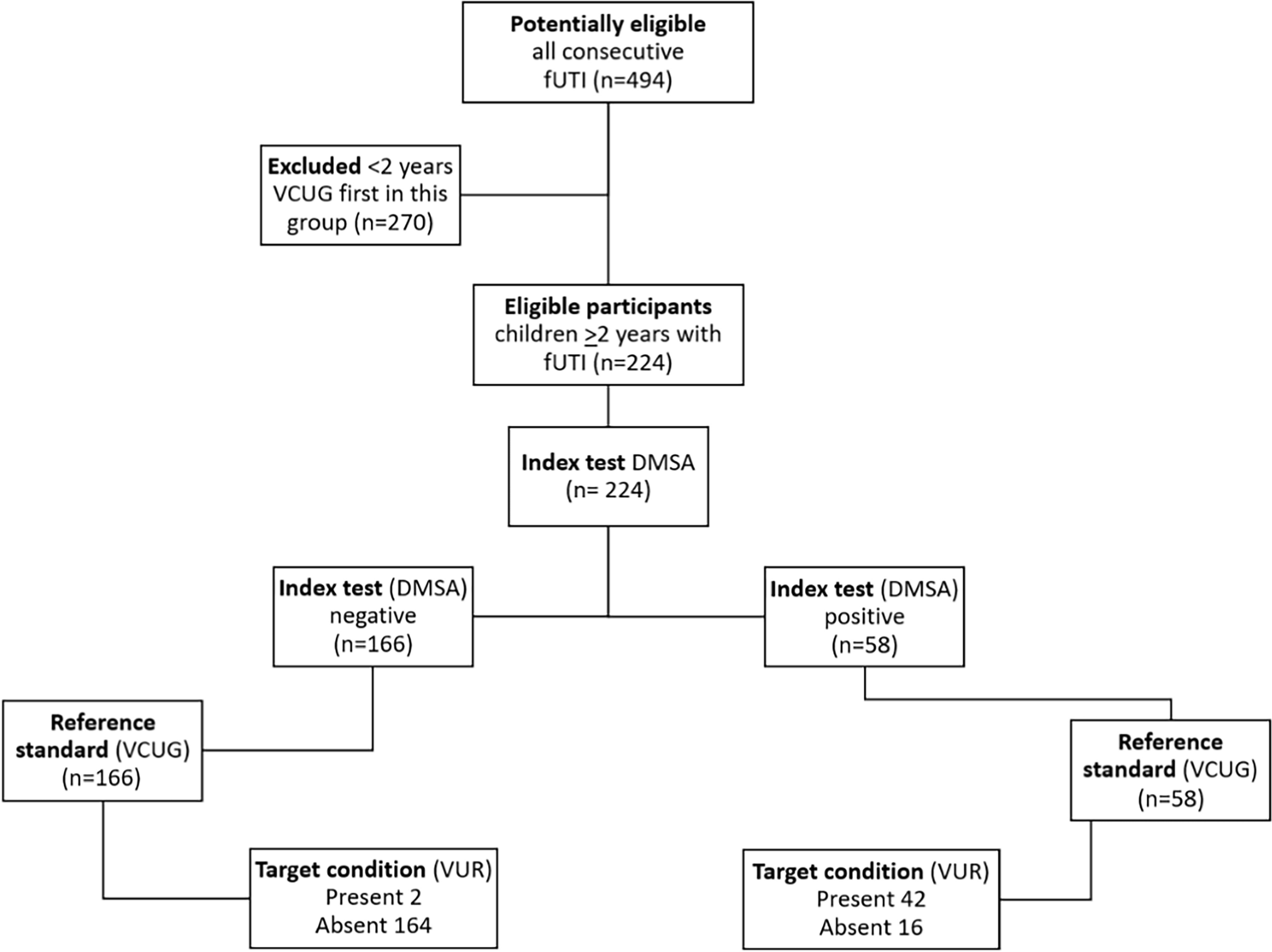
This is a retrospective audit of consecutive children > 2 years with febrile UTI who completed the index test (late-phase DMSA for the presence/absence of cortical scarring) and the reference standard (VCUG for the absence/presence of VUR). The main outcome measures were sensitivity, specificity, positive and negative predictive values of DMSA scan and US for detecting VUR and the number needed to diagnose (NND).
Results
A total of 224 children (mean age 3.5 years) were included. Late DMSA showed sensitivity 95.45% (95% CI 84.5–99.4%) and specificity 91.11% (95% CI 86.0–94.8%) for predicting VUR (NND 1.16). The sensitivity and specificity of renal ultrasound were 18.18% (95% CI 8.2–32.7%) and 98.89% (95% CI 96.0–99.9%); NND was 6.25. MTDA avoids 5/6 VCUGs.
Conclusion
In children > 2 years with febrile UTI, late-phase DMSA had a high diagnostic accuracy and could be used to selectively perform VCUG, reducing invasive testing.




Comments (0)