
Remember me


This work is framed within the communicative methodology (CM) that stresses the egalitarian dialogues between the scientific community and the participants in the research (Gómez-González et al., 2010, 2019), enhancing social impact and aligning research objectives with agreed goals for the advancement of humankind like the Sustainable Development Goals (SDG) (Gutiérrez-Fernández et al., 2024). This intervention especially impacts on SDG4 ‘Quality Education’ and SDG10 ‘Reduced inequalities’ by implementing actions that have already demonstrated an impact on the production of relevant and effective learning outcomes that support the academic trajectory of participants (Díez-Palomar et al., 2022; Guardiola-Fígols et al., 2024; Natividad-Sancho et al., 2024).
This methodology has been effectively implemented across various projects associated with the European Commission Framework Program, which acknowledged it as one of the best approaches for analysing the circumstances of the most disadvantaged social groups (Gómez-González et al., 2010, 2019), including the adolescents and young people who live in group homes who have participated in the current study.
The qualitative study is part of a broader research project called ‘Extended Learning Time IV: Contributing to the generation of scientific vocations in residential care’ (2021–2022), funded by the Spanish Foundation for Science and Technology of the Spanish government. Previous research has already identified that SEAs are contributing to increasing interest in STEM areas and educational improvement (García-Yeste et al, 2017); however, in this study, we deepen the analysis of the educational interventions of the DGS linked to science workshops in bringing science closer to the young people in care, focusing on the impact it has had on their motivation for STEM, improving and increasing their educational learning and increasing future expectations to develop a profession linked to science.
Through these interventions, we respond to some of the main competencies of a professional in this field, such as intervening with vulnerable groups and contributing to their social integration and welfare, thus providing new knowledge applicable in the field of social work. More details on this connection will be provided in the ‘Discussion and Conclusions’ section.
ParticipantsThe group home engaged in this study is an out-of-home care resource for adolescents and young people between 15 and 21 years old, in a situation of lack of protection or at risk of social exclusion, without serious psychological pathologies and without family burdens, who cannot remain in the family or foster care environment. The study also involves an educational team of four social workers, two educational assistants, and the resource manager. This resource is located in an urban area of a city in northern Spain and has ten places divided into two connected flats within the same building, where the adolescents and young people are placed according to their educational level. Admission to the resource is structured in four phases: (1) When the children join the project, they are introduced to the space, the educational staff, and the other companions, as well as the rules and timetables of the group home. (2) The young person and her reference educator jointly set work objectives through an individual interview. (3) Socio-educational intervention and short- and medium-term objectives are defined in programmes according to the needs detected. (4) The last phase is autonomy, when the objectives have been met and enough tools have been acquired to start the exit.
The study involved all the people implicated in the project, nine adolescents and young people, eight girls and one transgender boy aged between 17 and 19 years old, all of whom entered the girls-only centre between 2018 and 2022. Five of the participants are currently involved in vocational training, one is in the first year of Bachillerato (upper secondary education), another is in the first year of university, one is in the last year of secondary education, and finally the last one is involved in a course for unemployed people (Table 1). In addition, five members of the educational team also participated in the study. Three of them are social educators, one is the coordinator, and the last one works as an assistant technician (Table 2).
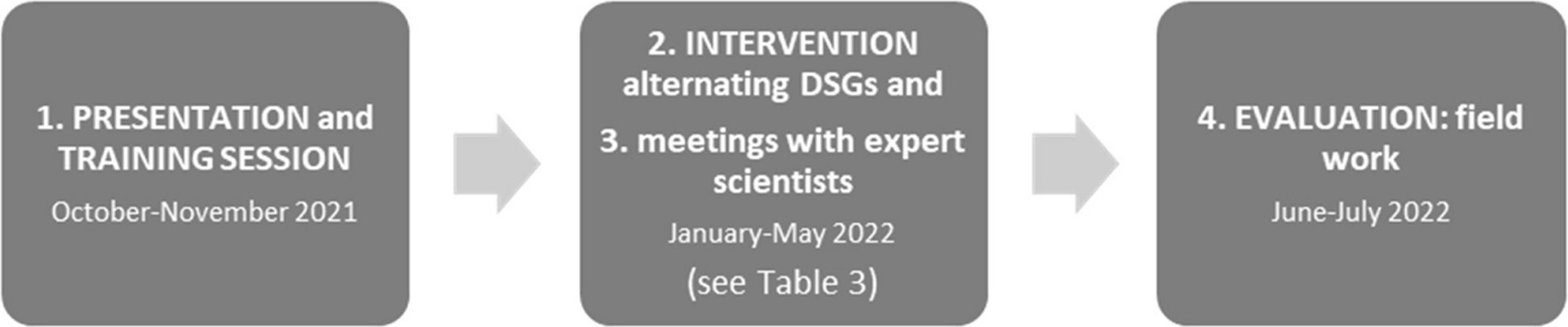
Table 1 Socio-demographic profile of adolescent and young people participantsTable 2 Socio-demographic profile of social workers involved in the studyInterventionThe intervention was carried out in four phases (Fig. 1). Firstly, the research team held a meeting with the social workers. In this session, the project team, the participating centres, and the scientists were introduced, and the impact of the extending learning time, the development of the intervention, and all phases of the research were explained. Secondly, the intervention was initiated through DSGs in which the participants read and discussed a scientific text. This phase was intertwined with a third phase in which training was planned by the research team and the scientists involved in the project. These sessions followed each DSG intervention so that the participants had already read and discussed the topic and had more tools for understanding and more opportunities to generate discussion and questions for the scientists. In the fourth phase, all fieldwork was carried out by collecting information through communicative-oriented interviews.
Fig. 1
Intervention phases from the beginning of the research to fieldwork
Table 3 below provides all the information on phase 2 of the intervention. First, the group read and discussed a scientific article in one session and, in the same month, another session was scheduled in which a meeting with a scientist was held with whom they had the opportunity to dialogue, ask questions, and generate connections between scientific knowledge and different aspects of daily life.
Table 3 Topics covered in each session: DSGs and meetings with scientistsData Collection TechniquesSemi-structured interviews were conducted to gather data at the end of the project (June, 2022). Two instruments, both semi-structured interviews, were created to explore the perspectives of the social workers and the adolescents and young people involved in the project. The interview for social workers covered topics such as introductory questions, residential environment, expectations for adolescents and young people, the project’s impact, and concluding questions. Additionally, a second instrument was developed to interview the adolescents and young people, focusing on areas like introductory questions, perceptions of science, fostering scientific careers, the impact of SEAs, science and diversity, residential environment, and concluding questions. Both instruments were designed to capture participants’ perceptions and the project’s impact.
The interviews were conducted in a room in the centre, ensuring that the interviewees felt comfortable at all times. The interviews were audio-recorded with a voice recorder, and all interviews were transcribed verbatim by the project research team.
Data AnalysisIt was employed to identify the barriers and obstacles (exclusionary dimension), as experienced by the participants, as well as the strategies they utilized to overcome these challenges (transformative dimension) (Gairal-Casadó et al., 2019).
The collected data was analysed to identify both barriers and opportunities that could either limit or promote access to scientific knowledge. A coding scheme was developed based on previous studies and the communicative discussions among researchers regarding the data transcripts (Table 4). This coding scheme was applied by researchers to review and discuss the data, following an egalitarian dialogue in line with the communicative methodological approach. The category called Scientific literacy attitudes contains three subcategories according to the OECD Report (2013) for Programme for International Student Assessment (PISA) 2015. Here, we have included the data collected from the interviews that show two of them, the interest in science and technology, that which is not only enjoying learning, but also appreciating the personal value of science, showing motivation for science-related activities or even considering a career in STEM areas in the future. Appreciating scientific approaches to research involves identifying, supporting, and valuing the research procedures that participants have read and discussed (OECD, 2007). Next, the category Academic improvement, motivation, and expectations includes elements that can contribute to improve young people’s and adolescents’ formal learning, such as enhanced competences in the use of language and academic vocabulary, increased motivation towards learning science, and increased academic expectations.
Table 4 Analysis and categories and subcategories for data collectionEthical ConsiderationsThe project was approved by the Ethics Committee of the Community of Researchers on Excellence for All (CREA) (reference 20231112).
All the participants in the research were informed of the purposes of the research and personally signed an informed consent form, including the possibility to revoke it at any stage of the study. Also, it was ensured that the data treatment would guarantee participants’ anonymity using codes. It is important to stress the importance of anonymizing all information that could identify the participants. Apart from that, consent was also obtained from the Institute of Social Services of the government of the region.
Comments (0)