Strategic Integration of Companion Diagnostics in Precision Oncology: Key Factors, Drug Development Timelines, and Regulatory Insights from U.S. FDA Approvals
Background
Companion diagnostics (CDxs) are central to precision oncology, enabling identification of patients most likely to benefit from targeted therapies. Their quantitative impact on anticancer drug development timelines and regulatory outcomes has not been fully defined, and co-development often poses logistical and regulatory challenges.
Methods
We reviewed 354 oncology indications across 127 anticancer drugs approved by the U.S. Food and Drug Administration between 2014 and 2024. Indications were classified by CDx requirement. Clinical, molecular, and regulatory features were compared between CDx and non-CDx indications. Multivariable logistic regression analysis identified factors associated with CDx adoption, and multivariable linear regression restricted to new molecular entities assessed associations with development timelines.
Results
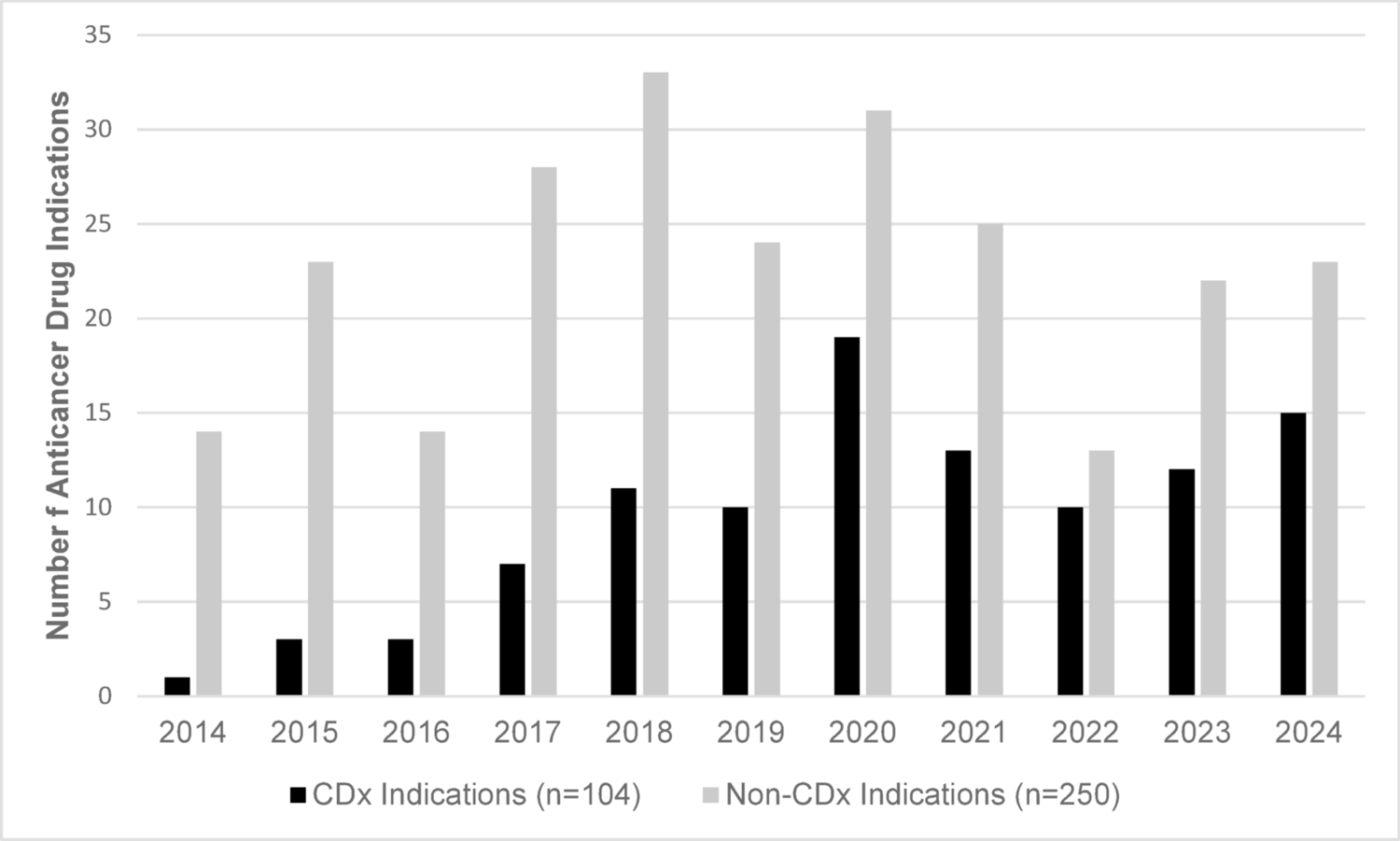
CDx-associated approvals increased steadily, comprising 43% of all oncology indications by 2022. CDx use was significantly associated with low-prevalence biomarkers (odds ratio [OR] 49.07), intermediate-prevalence biomarkers (OR 6.88), enzyme targets (OR 14.56), kinase targets (OR 5.18), and solid tumors (OR 3.65) compared with high-prevalence biomarkers, receptor targets, and hematologic tumors. Neither sponsor size nor orphan drug designation influenced CDx adoption. In regression models of new molecular entities, CDx presence was associated with a mean reduction in development time of 379.5 days (p = 0.006), similar in magnitude to Breakthrough Therapy Designation. Accelerated timelines were largely attributable to increased likelihood of early-phase approvals.
Conclusion
CDx co-development enriches trial populations and facilitates initial approvals, particularly for molecularly defined solid tumors with low- or intermediate-prevalence biomarkers. Early, indication-specific integration of CDx, combined with regulatory accelerators, provides a pragmatic strategy to enhance trial efficiency, shorten development timelines, and expand timely patient access to life-prolonging therapies.



Comments (0)