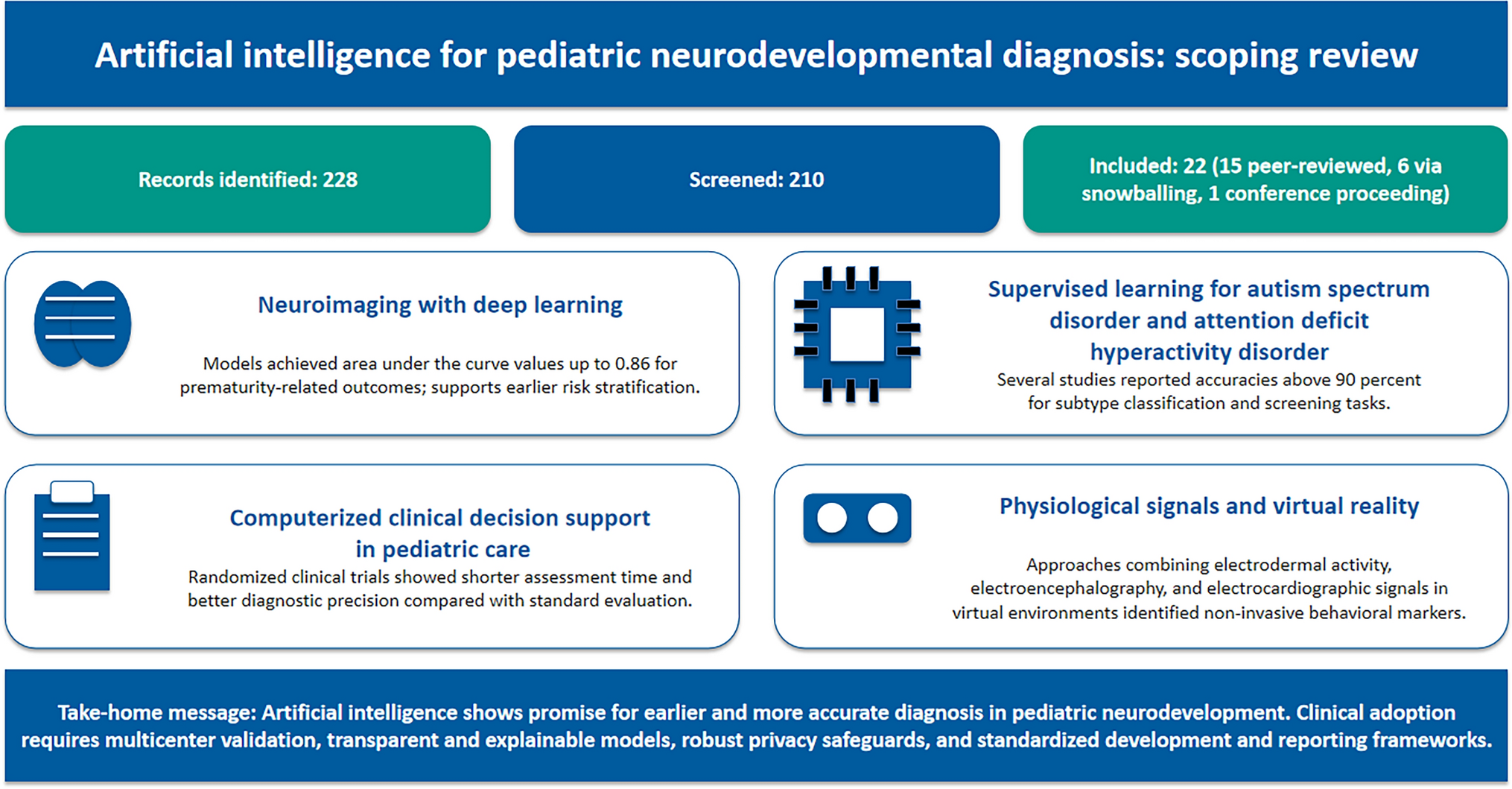
After the search strategy was applied to multiple databases and information sources, a total of 228 records were identified. After removing duplicates (n = 18), 210 records were screened and 169 were excluded. Then 41 full-text reports were assessed for eligibility, of which 26 were excluded. Fifteen studies met the inclusion criteria; six additional studies were identified through snowballing, and one conference proceeding (gray literature) was also included, for a total of twenty-two studies. The studies included in this review explored various applications of artificial intelligence in the diagnosis, classification, and treatment of neurodevelopmental disorders. Overall, four main approaches of AI used were identified: (1) deep neural networks (deep learning) and diagnostic accuracy of NDD; (2) supervised machine learning and diagnosis of ASD and ADHD; (3) computerized decision aids and prediction of NDD, and (4) biosignal analysis for early diagnosis of NDD and virtual reality (AI-enhanced biomarkers). Some of these results are summarized in Table 3.
Deep neural networks and neurodevelopmental disorders diagnostic accuracy
AI methodology, such as deep learning, is an advanced type of machine learning that uses artificial neural networks to analyze large volumes of data to recognize images, text, or behavioral patterns and extract complex patterns. In the articles reviewed, it was applied in six studies, where convolutional neural networks (CNNs) were highlighted for the analysis of neuroimaging and clinical data. These tools are especially useful in the early detection of brain abnormalities in high-risk pediatric populations.
For example, “A multitask, multistage deep transfer learning model for the early prediction of neurodevelopment in very preterm infants”, which uses a multitask deep learning framework for the fusion of clinical and neuroimaging data to predict multiple neurodevelopmental abnormalities early, was highly accurate in the early prediction of neurodevelopment in preterm infants, with an ROC of 0.86 for cognitive deficits, 0.66 for language deficits, and 0.84 for motor deficits [8].
On the other hand, a study in which motor outcomes in preterm infants were predicted from very early brain diffusion, magnetic resonance images (MRI) via a deep learning CNN model revealed the efficacy of CNNs in predicting motor development in preterm infants, with a sensitivity of 70%, specificity of 74%, and an ROC of 72%. It also identifies key brain regions, such as the motor cortex and somatosensory areas, for the prediction of abnormal Neurological, Sensory, Motor, Developmental Assessment (NSMDA) scores (discriminative and predictive tests of gross and fine motor development and neurological and sensorimotor performance) [9].
Supervised machine learning and diagnosis of autism spectrum disorder and attention deficit hyperactivity disorder
The machine learning methodology was the predominant approach in ten studies, which employed algorithms such as support vector machines (SVMs), decision trees, and extreme learning machines (ELMs) for the classification of neurodevelopmental disorder subtypes.
An outstanding example is the “Multiclass classification for the differential diagnosis of ADHD subtypes via recursive feature elimination and hierarchical extreme learning machine” [14], which implements a model based on recursive feature elimination (RFE) and hierarchical machine learning model (H-ELM) to improve the accuracy of the classification of ADHD subtypes, achieving an accuracy of 92.3%, where the AI method focuses on the most relevant features—surface area of the superior frontal lobe, cortical thickness, volume and mean surface area of the entire cortex.
Additionally, “A protocol for the diagnosis of autism spectrum disorder structured in machine learning and verbal decision analysis” used verbal analysis and machine learning models to improve the diagnostic accuracy of ASD, resulting in a 20% improvement in diagnostic accuracy over conventional assessments [15].
Another study, “Identification of autism spectrum disorders via deep learning and the ABIDE dataset” used an SVM to differentiate children with ASD from healthy controls, with a sensitivity of 88% and a specificity of 85% [10].
Similarly, the study “Application of supervised machine learning for behavioral biomarkers of autism spectrum disorder based on electrodermal activity and virtual reality” showed that machine learning models achieved an accuracy of over 90% in identifying biometric patterns associated with ASD [11].
Finally, recent studies have incorporated supervised ensemble strategies in ASD gene prediction. Ismail et al. (2022) developed the hybrid ensemble-based classification (HEC)-ASD model, a gradient-based ensemble learning approach that achieved 88% accuracy for predicting ASD-associated genes via functional matrices and gene ontology [12]. The same group subsequently proposed the stacking-synthetic minority oversampling technique (SMOTE) model, which integrates class balancing with supervised classifiers [such as SVM, K-nearest neighbor (k-NN), and random forest], achieving 95.5% accuracy [13]. Although these studies focused on genetic data rather than behavioral or clinical biomarkers, they demonstrated the robustness of supervised learning to improve the early diagnosis of ASD via a multidimensional approach.
Clinical decision support systems and neurodevelopmental disorders prediction
Clinical decision support systems such as AI technologies focus on feeding medical data and providing evidence-based recommendations, thereby detecting patterns that humans may miss. In this sense, four studies were evaluated, which analyzed the usefulness of computerized tools to improve ADHD diagnosis and child development surveillance. These systems have proven to be valuable tools for facilitating clinical decision-making in the detection of neurodevelopmental disorders.
For example, the study “Use of a computerized decision aid for ADHD diagnosis: a randomized controlled trial” showed that the use of an AI-based system reduced the assessment time and improved the diagnostic accuracy of ADHD by 15% compared with standard clinical assessment [21].
Similarly, “The use of a computerized decision aid for developmental surveillance and screening” showed that the implementation of AI-based tools improved the early detection of developmental delays in at-risk children, with a sensitivity of 89% and a specificity of 83% [22].
Biosignal analysis for the early diagnosis of neurodevelopmental disorders and virtual reality
Finally, four studies were explored in this field, which combined the use of physiological sensors and virtual reality environments with AI algorithms to detect neurobehavioral patterns associated with ASD.
Machine learning techniques, such as electrodermal activity (EDA), electroencephalography (EEG), and electrocardiographic changes (ECGs), have been applied to biosignals.
A relevant study mentioned previously, “Application of supervised machine learning for behavioral biomarkers of autism spectrum disorder based on electrodermal activity and virtual reality”, combined these methodologies to improve ASD detection through physiological and behavioral responses measured in controlled environments, achieving a sensitivity of 91% and a specificity of 85% [11].
Similarly, a study of biomarkers of autism spectrum disorder based on biosignals, virtual reality, and artificial intelligence revealed that the combination of neurophysiological signals with AI improved the classification of children with ASD by 18% compared with traditional methods [23].
Comparative performance overview
Deep learning models such as CNNs and transfer learning have shown strong diagnostic performance in neuroimaging tasks, particularly in prematurity-related conditions (e.g., AUCs up to 0.86). Supervised machine learning models—including SVM, H-ELM, and gradient boosting—were predominantly applied in ASD and ADHD classification, achieving high precision values, some above 90%. Clinical decision support systems have demonstrated significant improvements in diagnostic utility in real-world pediatric settings, whereas biosignal-based approaches (e.g., electrodermal activity combined with virtual reality) have shown promise in noninvasive ASD screening. Notably, two recent studies extended supervised models to genetic biomarker prediction, reaching accuracies of 88% and 95.5%, highlighting AI’s potential in genomic-level ASD detection (Table 3).




Comments (0)