Dialling in the heat
Laboratory heating is conventionally driven from the outside, transferring heat inward from a hot surface, creating strong temperature gradients within a sample. Radio frequency (RF) fields heat materials differently: they couple directly to charges and dipoles within a material to heat the bulk of the sample in its entirety. This drastically reduces surface-to-core temperature differences. With careful design, RF heating becomes a tool for precision probing and processing of materials.
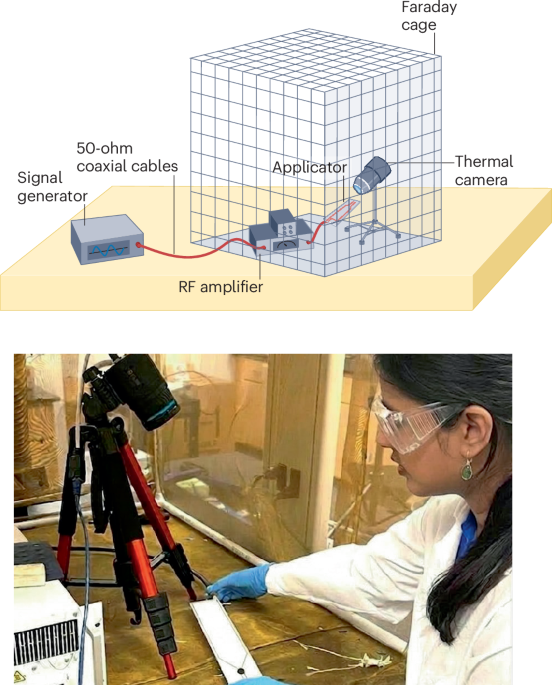
The RF applicator consists of copper threads patterned onto a circuit board, which can be redesigned easily for new applications or geometries. The applicator and sample are enclosed, together with the RF amplifier, inside a compact Faraday cage made from thin, flexible metal mesh wrapped around a simple hollow metal or wooden frame (see image). The system is typically operated between 100 and 300 MHz (the maximum frequency is limited by the RF amplifier), and the sample is placed within ~2 mm of the applicator (Cu threads). The entire setup is bench-top, easily transferable and reconfigurable. Currently, centimetre-scale samples can be heated efficiently, with straight-forward scaling to conveyor-belt or roll-to-roll processing.






Comments (0)