Study Design and Ethical Aspects
This research is a quantitative, analytical, observational, and cross-sectional study, developed by the Strengthening the Reporting of Observational Studies in Epidemiology (STROBE) guidelines. The project was submitted to the Research Ethics Committee of the Metropolitan University Center of Maringá (Unifamma) and approved under opinion number 2.305.331.
Participants
In 2022, the population of Maringá (Brazil) was 409,657 inhabitants, with projections estimating 425.983 people in 2024, of whom approximately 75.004 were aged 60 years or older. A non-probabilistic sample was intentionally and conveniently selected, consisting of 225 older adults who regularly practiced physical activity: 75 from private gyms, 75 from Senior Fitness Academies, and 75 from municipal sports centers, all located in Maringá, Paraná State, Brazil.
The inclusion criteria were: older adults of both sexes, aged 60 years or older, who self-reported practicing one or more types of physical activity (e.g., gymnastics, dance, water aerobics, stretching, strength training, Pilates Method exercises, among others) for at least six months in the exact location. Private gyms, municipal sports centers, or Senior Fitness Academies could offer these activities. Additionally, participants needed adequate verbal and auditory communication skills to complete the research questionnaires.
In 2024, Maringá had 76 Senior Fitness Academies, 14 municipal sports centers, and 171 private gyms (Prefeitura de Maringá, 2024). The data collection sites were selected through simple random sampling based on official registries. The list of private gyms was obtained from the Associação Comercial e Empresarial de Maringá (ACIM); the list of municipal sports centers was provided by the Municipal Department of Sports and Leisure; and the list of Senior Fitness Academies was obtained from the Municipal Health Department. Four locations were randomly selected from each list to ensure geographic distribution across different city regions.
There was no predefined number of locations initially contacted, as the sample was intentionally designed based on logistical feasibility and the goal of ensuring geographic diversity within the city. The choice of four locations per exercise setting (private gyms, municipal sports centers, and Senior Fitness Academies) was determined considering operational aspects such as researcher availability, time constraints, and accessibility, as well as the need to reach the intended number of participants (75 per group).
To screen for cognitive impairment and ensure participants’ ability to respond to the questionnaires, the Mini-Mental State Examination (MMSE) was administered. The first part evaluates orientation, memory, and attention (maximum score: 21), while the second part assesses specific skills, including naming and comprehension (maximum score: 9), for a total score of 30. The cutoff scores vary based on educational level:
20 points for illiterate individuals,
25 for 1–4 years of schooling,
26.5 for 5–8 years,
28 for 9–11 years, and.
29 for more than 11 years of education (Folstein et al., 1975; Brucki et al., 2003).
Exclusion criteria included older adults who practiced exercise exclusively with personal trainers, those with cognitive impairment identified by the MMSE, and those who engaged in physical activity in multiple settings (e.g., private gyms and Senior Fitness Academies). The exclusion of individual training with personal trainers aimed to maintain consistency in the type of exercise guidance across groups since personal training represents a highly individualized and tailored form of supervision that differs substantially from the group-based or unsupervised settings examined in this study. Similarly, participants who exercised in more than one type of environment were excluded to ensure that the motivational and barrier profiles could be attributed to a specific practice context, thus preserving the internal validity of group comparisons.
Instruments
The authors developed a questionnaire to identify the sociodemographic profile and patterns of physical exercise practice. It included questions related to age, age group, sex, education level, monthly income (in minimum wage units), marital status, overall physical exercise practice duration, and the frequency and duration of specific types of physical activity practiced weekly.
The Exercise Motivations Inventory – EMI-2 was used to assess motivation for adherence to regular physical exercise (Guedes, Legnani, & Legnani, 2012). This instrument aims to identify, measure, and rank both intrinsic and extrinsic motivational factors related to physical activity. It consists of 44 items distributed across ten factors: fun/well-being (“Because it is rewarding in itself”), stress control (“To help manage stress”), social recognition (“To demonstrate my value to other people”), affiliation (“To make new friends”), competition (“Because I feel good competing”), health/rehabilitation (“To feel healthy”), disease prevention (“To avoid health problems”), body weight control (“To maintain body weight”), physical appearance (“To look younger”), and physical condition (“To develop muscles”). The items are answered using a 6-point Likert scale (0 = “not at all true” to 5 = “completely true”), headed by the statement “Personally, I practice (or could come to practice) physical exercise” (Guedes, Legnani, & Legnani, 2012). The values of each factor are obtained from the arithmetic mean of the values answered in their respective items. The validation study showed Cronbach’s alpha coefficients to be acceptable (0.738 to 0.918), and 78.4% of items had a substantial kappa index of agreement (> 61%) when the questionnaire was applied repeatedly.
The Questionnaire on Barriers to Physical Activity in Older Adults (QBPAFI) was used to assess perceived barriers to greater adherence to physical exercise. This questionnaire presents a list of 22 potential barriers, and participants are asked to indicate how often each barrier occurs using a 5-point Likert scale: 1 (Always), 2 (Often), 3 (Sometimes), 4 (Rarely), 5 (Never). Items can be distributed across five barriers: Physical (“I have no energy”), Social (“I am very shy or embarrassed”), Beliefs (“I do not believe that physical activity is good”), Motivation (“I need to rest and relax in my free time”), and External (“Lack of company”). The values of each factor are obtained from the arithmetic mean of the values answered in their respective items. The scaling method allows for the quantitative assessment of perceived barriers, providing greater precision in identifying the significance of each barrier (Hirayama, 2006).
Procedures
Initially, the Municipal Department of Sports of Maringá was contacted to request authorization to conduct research at local sports centers. Likewise, authorization was sought from the Municipal Health Department to collect data at the Senior Fitness Academies. Four sports centers and four Senior Fitness Academies distributed across the city were randomly selected. For data collection in private gyms, authorization was first requested from the respective facility administrators. Four private gyms in the municipality were randomly selected to participate in the study.
Once the necessary permissions were obtained, those responsible for the sports centers and private gyms were asked to provide information regarding the days and times when group activities for older adults were offered. In private gyms specifically, schedules for times when older adults most frequently exercised individually were also requested. For Senior Fitness Academies, public spaces without a fixed activity schedule were randomly selected, based on the researcher’s availability, on different days and times.
The researcher approached older adults during visits and explained the study’s objectives and procedures to them. Those who agreed to participate signed the Informed Consent Form (ICF). Data collection took place between July and December 2024.
The questionnaires were administered collectively to participants who did not require assistance, with each session lasting approximately 30 to 45 min. For illiterate participants, individual appointments were scheduled to read and explain the objectives, questionnaires, and the ICF. These individual sessions lasted approximately 80 min to complete.
Data Analysis
The analysis was conducted using both descriptive and inferential statistical approaches. In the descriptive analysis, absolute and relative frequencies were calculated for categorical variables, while means and standard deviations were used to measure central tendency and dispersion for numerical variables. For numerical variables, normality was assessed using the Kolmogorov-Smirnov test and by evaluating skewness and kurtosis coefficients.
Additionally, bootstrapping procedures (1,000 resamples; 95% BCa confidence interval) were applied to improve the reliability of the results, correct for potential deviations from normal distribution, account for unequal group sizes, and generate 95% confidence intervals for the means (Haukoos & Lewis, 2005).
One-way ANOVA was used to compare barrier perception and motivational factors based on variables related to physical activity practice, followed by Tukey’s post hoc test (for more than two groups). Additionally, 15 multiple linear regression models were conducted using the enter method to investigate the association between age, gender, weekly frequency of exercise, and weekly duration of exercise (independent variables) and the perceived barriers (Models 1 to 5) and motivational factors (Models 6 to 15) (dependent variables). Variance inflation factors (VIFs) were calculated to check for multicollinearity (VIF < 5.0).
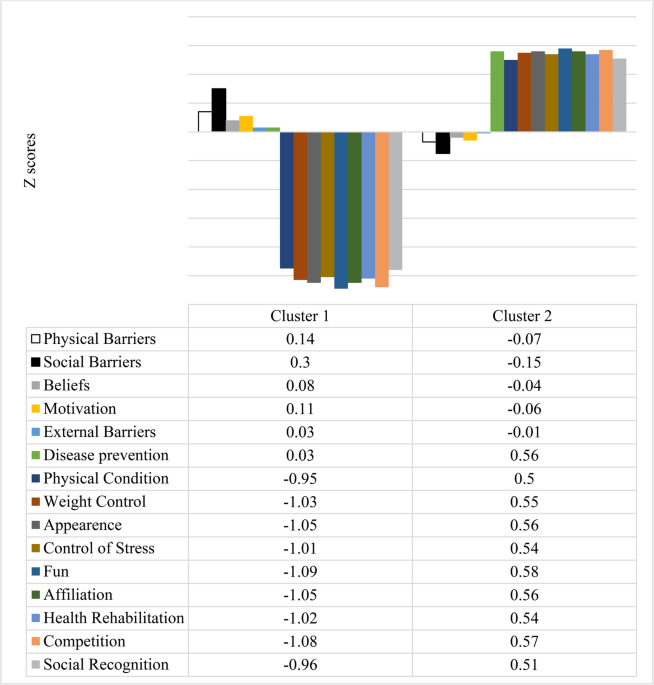
Older adults were also grouped and classified using hierarchical and non-hierarchical cluster analyses based on barrier perception and motivation scores. First, a nearest-neighbor hierarchical cluster analysis was conducted, using squared Euclidean distance as the dissimilarity measure. The R² value was used to determine the number of clusters to retain. Based on this analysis, three clusters were identified. A non-hierarchical cluster analysis was performed to validate and classify individuals into these three retained clusters.
According to Cumming and Duda’s (2012) criteria, z-scores below − 0.5 were considered low; z-scores between − 0.5 and + 0.5, moderate; and z-scores above + 0.5, high. Chi-square tests were used to investigate associations between barrier perception and motivational profiles about physical activity variables. A significance level of p < 0.05 was adopted. Data analysis was conducted using SPSS software, version 29.0 (IBM Corporation, 2025).




Comments (0)