
Remember me



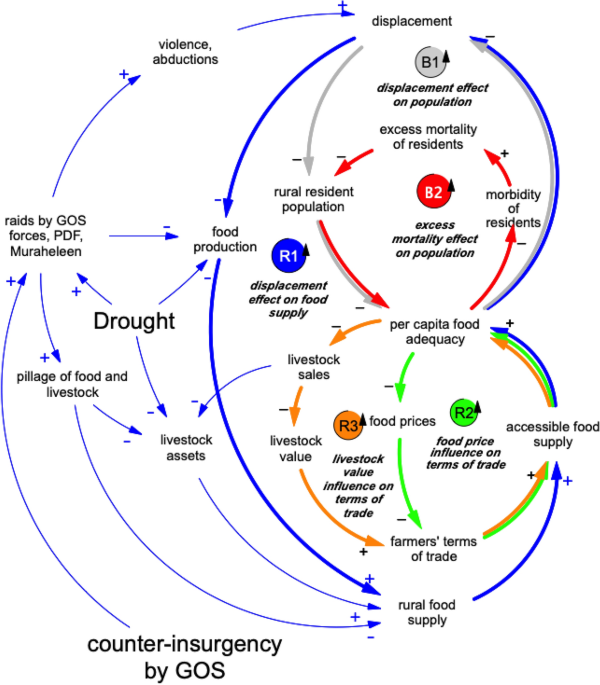
Our conceptual model is expressed in causal loop diagrams (CLDs) in Figs. 1 and 2. In Fig. 1, the pressures from the Sudanese Government’s counterinsurgency efforts and drought are assumed as exogenous (indicated in large font). As illustrated in the CLD, the counterinsurgency encouraged raids on rural communities that disrupted food production, pillaged food supplies and livestock, and directly caused displacement of the population through acts of violence. Drought compounded the problem by reducing crop yields and causing the loss of livestock, and by drying out the terrain which facilitated the mobility of the counterinsurgency militias. In our conceptual model, displacement is given internal momentum by three reinforcing feedback loops. In feedback loop R1 (in blue), displacement causes local food production to fall, reducing the food supply, food access, and food adequacy, driving further displacement. By food adequacy we mean the extent to which current diet meets a minimum required caloric level to maintain normal health and vitality. Feedback loops R2 (in green) and R3 (in orange) combine to cause residents’ terms of trade to fall. Terms of trade in this case are considered the ratio of the returns from sales of livestock assets to the cost of obtaining food, and serve as an indicator of the ability to access food. In feedback R2, lack of per capita food adequacy drives up food prices, lowering the terms of trade. In feedback R3, residents sell livestock to obtain money to purchase food or directly barter their livestock for food; their urgent need to sell or trade their livestock assets for food causes the market value of livestock to fall and with it the terms of trade.
Fig. 1
Causal loop diagram of GoS counterinsurgency and drought effects on the resident population of Bahr el Ghazal. The arrows indicate causal linkages. Linkages with negative signs cause change in the opposite direction; if the variable at the base of the arrow increases (decreases), the variable at the point of the arrow tends to decrease (increase). Linkages with positive signs cause change in the same direction; if the variable at the base of the arrow increases (decreases), the variable at the point tends to increase (decrease). Feedback loops are indicated in bold and are designated as either reinforcing (R) or balancing (B). Reinforcing feedback loops cause change in the state of the system. Balancing feedback loops tend to counteract change in the system. The feedback loops are given descriptive titles in italics and separate colors for clarity in the electronic version of the paper
Fig. 2
Resident and displaced populations are combined into one system of famine. Variables from the resident sub-system (Fig. 1) that interact with variables in the displaced sub-system are indicated in boxes. Time lags between variables are indicated with hashmarks
Two balancing loops in Fig. 1 operate as counters to the momentum of displacement. In feedback loop B1 (in gray), displacement causes the resident population to decrease, increasing the per capita food adequacy and moderating further displacement. In feedback loop B2 (in red), excess mortality reduces the resident population and improves per capita food adequacy, lessening excess mortality and displacement. However, in the Bahr el Ghazal famine, continual pressures of raids and drought overwhelmed the balancing effect of these feedback loops.
Figure 2 combines the resident and displaced populations into one system. In the CLD, displacement occurs in response to expectations of food aid availability. It was witnessed that the delivery of food aid created an attractant (colloquially called at the time an ‘aid magnet’), causing further displacement of populations to the distribution sites and generating a phenomenon labeled as ‘C-130 invitees’ with the number referring to the high-capacity planes that dropped the food aid. Also, as displacement migration occurs, word-of-mouth and peer examples drive yet more migration, shown in the CLD as reinforcing feedback loop R4 (shown in green).
Feedback loop B5 (in blue) represents the response of aid institutions to famine. As the number of displaced people increases, per capita food adequacy for the displaced is exceeded, leading to undernutrition. Undernutrition works in concert with a crowding effect to cause disease and morbidity, leading to excess mortality. Excess mortality reduces the number of displaced persons, which sets in motion two balancing feedback loops that have a dampening effect on mortality: feedback loop B3 (in black) by reducing crowding and its effects on disease and morbidity, and B4 (in gray) by improving accessability of food and reducing undernutrition; however, displacement originating from drought and raids on the resident population more than cancels the effects of these balancing feedback loops.
The famine dynamics were able to play out because of three principal holds. First, the imposition of the flight ban—blocking food aid by preventing OLS planes from flying to locations requiring assistance—by the GOS as a counterinsurgency action is shown in the lower part of Fig. 2. It represented an important hold by ensuring that humanitarian assistance did not break the reinforcing dynamics in a timely manner. Second, some elements of the SPLA leadership diverted food aid intended for famine victims for their own benefit. Expectations of profit driven by high food prices induced by food shortage encouraged the diversion, modeled in the CLD as reinforcing feedback loop R6 (in brown). This hold compromised the accessibility of the relatively small amount of food aid that was delivered to Bahr el Ghazal. Third, there was a delay, indicated in the CLD with a hashmark, as aid institutions adjusted from a prevailing development orientation with its focus on the polio campaign to a more emergency-relief footing. This delay was a hold that allowed famine conditions to unduly persist.
A key link to feedback loop B5—and a key to understanding how the holds were finally broken—is the action of observers to bring the developing famine to the attention of the news media. Media attention tends to be self-reinforcing, described as media frenzy by Howe [7], and shown in Fig. 2 as feedback loop R5 (in magenta). Media exposure put pressure on NGOs and other institutions to deliver food aid to the displaced. However, there was a delay in response, as aid institutions shifted their focus from development to emergency assistance. The media exposure also threatened to compromise the reputations of the GOS and SPLA unless they removed the flight ban and stopped the aid diversion, respectively. These dynamics are modeled in the CLD with feedback loops B6 and B7. It was in part through this media pressure that the three main holds were broken and assistance was able to be delivered at scale to alleviate the ongoing famine, but not before tens of thousands of people lost their lives.
Simulation modelThe structure of the simulation model is described in the Supplemental Material Part B. The base simulation and comparison to historical data are described in the Supplemental Material Part C.
In the base simulation the three holds described in the conceptual systems model cause disruption of food delivery and increase excess mortality. Over time the holds were released due to media attention, political pressures, and growing awareness of the seriousness of the crisis. To deconstruct the effects of the holds we have run scenarios of excess mortality in Bahr el Ghazal during 1998 while withholding the three holds one by one, and then with all three holds removed. The results are shown in Fig. 3.
Fig. 3
Illustrative simulation of excess mortality during 1998 with the effects of each of the 3 holds withheld separately (A, B, C) and with the effects of the 3 holds withheld at once (D). Simulations with holds withheld are shown with red dotted curves. The base case with all holds in place is shown with the blue solid curves
It is difficult to weigh the relative impacts of the holds on excess mortality as data is lacking for influential parameters, for example the percentage of food aid blocked by the flight ban, the percentage of food aid delivered that was diverted, and the length of time for aid institutions to shift their focus to aid delivery, which are based on expert opinion. However, the patterns displayed appear logical. The flight ban occurred during the peak of the famine and its removal in the simulation shown in Fig. 3A lessens the spike in famine deaths. Diversion of food aid occurs after food aid deliveries commence and increase after the flight ban is lifted as more food delivery is available to divert, as seen in Fig. 3B. Removal of the delay in shifting from development focus to food aid focus causes a reduction in excess deaths from the beginning of the simulation. Figure 3D shows a large reduction in excess deaths when all holds are removed. There is an adverse compounding effect between the holds in the simulation that makes their combined effect about 10 percent greater than the sum of the individual effects.
The simulation in Fig. 4 compares excess mortality in our base case with that in a scenario in which there is no counterinsurgency pressure and no holds caused by the flight ban and food aid divergence. The hold associated with aid agencies shifting from a development focus to emergency food aid is included.
Fig. 4
Illustrative simulation of excess mortality with the pressure of counterinsurgency and associated flight ban and divergence holds withheld
There is some excess mortality in the simulation due in part to the development orientation of the aid agencies which is still in place, but the reduction in deaths when the counterinsurgency pressure is withheld is huge. The large gap in excess mortality at the beginning of 1998 is due to the impacts of the counterinsurgency that was occurring in the previous year. The simulation suggests that without counterinsurgency violence and with a more proactive and timely delivery of sufficient food aid (which would be facilitated by better access without the conflict), excess mortality may have been eliminated.
Modeling famine with a system dynamics approach could help guide strategies or policies by revealing the compounding effects of holds or other causal elements of famine. In our current model food aid deployment is reactive, responding to elevated mortality and observed undernutrition, rather than proactive, responding to signs. The lack of proactive response to early warning is itself a policy hold that was not captured in our simulation. The simulations suggest that if all these holds were removed, and the humanitarian system responded proactively to signs such as food price increases or a surge in livestock sales, it could be possible to eliminate most excess mortality due to famine.
It is important to underscore that these simulation results are indicative of the kinds of findings that could emerge from this approach. However, we are not suggesting that these are definitive results for the 1998 Bahr el Ghazal famine, since that would require further analysis and refinement of the model and would still be limited by the absence of key data.
Comments (0)