This is the first study to evaluate the impact of SSSIs on the use of medicines subject to shortages. While the TGA has not specified what ‘successful’ implementation of an SSSI looks like, they are designed to ensure continuity of therapy for patients. Our results indicate that three-quarters of the SSSIs examined were successful in addressing product shortages and potentially maintaining patient adherence.
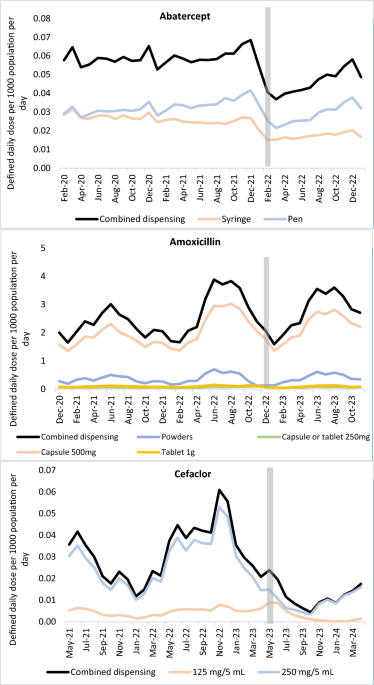
We identified that availability of substitute products was a key component of SSSI success. When observing duration of shortage there did not appear to be any relationship between duration of shortage and percentage change in use of the scarce medicine or substitutes overall. For many of the medicines (abatacept, amoxicillin, cefaclor, cefalexin, fluoxetine, phenoxymethylpenicillin and vigabatrin), there were multiple shortages listed in the TGA Medicines Shortage Reports Database archive in the 2 years prior to the individual medicine SSSIs being issued [13]. We noted that for half of the medicines examined, the SSSIs appear to have been implemented late (i.e., after product shortages began); however, the late implementation of the SSSIs and the number of shortages in the 2 years prior did not appear to impact on an SSSI’s success (analysis not shown).
Medicine shortages are increasingly common and disrupt health care access for consumers [14]. Managing the impact of shortages can also increase the workload on prescribers and pharmacists [15, 16]. Consequently, it is important to understand the effectiveness of programmes put into place to manage access to medicines in times of scarcity. This is the first study to examine the impact of SSSIs in Australia. Similar schemes are operational in Canada [17, 18], New Zealand [19], and the UK [20], although their impacts on utilisation of medicines over time, to our knowledge, have not been evaluated. In the UK, a similar mechanism to SSSIs is the serious shortage protocols (SSPs). When an SSP is active, pharmacists can supply a medicine or device on the defined protocol rather than the medicine formulation and strength prescribed. The SSP may allow a pharmacist to supply an alternative quantity of the medicine, an alternative formulation, different generic equivalent or a therapeutic alternative [20]. Pharmacists in the UK reported finding early scarcity arrangements overly complex and inflexible [21]; however, a 12-month Department of Health and Social Care review reported that there were no apparent concerns or negative effects of the policy on the market for prescription medicines [22, 23]. In New Zealand, in selected cases such as methylphenidate shortages, the national medicines regulator Medsafe allows pharmacists to provide an alternative strength of methylphenidate to a patient without requiring the medical practitioner to write a new prescription or countersign a prescription amendment [24]. Moreover, in some countries such as in Canada, pharmacists can prescribe medicines in selected provinces and therefore may be able to alter treatment more readily during a medicine shortage. Similarly, in the USA, in some states, pharmacists can prescribe medicines which may provide more flexibility when providing alternatives during shortages. Queensland is the only state in Australia that provides a legal mechanism for pharmacists to supply a substitute medicine that is of equivalent dose and duration if the pharmacist is not able to supply the medicine that the medical practitioner prescribed [25]. This includes therapeutic substitution with a medicine within the same class. One major caveat of this supply mechanism is that such supplies are not covered by the PBS therefore the patient is required to pay the full cost of the medicine [25]. When considering this and the shortage mitigation mechanisms that operate in the international setting, a distinguishing feature of the Australian SSSI framework is its national consistency and legal clarity, with time-limited instruments specifying exact substitute products and conditions of use. This contrasts with more decentralised or discretionary models internationally, which may rely on professional judgement or regional guidance. Our findings suggest that this prescriptive approach by the national regulator may be most effective when substitute products are demonstrably available, highlighting the importance of real-time supply intelligence in policy design.
This is the first study to examine the impact of SSSIs on utilisation of medicines with known shortages. This is likely to be of ongoing importance to prescribers, patients and policy makers in the future due to ongoing supply chain issues and international trade instability [14]. Our outcome measure, defined daily dose per 1000 population per day, accounted for underlying changes in the Australian population over time, as well as artefacts that would have occurred had we used prescription counts based on differing pack sizes and doses. Our findings suggest that the effectiveness of SSSIs is contingent not merely on their legal authorisation, but on the underlying availability of substitute products. Future iterations of the SSSI framework may benefit from tighter integration with supply forecasting systems to ensure that authorised substitutes are themselves resilient to shortages.
All studies have limitations. This study used aggregated rather than individual-level data. While SSSIs are intended to support patient need during medicine shortages, our analysis was limited to aggregate utilisation and cannot directly assess patient-level outcomes such as treatment interruption, clinical deterioration, or patient experience. Utilisation therefore represents a proxy indicator of continuity of access rather than a direct measure of patient need being met. The TGA have not specified any medicine utilisation targets for their SSSIs, and despite being based on traditional adherence measures, we acknowledge that our ‘success’ benchmark of < 20% is an arbitrary one. Also, we did not look at substitutions outside of the SSSI, which prescribers might have used as substitutes (e.g., other medicines in the same class) [14]. This would have given insight into prescriber behaviour during shortages but not the success of the SSSIs per se, which was our aim.
This study was not designed to estimate the causal effect of SSSIs on medicine utilisation. Rather, we used interrupted time series methods to describe changes in utilisation patterns before and after implementation of SSSIs in the context of known shortages. Without a contemporaneous control group of unaffected medicines, it is not possible to fully account for secular trends or concurrent policy and market factors influencing medicine use. However, by examining multiple medicines across different therapeutic areas and shortage contexts, we were able to identify consistent patterns that provide insight into the conditions under which SSSIs are more or less likely to mitigate utilisation declines. Identifying appropriate comparator medicines unaffected by shortages but subject to similar demand dynamics is challenging in the context of widespread, multi-product supply disruptions occurring during the study period.
At present, SSSIs can be applied to most prescription medicines in Australia but not those that are controlled drugs or drugs of addiction such as opioids, medicines for attention-deficit hyperactivity disorder (ADHD) and some benzodiazepines [26]. Medicine regulators could consider allowing pharmacists to substitute controlled drugs or drugs of addiction during shortages where there are alternative strengths of the same product formulation available. Where appropriate, such as a severe shortage of all brands and strengths of a medicine, SSSIs could also be expanded to include therapeutic substitution. That is, provision of a mechanism for pharmacists to swap a medicine with another of equivalent pharmacological action when faced with a medicine shortage. At present SSSIs that have been implemented have been limited to substitution with an alternative strength of the same medicine, alternative formulations, alternative release profiles such as immediate-release with sustained or extended-release version or a different salt formulation of the same product [26]. The current SSSI mechanism could also be integrated into prescriber and dispensing software as pop-ups when medicines that are in shortage are selected for prescribing or dispensing. Similar pop-ups exist for safety warning and common dispensing errors in dispensing software. Such pop-ups could remind prescribers and pharmacists of the SSSI and streamline clinical decision making when attempting to assist a patient experiencing a shortage of their medicine, although pop-ups can become distracting so implementation would need to be carefully considered [27].

Comments (0)