
Remember me


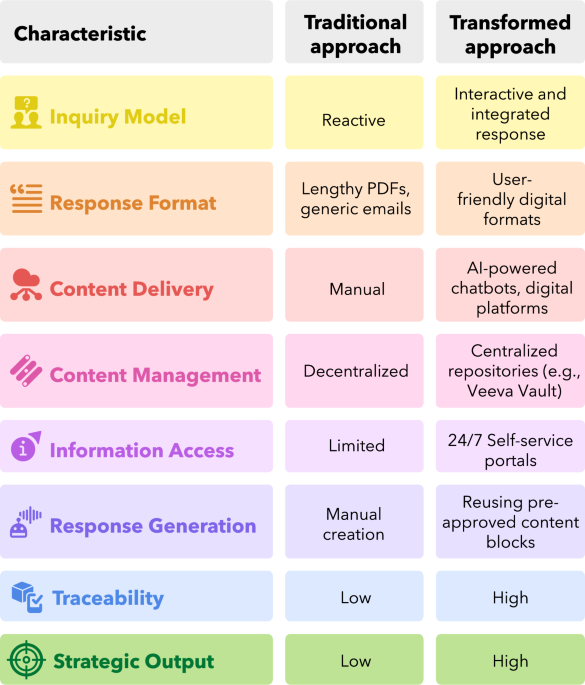

The term “digital” in MA refers to more than converting offline or paper-based activities into online formats [4, 14]. It represents a shift in how MA identifies problems, develops solutions, engages stakeholders, and measures value [4, 12, 13]. In this context, digital should be understood as an enabler of more relevant, timely, trusted, and measurable scientific engagement [4, 10, 13]. Its purpose is to improve the quality, accessibility, and impact of scientific exchange in ways that are aligned with patient and healthcare system needs [1, 9, 10].
2.1 Embracing the Need for Digital Transformation in MAThe traditional model of MA, characterised by predominantly face-to-face interactions, paper-based processes, and siloed operations, may be less suited to a healthcare environment increasingly shaped by data, digital channels, and evolving stakeholder expectations. Healthcare professional expectations are generally centred on credible, timely, accessible, and relevant scientific information rather than digital engagement as an end in itself. Digital approaches can help MA meet these expectations more effectively and at greater scale [4, 13].
As medical science becomes more complex and healthcare delivery more personalised, HCPs and patients increasingly require efficient and flexible ways to access, interpret, and share information. Digital technologies, including AI, machine learning (ML), big data analytics, mobile applications, and generative AI platforms, are reshaping healthcare by enabling MA teams to access and analyse large volumes of information, generate RWE, and deliver targeted scientific content across multiple channels [2, 15, 16].
These tools can support routine activities and enable MA work that may be difficult to deliver consistently at scale, including continuous insight generation, responsive scientific exchange, and evidence-informed engagement. Automation can support this shift by reducing the burden of repetitive or structured tasks, allowing MA professionals to focus more on scientific interpretation, stakeholder partnership, strategic decision-making, and patient-centred value creation [11, 12, 17].
2.2 The Omnichannel Maturity Journey in MADigital transformation in MA is best understood as a stepwise maturity journey that progresses through basic activation, channel variety, tactical integration, smart sequencing, and advanced personalisation, with each stage building capability and creating new opportunities for scientific engagement [18,19,20] (Fig. 1).
Fig. 1
The Omnichannel Climb: conceptual framework illustrating the progression from single-channel engagement to fully omnichannel engagement in MA. The framework shows increasing strategic value alongside rising operational effort and complexity, with maturity progressing from basic activation and channel variety to tactical integration, smart sequencing, and advanced personalisation. MA Medical Affairs, OCE online community engagement
Figure 1 presents an author-developed conceptual synthesis informed by published literature on digital transformation, omnichannel engagement, and MA capability development [4, 18,19,20]. The five stages are intended to describe increasing levels of coordination, data use, personalisation, and organisational maturity rather than a fixed or universally mandated sequence [18,19,20]. The distinction between stages lies in how deliberately channels are connected, how engagement data are used, and whether interactions are planned retrospectively, proactively, or predictively [18,19,20].
At the first stage, basic activation, digital activity is limited, isolated, and largely transactional. Existing materials may be converted into digital formats, such as PDFs, emails, or simple online resources, but these activities are not strongly connected to a broader medical strategy. The purpose at this stage is usually access or distribution rather than coordinated engagement [18].
At the second stage, channel variety, MA teams use multiple digital and non-digital channels, such as webinars, virtual advisory boards, medical portals, email communications, and field-based interactions. However, these channels often operate independently. The organisation may increase reach, but the HCP experience can remain fragmented because touchpoints are not yet connected through a shared engagement logic or data framework [18, 19].
At the third stage, tactical integration, selected channels begin to be coordinated around defined medical objectives. For example, insights from a webinar, medical inquiry, or advisory board may inform a follow-up MSL discussion or targeted educational resource. The key feature of this stage is deliberate coordination between activities, but the sequence is still largely planned manually and retrospectively [18, 20].
At the fourth stage, smart sequencing, engagement becomes more data-informed and proactive. Modular content and channel choices are sequenced according to HCP behaviour, preferences, practice context, or external triggers such as new guidelines or emerging clinical data. Unlike tactical integration, where activities are connected after or around discrete events, smart sequencing uses data to anticipate the next most relevant interaction and deliver information at the appropriate time and through the appropriate channel [17, 19].
At the fifth stage, advanced personalisation, AI and predictive analytics enable more dynamic tailoring of content and interactions. Engagement is informed by prior interactions, stated preferences, clinical context, and evolving scientific needs. At this stage, personalisation is not limited to selecting a preferred channel; it includes adapting the content, timing, format, and follow-up pathway within a continuously learning engagement model [18, 19].
2.3 Strategic Value of Omnichannel: The Climb to Advanced PersonalisationThe progression through the levels described in Fig. 1 also reflects the balance between the effort required and the value delivered. At the early stages (Levels 1–2), operational effort is low but so is the strategic return. Digital activities may increase communication volume without necessarily improving relevance, credibility, or scientific value. At Level 3, value may increase as integrated, sequenced activities provide coherent engagement and allow insights from digital interactions to inform MA strategy. At Level 4, potential benefits may increase, but this requires investment in infrastructure, cross-functional collaboration, and advanced analytics. This enables tailored, evidence-based communication at scale, but also demands strong organisational alignment. At Level 5, the “advanced personalisation zone”, operational complexity is high, but so is the potential for strategic impact. Here, AI and ML support predictive, real-time personalisation, allowing engagement to be informed by prior interactions, clinical context, and emerging scientific needs [18,19,20]. This progression shows that omnichannel maturity is not defined by the number of channels used, but by the degree to which engagement is coordinated, insight-led, measurable, and aligned with scientific value [18,19,20].
2.4 Data-Driven Omnichannel Engagement, Real-World Evidence and Evidence GenerationA key opportunity for digital transformation in MA lies in the intersection of RWE generation and omnichannel engagement [18, 19, 21, 22]. As the volume and diversity of health-related data expands from externally sourced, governed datasets such as electronic health records and claims analyses to internally held medical engagement data, publications, digital interactions, and patient-reported outcomes, MA can use these combined data streams to generate actionable insights [21,22,23]. Advanced analytics and ML may help teams identify treatment patterns, engagement preferences, scientific influence, and unmet needs, positioning MA as a strategic partner in shaping healthcare delivery [11, 21,22,23]. These combined data streams can be used to surface signals such as treatment discontinuation patterns, recurring tolerability concerns, or gaps in evidence application, which MA can then address through targeted scientific exchange and education without promotional intent [12, 21, 22, 24].
Evidence generation is a distinct scientific contribution of MA and should be differentiated from market research [21, 22, 25]. While market research may help organisations understand stakeholder perceptions, behaviours, preferences, and informational needs, MA-led evidence generation is intended to address scientific questions through appropriate methodology, governance, and dissemination [21, 22, 25]. Digital and omnichannel engagement can help identify evidence gaps by revealing recurring HCP questions, unmet clinical needs, variations in treatment pathways, or areas where available evidence is difficult to apply in practice [18, 19, 21, 22]. These signals can inform hypothesis generation and support the development of real-world studies, observational analyses, registries, patient journey research, or other evidence-generation activities designed to add to the scientific literature [21,22,23, 25]. This distinction is reflected in the intended outputs: MA-led evidence generation is designed to produce findings that meet scientific and methodological standards appropriate for peer-reviewed dissemination, whereas market research outputs typically remain internal to the organisation and are not intended for the scientific literature [21, 22, 25].
As an illustrative example, digital engagement data may show that oncologists are highly interested in a new therapy, while MA field insights, advisory board discussions, or medical inquiries reveal unresolved questions about tolerability, treatment sequencing, or real-world use in a specific patient subgroup [18, 19, 21, 22]. Rather than treating this only as an engagement or education issue, MA can identify it as a potential evidence gap [21, 22, 25]. The question may then be translated into a structured evidence-generation activity, such as a retrospective real-world data analysis, registry study, patient journey analysis, or observational study, depending on the available data and governance requirements [21,22,23, 25]. Where appropriate ethical, privacy, and methodological standards are met, the findings are then disseminated through peer-reviewed publication, with congress presentations and medical education activities supporting wider scientific exchange [23, 25, 26]. In this way, digital and field insights progress from engagement optimisation to scientific evidence generation [23, 26].
As a further illustration, in a chronic neurological disease setting, longitudinal data collected through patient support programmes, including treatment patterns, adherence, symptom trajectory, and health service utilisation, can surface gaps between real-world disease management and existing clinical guidance [27, 28]. Where ethical, privacy, and methodological standards are met, MA can lead structured analyses of these data, interpret the findings in collaboration with clinical experts, and disseminate the results through peer-reviewed publication [21, 22, 27,
Comments (0)