4.1 Summary of Main Findings
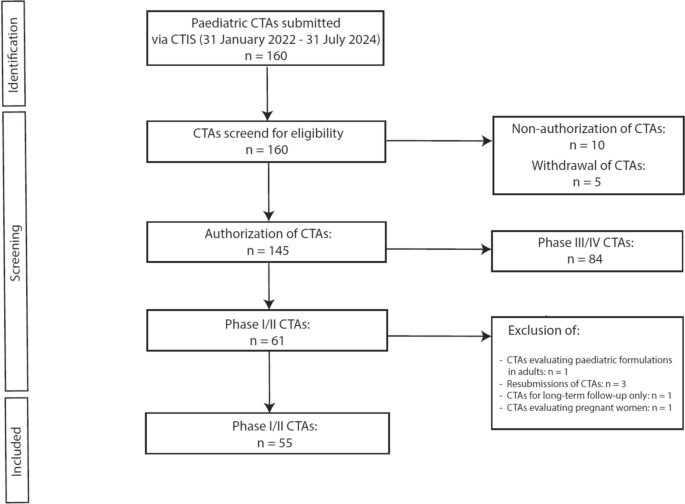
This comprehensive analysis of paediatric CTAs under the new CTR reveals several important findings. The marked variation in both the number and nature of considerations raised by different MSs, particularly when acting as MSCs, suggests that despite the CTR’s aim for harmonisation, national interpretations of requirements remain diverse. This inconsistency directly impacts children by creating inequitable access to clinical trials depending on their country of residence within the EU.
While the vast majority (90%) of CTAs were authorised, which indicates general support for paediatric trials by authorities, a notable disproportionality was observed for oncology trials—constituting 10% of authorised CTAs but 40% of non-authorised CTAs, despite well-documented high unmet medical need in high-risk malignancies [14, 15] and widespread off-label use in this field [4]. The predominant reasons for rejection included toxicity concerns, unfavourable risk-burden-benefit analysis, and insufficiency of required evidence.
Three key challenges emerged from our analysis. First, MSs demonstrated differing levels of required evidence, with 36% of assessments raising concerns about insufficient clinical and preclinical data without specifying toxicity or efficacy concerns. Through personal communication with MSs, it became apparent that approaches to evidence prerequisites vary considerably: some demand robust Phase II or even Phase III adult clinical data and/or juvenile preclinical toxicity studies, while others conduct case-by-case assessments. Second, significant variation exists in how MSs consider PIPs during CTA assessments. Sometimes, CTA assessment were detached from their respective PIPs and/or trial characteristics defined in the PIP questioned in the CTA, while in other cases, sponsors had to justify when deviating from the respective PIPs. This inconsistency was highlighted in personal communication with NCAs: some do strictly adhere to PIP elements during CTA assessment, while others do not assess CTA differently when there is a PIP in place. Third, MSs demonstrated widespread hesitancy to include adolescents in adult Phase I/II trials, despite their physiological similarity to adults.
4.2 Comparisons with Existing Literature
Our findings align with findings from Beck et al [12], who reviewed paediatric oncology trial application assessments in Germany from 2014 to 2019 and similarly identified deficiencies regarding toxicity and safety as predominant issues, including insufficient clinical and non-clinical data. These findings suggest that the requested amount of non-clinical and clinical data was already an important issue before the CTR came into place.
The findings regarding Phase I/II adult-adolescent CTAs show that MSs, despite final approval, demonstrated hesitancy to include adolescents in these trials, potentially reflecting stringent interpretations of the requirements outlined in CTR’s article 32. Given that pharmacokinetic parameters and physiology in adolescents typically closely mirror those of adults [16, 17], their inclusion in adult trials has been identified as crucial for ensuring timely access to innovative therapies [18,19,20]. Our findings confirm that despite this recognition and even when adolescent inclusion is favoured in PIPs, a gap remains between recommendations and widespread implementation.
The heterogeneity in PIP consideration during CTA assessment reflects ongoing debates in the scientific community about the Paediatric Regulation [21,22,23,24,25]. While the PIP requirement was established to advance paediatric medicine development [26] and has made a positive impact, our analysis reveals that Article 6 of the CTR, which states that PIPs should be considered during CTA assessments, is interpreted and applied inconsistently across MSs. Some MSs also acknowledged divergent interpretations of Article 32 by NCAs and ECs, highlighting the complexity of achieving harmonisation.
4.3 Clinical and Regulatory Implications
The high proportion of considerations relating to insufficient clinical and preclinical data (without specifying toxicity or efficacy concerns) points to a strong need for alignment in the interpretation of CTR Article 32. This becomes particularly relevant for conditions primarily occurring in childhood or adolescence, where the conventional approach of establishing evidence in adults first creates practical obstacles. The requirement for extensive adult clinical activity data warrants careful reconsideration, especially given for example the questionable translatability of adult oncology data to paediatric populations [21, 27]. Conservative approaches that delay paediatric trials create another problematic cycle: off-label use following adult authorisation undermines recruitment for formal paediatric trials while reducing market exclusivity periods for sponsors. Early adolescent inclusion could accelerate trials in younger age groups and break this cycle.
As emphasised in the revised Declaration of Helsinki, children can be harmed by their systemic exclusion from medical research and clinical trials, potentially denying them early access to innovative treatments [7], especially for diseases with high unmet medical need such as high-risk malignancies [15, 28, 29]. The pronounced focus on toxicity concerns may warrant reconsideration—particularly in light of the severely limited therapeutic options available for paediatric oncology patients. Alternatively, evidence frameworks such as enhanced preclinical proof-of-concept models like ITCC-P4 or PIVOT [30, 31] might provide relevant predictive value for paediatric oncology. This area may receive further regulatory attention, as indicated by the Non-Clinical Working Party’s planned reflection paper on the implementation of mode-of-action–driven oncology paediatric development plans [32].
The varying approaches to PIP integration during CTA assessment raise important questions about how MSs interpret the role of PIPs in guiding paediatric drug development. The inconsistency—where CTA assessments are sometimes detached from their respective PIPs while in other cases sponsors must justify deviations—suggests need for clearer guidance on the weight and application of PIP requirements during CTA evaluation.
For regulatory authorities, these findings identify specific areas needing guidance to support harmonisation. For sponsors, understanding this variation can inform CTA preparation and facilitate early engagement with authorities. This analysis gains particular significance given the 2024 Declaration of Helsinki revision, which recognises that excluding vulnerable populations from research may itself pose ethical concerns. As regulatory bodies develop guidance, they must balance protective measures with the imperative to advance paediatric medicine through well-designed research.
4.4 Strength and Limitations
This study represents the first systematic analysis of paediatric CTA assessments across EU Member States under the new CTR. Conducted in collaboration with the Clinical Trials Coordination Group (CTCG) and the Paediatric Committee (PDCO), the analysis benefited from access to both public and non-public data from CTIS through an EMA fellowship, enabling comprehensive evaluation of assessment practices. The focus on Phase I/II trials, which typically involve innovative treatments and complex risk-benefit assessments, provides insights into areas where harmonisation is most critically needed.
Several limitations should be acknowledged. First, the analysis period coincides with the early implementation phase of the CTR, and some observed patterns may reflect initial adjustment challenges rather than persistent systemic issues. Additionally, no comparison was possible between the transition phase and mandatory phase due to the limited number of CTAs submitted during the transition phase. Second, categorisation of assessments according to significance and feasibility involves inherent subjectivity. Third, the number of CTAs per MS is currently limited, necessitating caution in interpreting statistical results and individual MS-level findings. Fourth, the focus on Phase I/II trials may not capture assessment patterns unique to later-phase studies. Finally, structural limitations of CTIS, such as the absence of additional search categories for different age groups, made some analyses more challenging. Further analyses are warranted to evaluate whether these patterns persist as the CTR implementation matures, and structural improvements to CTIS would facilitate future monitoring efforts.
4.5 Future Directions
The implementation of the revised Declaration of Helsinki presents a promising opportunity to embrace a more enabling approach in paediatric CTA assessment, potentially closing gaps in equal access to innovative treatments across the EU for children and adolescents. An assessor’s workshop held in July 2025 [10] marks a vital step toward harmonisation. Future research should include longitudinal monitoring of harmonisation progress as the CTR implementation matures, with particular attention to whether targeted guidance successfully reduces variation in evidence requirements, PIP integration and adolescent inclusion practices.





Comments (0)