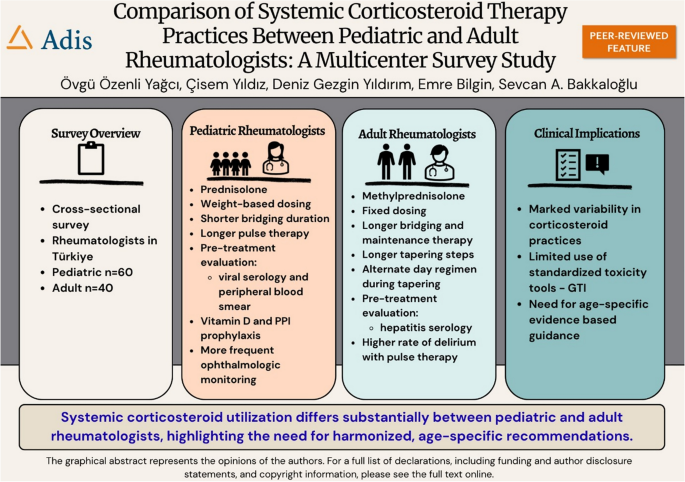
This study provides an overview of real-life corticosteroid utilization, tapering, and monitoring strategies among PRs and ARs. To our knowledge, this is the first study to directly compare and evaluate the approaches of two specialties to corticosteroid therapy in rheumatic diseases. The present survey showed heterogeneity in terms of choice of formulation and dose of corticosteroids, preventive measures of adverse effects, and immunization practices between ARs and PRs.
There are various forms of therapeutic corticosteroids with varying degrees of glucocorticoid and mineralocorticoid effect, potency, and pharmacodynamic properties [5]. Current international guidelines emphasize using the lowest effective dose for the shortest possible duration and tapering/ceasing once the disease control is achieved [7, 8]. However, they provide no clear recommendations about the most suitable and safest formulation. In our study, prednisolone was the most commonly preferred oral corticosteroid by PRs, with a maximum daily dose of 60 mg, while ARs preferred mostly MP with a maximum dose of 80 mg/day. Prednisolone is usually the choice of oral therapy in both adult and pediatric rheumatology practice [1, 9,10,11,12]. Compared to prednisolone, MP is more potent, has less mineralocorticoid activity, and is available in both intravenous and oral formulations; however, it is less suitable for long-term daily regimen because of its higher tissue uptake and half-life that prolong the duration of steroid exposure and increase the risk of growth suppression [5, 13]. Recently deflazacort has gained popularity as a potentially safer alternative for long-term therapy in children owing to its lower risks of growth retardation and adrenal suppression and also in adults for its bone-sparing effect [14]. Nevertheless, only 11.7% of PRs and 20% of ARs in our survey reported using it, probably owing to lack of large-scale studies [3]. Overall, the maximum daily doses of oral corticosteroids preferred by clinicians were in line with current recommendations [3, 7].
Pulse MP therapy rapidly suppresses severe exacerbations while reducing the cumulative toxicity associated with long-term continuous treatment [3]. Several sources support the use of pulse corticosteroid for induction and flare management. The advised dose is usually 15–30 mg/kg/day for pediatric patients and > 250 mg/day for adult patients, with a maximum of 1 g/day with treatment durations changing between 1 and 7 days depending on the underlying disease [15,16,17,18,19,20,21]. In our survey, the doses preferred by clinicians are consistent with the literature; however, ARs reported significantly shorter pulse courses compared to PRs, likely reflecting the more aggressive and severe course of childhood-onset rheumatic diseases, which often necessitate more intensive corticosteroid treatment [22]. In line with this, higher proportion of PRs in our survey reported using pulse MP in Still’s disease, as macrophage activation syndrome (MAS), a life-threatening complication of Still’s disease, occurs more frequently in children [19, 23].
In systemic and localized scleroderma, PRs also reported greater pulse MP use. Although not recommended in adult systemic sclerosis cases due to the risk of renal crisis, Furusawa et al. have suggested that pulse MP can be used safely in pediatric cases with close monitoring of blood pressure and renal function tests [24, 25]. Localized scleroderma occurs predominantly in pediatric patients and Childhood Arthritis and Rheumatology Research Alliance (CARRA) consensus guidelines endorse pulse MP in combination with cDMARDs as induction therapy [26]. However anti-RNA polymerase III positivity was shown to increase renal crisis risk exceptionally in some subsets of the disease and thus close observation or complete avoidance of systemic corticosteroid was strictly recommended for these patients [27]. For takayasu arteritis (TA) both American College of Rheumatology (ACR) and European Alliance of Associations for Rheumatology (EULAR) guidelines discourage pulse therapy stating that high-dose glucocorticoid (40–60 mg/day) is sufficient [15, 21]. Nevertheless, studies indicate that childhood-onset TA present with more severe manifestations and higher risk of mortality which may explain why PRs more often consider pulse therapy [28]. In our survey, 33.3% of PRs reported considering pulse MP in Kawasaki disease whereas ARs reported never using pulse therapy although adult-onset cases have also been described [29]. Notably, in contrast to the SHARE 2018 guideline, the most recent ACR and American Heart Association (AHA) guidelines recommend high-dose corticosteroids rather than pulse therapy in IVIG-resistant or high-risk patients [30,31,32].
Oral corticosteroids are frequently used as bridging therapy to suppress inflammation rapidly and prevent damage until cDMARDs demonstrate therapeutic effects [33]. PRs reported using bridging corticosteroids at a starting dose of 1–2 mg/kg/day, usually in divided doses for 15–30 days, whereas ARs preferred fixed doses of 10–20 mg/day for longer durations. There is no universally accepted dosing or tapering strategy for bridging therapy. However, long-term glucocorticoid treatment should not be discontinued abruptly because of the risk of adrenal insufficiency [34]. ACR recommends bridging glucocorticoids for initiation or escalation of therapy in moderate-to-highly active polyarticular-JIA and also in enthesitis-related arthritis (ERA) with active sacroiliitis, generally for up to 3 months [35]. ACR highlights potential issues regarding tapering difficulty that may eventually lead to prolonged use of glucocorticoids [4]. For new onset polyarticular-JIA, CARRA allows bridging glucocorticoids at any step using doses of 0.2 mg/kg/day (max 20 mg/day) tapered within 2 weeks, 0.5 mg/kg/day (max 30 mg/day) tapered within 1 month, or 1 mg/kg/day (max 60 mg/day) tapered either within 1 month or slowly over 3 months [36]. For RA, EULAR recommends bridging therapy with a strong emphasis on discontinuation within a maximum of 3 months, though low-dose corticosteroid use is solely allowed for difficult-to-treat RA cases [37]. A survey demonstrated that 15–30 mg/day prednisolone in RA is the most commonly prescribed bridging dose and is typically discontinued within 6 months [38]. In our study, 37.5% of ARs reported continuing oral glucocorticoids in minimal doses, generally ≤ 5 mg/day, mostly for up to 4–6 months, sometimes even 12 months. If discontinuation was not immediately possible, many PRs reported maintaining the dose of 5 mg/day up to 3 months.
In some rheumatic diseases such as AAV and SLE, oral corticosteroids are started as a part of induction therapy at medium-to-high doses, then tapered slowly and continued at low dose for a prolonged time to maintain remission and prevent flares [39]. In JIA-associated severe complications such as MAS, carditis, pleuritis, or peritonitis, glucocorticoids should be tapered to low dose within 3 months after pulse therapy and discontinued within the following 3 months [19]. Despite discontinuation is encouraged, prolonged corticosteroid use remains common. A meta-analysis demonstrated that patients with both RA and SLE achieved low disease activity with continuous low-dose glucocorticoid treatment and tapering caused disease flares more often [40]. To guide clinicians through tapering and discontinuing corticosteroids, Priya et. al. designed a three-step tapering algorithm for medium–high dose oral corticosteroids. Dose is reduced by 25%/week and 12.5%/week during rapid and gradual tapering phases respectively. In slow tapering phase where near-physiological dose of corticosteroid is achieved (5 mg/day), alternate day treatment is recommended [41]. Ravelli et al. recommended reducing moderate-to-high doses of glucocorticoids by 5–10 mg at a time, whereas lower doses should be reduced in even smaller proportions and alternate day regimen must be considered whenever feasible [3]. Consistent with the recommendations, both PRs and ARs most commonly preferred reducing oral corticosteroid dose by 25% at each tapering step; however, ARs were more likely to employ larger dose reductions and alternate day regimens.
The most common adverse effects of pulse MP include hyperglycemia and infections whereas the most severe ones comprise hypertension, seizures, arrhythmia, and neuropsychiatric symptoms [42]. In our survey, the most frequently reported complications were hyperglycemia, hypertension, flushing, and arrhythmia, respectively. Similar to a retrospective study showing that delirium was the most common corticosteroid-induced psychiatric manifestation, ARs in our survey reported observing delirium significantly more often than PRs [43]. This may reflect the increased susceptibility to neuropsychiatric disorders and higher risk of comorbidities with advanced age [44]. In line with previous studies, almost all clinicians reported observing MRI-confirmed avascular necrosis, particularly of the hip [1].
Prior to initiating medium-to-high dose corticosteroids, EULAR recommends evaluating for comorbidities that may increase treatment-related complications [8]. Screening for symptoms of serious infections is essential because corticosteroids may exacerbate underlying infections. Owing to underlying immune dysregulation, patients with rheumatic diseases are at increased risk of opportunistic infections including Pneumocystis jirovecii, tuberculosis, hepatitis B/C, and herpes zoster viruses [45]. In our survey, ARs were significantly more likely to request hepatitis serology given that routine hepatitis B vaccination has been implemented in children since 1998 in Türkiye and older populations have higher risk of hepatitis B infection [46]. On the other hand PRs reported requesting other viral serology tests and PBS more often probably reflecting a more comprehensive approach to differential diagnosis [47].
For children expected to require long-term treatment, assessment of nutrition, development, and immunization status is essential [36]. Numerous studies showed that > 5 mg/day prednisolone for 3–6 months results in significant decline in BMD and increase in fracture risk [1]. Therefore, annual BMD assessment is advised to assess bone health; however, ACR recommends first BMD evaluation within 6 months after the initiation of corticosteroids in children [1]. In our study, consistent with recommendations, both PRs and ARs reported ordering BMD annually. Cataract and glaucoma typically occur in patients using prednisolone more than 10 mg/day for at least a year and annual ophthalmologic examinations are recommended for these individuals. Immature lenses are more prone to effects of steroids and more frequent ophthalmologic examinations are needed in children [48]. These findings may explain why PRs in our survey preferred shorter intervals between ophthalmologic examinations.
Glucocorticoids disturb intestinal absorption and renal tubular reabsorption of calcium leading to bone loss. Although prevention and management of osteoporosis are well defined for adults, there are no established guidelines for children [1]. Given that both inflammation and glucocorticoids contribute to impaired bone metabolism and that vitamin D monotherapy is not as efficient as combination therapy, pediatric patients using > 7.5 mg/day for more than 3 months are advised to use 1000–2000 mg/day calcium together with 600 IU/day vitamin D [7, 8, 36]. In our survey, PRs are more likely to initiate vitamin D prophylaxis alone, whereas combination of calcium and vitamin D is more often preferred by ARs, likely reflecting the higher risk of osteoporosis and fracture in the adult population.
In our survey, PRs stated to investigate patients for VZV, MMR, and meningococcal vaccinations significantly more than ARs. EULAR recommends non-live seasonal influenza vaccination, MMR booster, and VZV for patients receiving low-dose glucocorticoids. Most clinicians reported waiting 1 day after an inactivated vaccination and 4 weeks after a live vaccination (p > 0.05). Similarly, most clinicians reported postponing inactivated and live vaccination for 1 day and 4 weeks, respectively, after the completion of therapy (p > 0.05). Non-live vaccines can be administered any time during immunosuppressive therapy, whereas live-attenuated vaccines should be avoided during corticosteroid treatment. The optimum time for live vaccines is 4 weeks before the immunosuppressive treatment to provide sufficient time for antibody responses or 4 weeks after the initiation of treatment to allow immune system to regain immune competency [49, 50]. Interestingly, a high percentage of clinicians reported not inquiring about vaccination status prior to initiating therapy. This finding likely reflects acute clinical scenarios where the immediate benefits of life-saving corticosteroid therapy heavily surpass the potential risks of delayed treatment [50].
Our survey demonstrated that GTI is rarely utilized by both PRs and ARs; however, greater integration of this tool into clinical practice will support individualized toxicity assessment and earlier transition to steroid-sparing therapies.
The study has several limitations. Firstly, this is a single-country, cross-sectional survey study conducted among rheumatologists in Türkiye. The findings reflect national practice patterns and may not be generalizable to other countries. For instance, prodrug prednisone is not available in Türkiye; however, in North America it is the preferred choice unless the patient has severe hepatic impairment [1, 11]. Secondly the study was based on self-reported practices rather than actual prescribing data which may be subject to recall and reporting bias.





Comments (0)