The present study investigated the neural correlates of collaborative problem solving in children using fNIRS hyperscanning, integrating global cross-brain summaries across the recorded montage with behavioral measures of engagement during a hands-on Tangram task. To our knowledge, this is one of the first demonstrations of two-child hyperscanning during a physically embodied, collaborative visuospatial task. This naturalistic design provides insights into how developing brains coordinate neural activity during real collaboration. Importantly, the present findings do not indicate that neural synchrony directly indexes learning success. Instead, the focal exploratory analysis suggests that block-wise global coupling during collaboration may covary with broader between-dyad differences in task-related manual engagement.
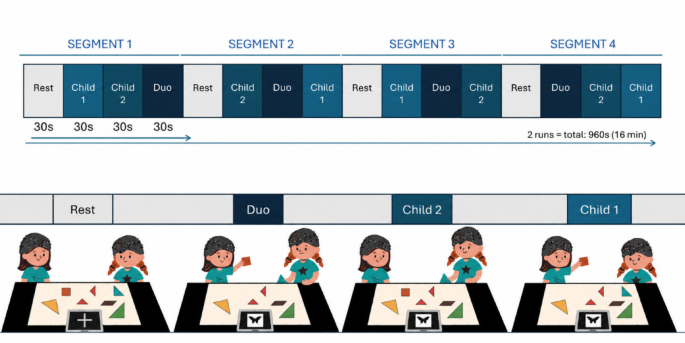
The present study yielded three main findings. First, dual-child fNIRS hyperscanning was feasible during a physically interactive and behaviorally demanding task. Second, the Duo condition produced a marked increase in manual-action frequency and duration, confirming that collaboration constituted a behaviorally distinct experimental state. Third, this behavioral differentiation was not accompanied by a reliable condition-level increase in global or regional inter-brain coupling. A focal exploratory analysis nevertheless showed that between-dyad variation in global Pearson coupling during Duo covaried with broader session-level manual activity. This association was supported by permutation inference, a bootstrap interval excluding zero, and leave-one-dyad-out stability, but did not survive correction across the expanded brain-behavior family and was weaker for collaboration-specific activity.
Dual-child hyperscanning in naturalistic tasks
A primary contribution of this work is extending the application of fNIRS hyperscanning deployed in pairs of school-aged children engaged in a cognitively demanding, physically interactive task. This extends feasibility demonstrations previously shown in adult dyads during collaborative or competitive tasks (Baker et al. 2016; Czeszumski et al. 2021) and aligns with emerging evidence that fNIRS is particularly well suited to naturalistic child-child paradigms (Bonnaire et al. 2024; Zhou et al. 2025; Nelson et al. 2025). By preserving ecological validity while maintaining data quality, our findings support ongoing shifts in developmental neuroscience toward studying children in social contexts rather than artificial laboratory constraints. This methodological advance may facilitate broader adoption of hyperscanning in research on collaborative learning, joint attention, and peer interaction. In addition, these findings provide a step toward integrating hyperscanning approaches into classroom research frameworks, where embodied collaboration is central to learning dynamics.
Neural activation during collaborative problem solving
The revised activation analyses did not provide confirmatory evidence of posterior-parietal recruitment during collaboration. The prespecified posterior-parietal ROI did not differ significantly from baseline after dyad-level inference, and the positive effect observed at channel 17 did not survive channel-wise FDR correction. Nevertheless, its moderate effect size, anatomically plausible location, and opposite-direction HbO-HbR pattern identify a provisional spatial hypothesis for future studies.
The peak channel (CH 17, CP4-CP6) was located over an approximate posterior-parietal region implicated in visuospatial processing, object manipulation, and the integration of perception and action. Its moderate effect size and anatomical plausibility therefore identify a provisional spatial hypothesis for future studies. However, the effect was sensitive to the removal of individual dyads, and the available montage and sample do not permit precise localization or attribution to a specific functional network. Posterior parietal regions are widely implicated in integrating perception and action during object manipulation and spatially guided behavior (Wilson and Knoblich 2005; Sebanz et al. 2006; Glenberg 2008), and the parieto-frontal mirror system has been involved in executing actions, predicting, and interpreting others' physical actions in shared space (Rizzolatti and Sinigaglia 2010). The Tangram task required participants to monitor the shared workspace and provided opportunities to adjust their actions in relation to their partner. The observed activation is therefore consistent with increased demands on visuomotor activity during collaborative manipulation compared to baseline.
Within the joint action literature, coordinated behavior has been proposed to rely on the alignment between observed and executed movements (Wilson and Knoblich 2005; Sebanz et al. 2006). In this framework, posterior parietal activity may reflect the integration of visual information about a partner’s actions with one’s own motor planning processes, supporting temporally organized interaction. Importantly, the present data do not allow attribution to a specific functional network. fNIRS measures superficial hemodynamic signals with limited spatial specificity and substantial inter-channel covariance (Pinti et al. 2020; Yücel et al. 2021). Therefore, the current findings are compatible with accounts in which social coordination emerges from domain-general sensorimotor coupling during joint behavior (Hari et al. 2015; Redcay and Schilbach 2019).
Condition-level stability in inter-brain connectivity
Contrary to initial expectations, global IBC did not vary significantly across experimental conditions. Rather than contradicting prior hyperscanning findings in adults (Nozawa et al. 2016), this result suggests that inter-brain coupling is not necessarily a categorical marker of task type. Instead, it may depend on the temporal structure of interaction, consistent with evidence that IBC reflects dynamic social alignment over time (Dai et al. 2018; Wass et al. 2020).
Several factors may contribute to the absence of condition-level effects. First, developmental variability may increase heterogeneity in neural coordination across dyads, making global condition contrasts less sensitive in children (Sheridan et al. 2014). Second, the large-scale, channel-agnostic IBC metric used here summarizes widespread cross-brain covariance, which likely includes both interaction-related and condition-invariant components. Such aggregation can reduce sensitivity to categorical contrasts while potentially retaining sensitivity to stable between-dyad differences.
Accordingly, the absence of a condition-level effect does not exclude meaningful between-dyad variation in coupling during collaboration. The focal brain–behavior association suggests that a block-wise global Pearson measure may capture differences among dyads that are not expressed as a uniform categorical contrast between experimental conditions. However, the current data do not establish that IBC is a general index of manual activity, because the association was exploratory, did not survive the expanded multiplicity correction, and was weaker when behavior was restricted to the Duo condition. The condition-level and correlational analyses therefore address complementary questions: the former asks whether collaboration produces a uniform increase across dyads, whereas the latter asks whether variation among real dyads covaries with behavioral engagement.
Exploratory association between block-wise inter-brain coupling and dyad-level manual engagement
During the collaborative condition, the IBC was positively associated with behavioral engagement, specifically the number of actions performed on the Tangram pieces. This pattern is compatible with the possibility that between-dyad differences in behavioral engagement covary with block-wise neural coupling (Hasson et al. 2012; Redcay and Schilbach 2019). In developmental contexts, neural and behavioral synchrony have been discussed in relation to scaffolding and co-regulation (Hoehl et al. 2021). The present results indicate that dyads with greater overall manual activity tended to show higher global coupling during the Duo condition.
Importantly, this association suggests that dyads with greater overall task-related manual activity exhibited higher global block-wise cross-brain covariance during collaboration. Such a pattern is compatible with frameworks emphasizing embodied coordination and perception–action coupling (Glenberg 2008; Gallese 2014; Kontra et al. 2015) as well as interactive approaches to social neuroscience (Schilbach et al. 2013), without implying that identical cognitive processes occurred simultaneously in both participants.
Our results also relate to the distinction between co-action and joint action described in adult hyperscanning research. Previous studies indicate that simultaneous presence or parallel activity alone may be insufficient to produce robust inter-brain synchrony (Cui et al. 2012; Cheng et al. 2015). Because mean global coupling did not differ among observation, individual action, collaboration, and rest, the present data do not isolate social presence or collaboration as categorical determinants of the global IBC measure. The exploratory association was observed for the global Duo coupling score, but the behavioral variable showing the strongest relationship represented total session-level activity rather than a direct measure of continuous reciprocal adjustment. This observation is compatible with the proposal that social interaction can be understood in terms of coordinated action dynamics (Konvalinka and Roepstorff 2012).
From a developmental perspective, the exploratory association raises the possibility that stable differences in dyad-level engagement are related to inter-brain measures during peer collaboration. Given that collaboration supports learning in children (Warneken 2018; Tomasello 2019), these findings may help constrain hypotheses about when alignment-like neural signatures emerge during peer interaction, potentially during hands-on, jointly coordinated activity. Accordingly, the results motivate future classroom research but should not be interpreted as direct evidence for learning.
Limitations and future directions
Several methodological considerations should be noted when interpreting the present findings. First, although fNIRS is relatively tolerant to motion, the naturalistic, hands-on nature of the task inevitably elicited head movements. While careful signal processing was applied, managing motion artifacts remains an inherent challenge in unconstrained experimental settings. Second, our participants' age range spans a period of significant neurocognitive development, which likely introduced natural variability in executive function, social cognition, and collaborative skills. Third, the sensitivity analysis indicated that the sample could reliably detect only large effects. It limited our capacity to model more subtle variables, such as developmental trajectories or sex-composition effects. Additionally, dyads were formed by classmates; while this reflects typical peer interactions, relationship closeness was not formally quantified. Pre-existing familiarity may have facilitated collaboration, thereby increasing between-dyad heterogeneity. Moreover, the inherent variation in Tangram puzzle difficulty may have resulted in fluctuating cognitive demands across dyads and conditions. Regarding behavioral analysis, manual activity was coded by a single investigator, precluding the assessment of inter-rater reliability. Finally, our design deliberately prohibited speech and intentional gestures to reduce communication-related confounds. While this was necessary to isolate the effects of shared manual action, it constrained the ecological validity of the task and may have attenuated neural coupling that would otherwise emerge during unconstrained peer communication. The present conclusions therefore apply specifically to nonverbal, object-mediated collaboration.
Given the partial sensitivity of the CH17 finding to the multiple-comparisons strategy, we treat this localization as a promising but provisional result. The moderate effect size and anatomical plausibility motivate targeted follow-up studies to confirm localized posterior-parietal recruitment during collaborative embodied tasks. Furthermore, the lack of independent measures of executive function or social-cognitive skills limited our ability to connect neural coupling to individual developmental differences. Lastly, the small sample size limits statistical power and the generalizability of the findings.
Moreover, a recent meta-analysis suggests that children's age and brain regions are significant predictors of effect size in parent–child research (Zhao et al. 2024). Future research should involve larger, developmentally focused samples and incorporate additional behavioral assessments to refine and expand these findings. It should also examine developmental trajectories by including a broader age range of children and comparing contexts, such as collaborative versus competitive settings, to evaluate how neural response coupling varies across tasks.


Comments (0)