
Remember me




This study used pooled repeated cross-sectional data from the Scottish Health Survey conducted in 2018, 2019, 2021 and 2022. The survey uses multistage stratified probability sampling of people living in private households in Scotland. The 2020 experimental telephone survey was excluded because its shortened questionnaire and altered methodology were not comparable with the standard waves. The 2018, 2019 and 2022 surveys used primarily face-to-face household interviewing, whereas the 2021 survey used an opt-in telephone approach and a different sampling process during the COVID-19 pandemic; the change in mode may have affected comparability (Scottish Government 2022, 2023).
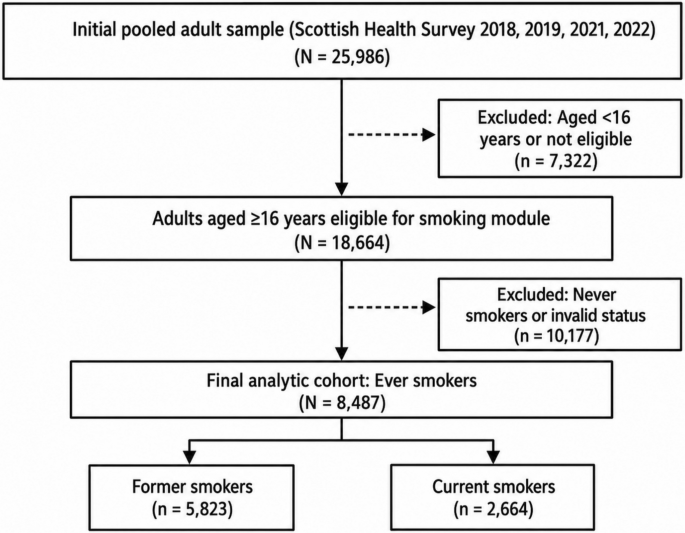
Study populationThe pooled source sample comprised 25,986 respondents across the four included survey years. Respondents aged younger than 16 years or otherwise ineligible for the smoking module were excluded (n = 7322), leaving 18,664 respondents aged 16 years or older. We then excluded respondents who had never smoked cigarettes or had invalid, missing or non-analytic smoking-status codes (n = 10,177). The analytic sample comprised 8487 ever cigarette smokers: 2664 current smokers and 5823 former smokers (see Fig. 1).
Fig. 1
Flow diagram showing derivation of the analytic sample from the pooled Scottish Health Survey waves (2018, 2019, 2021 and 2022). Of the initial pooled adult sample (N = 25,986), respondents aged younger than 16 years or otherwise not eligible for the smoking module were excluded (n = 7322). Of the remaining 18,664 adults, respondents who reported never having smoked cigarettes or who had invalid or missing smoking status codes were excluded (n = 10,177), leaving a final analytic sample of 8487 ever cigarette smokers, comprising 2664 current smokers and 5823 former smokers
Smoking cessation productsEver cigarette smokers were asked which products they had used during their most recent attempt to stop smoking. The seven products examined were nicotine gum, nicotine patches, nicotine inhalers or nasal sprays, nicotine lozenges or microtabs, varenicline (for example, Champix), bupropion (for example, Zyban), and e-cigarettes or vaping devices. Respondents could report more than one product within the same quit attempt. The survey did not establish whether multiple products were used simultaneously, sequentially or at different stages of the attempt. Unassisted quitting, behavioural support and methods outside these seven products were not examined.
Retrospective self-attributed helpfulnessFor each product reported as used, respondents were asked whether it had helped them stop smoking for at least 1 month. The outcome was coded as helpful when the respondent attributed at least 1 month of abstinence to the product. Respondents who reported using a product but whose reported abstinence lasted < 1 month were classified as not reporting the product as helpful. Refusal, don’t-know and other non-substantive responses were excluded from the product-specific denominator. This outcome captures retrospective attribution of short-term abstinence and does not establish sustained cessation, causal effectiveness or comparative efficacy.
Smoking statusSmoking status was measured at the survey interview. Current smokers reported smoking cigarettes at interview, while former smokers reported having stopped. Because smoking status occurred after the quit attempt and reflects sustained cessation or subsequent relapse, it was used only as a descriptive stratification variable. It was not treated as a baseline effect modifier, and no causal interpretation was assigned to current-versus-former differences.
CovariatesCovariates were age group (16–44, 45–64 and 65 years or older), sex (male or female), Scottish Index of Multiple Deprivation 2020 quintile (least deprived, fourth, third, second and most deprived), and survey year (2018, 2019, 2021 and 2022). These variables were selected a priori to describe demographic patterning and to account for compositional differences between survey waves.
Statistical analysisAll estimates incorporated the survey weights, strata and primary sampling units. A pooled individual weight was constructed by assigning the combined adult interview weight int17181921wt to respondents from 2018, 2019 and 2021 and the 2022 adult interview weight int22wt to respondents from 2022. The wave-specific weights were concatenated at respondent level rather than summed. Because the weights in each wave were already centred close to 1, no additional normalisation was applied. Pooled strata and primary sampling unit identifiers were made unique by crossing each original identifier with survey year. Single-unit strata were centred at the grand mean for variance estimation.
Sample characteristics were presented as unweighted counts with survey-weighted column percentages. Differences between current and former smokers were assessed using survey-design-adjusted Pearson tests, with design-based F-test p values reported. For each product, survey-weighted proportions and 95% confidence intervals were calculated among respondents with an analysable helpfulness outcome. Helpfulness was then estimated separately by smoking status. Absolute former-minus-current differences and 95% confidence intervals were obtained from survey-weighted linear probability models.
Product-use patterns were derived from the selected-product indicators for the most recent quit attempt, not from the presence of a helpfulness response. Pattern analyses were restricted to respondents who reported at least one selected product and had an analysable outcome for every product reported. We estimated the weighted distribution of common patterns and the weighted proportion reporting at least one helpful product within each pattern. These estimates were descriptive. We did not model the number of products against at least one helpful product because reporting more products mechanically increases the opportunity to endorse at least one as helpful.
Exploratory demographic correlates were examined using separate survey-weighted logistic regression models for nicotine gum, patches, inhaler or nasal spray, lozenge or microtab, varenicline and e-cigarettes or vaping devices. Each model mutually included age group, sex, SIMD quintile and survey year. Global associations were assessed using design-adjusted Wald tests. Bupropion was excluded from these models because only 91 respondents had an analysable outcome, providing insufficient precision for a stable multivariable model. No adjustment was made for multiple testing; emphasis was placed on global tests and consistency rather than isolated category-specific p values.
Analyses were conducted using StataNow version 19.5 (StataCorp, College Station, TX, USA). All tests were two-sided. The product-specific regressions and pattern estimates were considered exploratory, and all findings were interpreted as descriptive associations rather than causal effects.
Comments (0)