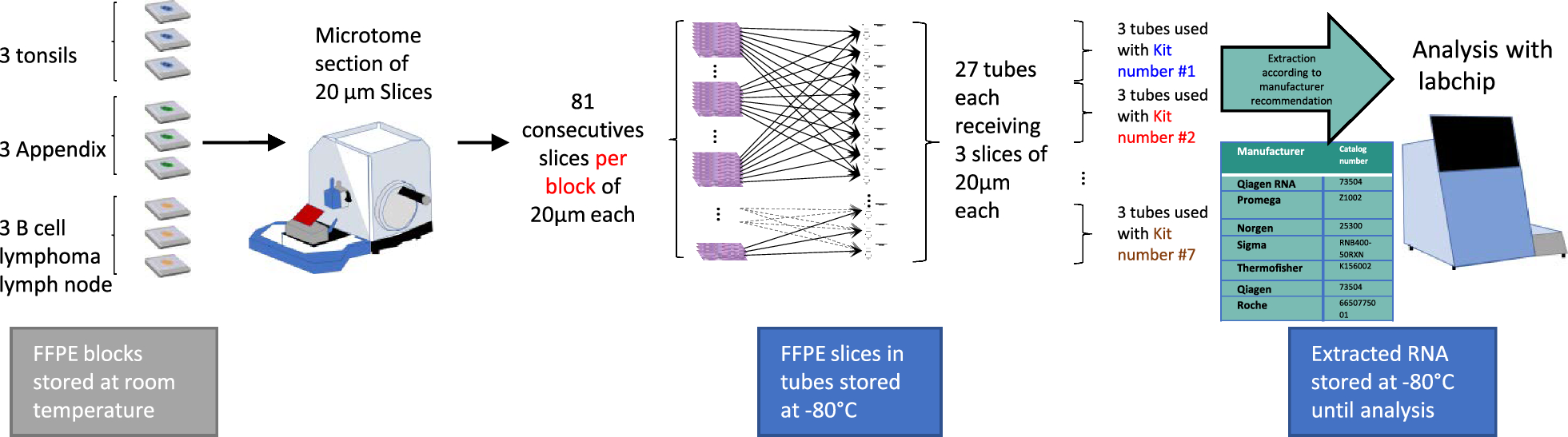
When extracting RNA from FFPE samples for RNA sequencing or RT-PCR, multiple parameters must be taken into consideration, including the quantity and quality of RNA recovered to allow proper sequencing and coverage for correct data analysis. In the study presented, some kits were systematically outperformed by others, both in terms of quality and quantity recovered. Among them, the historically commonly used kit from Qiagen (both RNA-specific and ALL PREP) was a surprise to us.
In terms of quantity recovered, the Promega kit performed better on average than any of the other kits, but this could have come at the expense of quality of the recovered RNA in some samples. Therefore, in cases of small biopsies or small samples, this kit might be the best choice to maximize the recovery rate. However, it is important to note that in some cases, we observed large standard deviations in the quantity recovered between triplicates of the same sample (including with Promega). Our hypothesis is that in some cases, the column used can be slightly clogged, resulting in less volume recovered after final centrifugation and therefore, higher concentration. This would not affect the quality of the RNA recovered, explaining why less variation was observed in terms of RQS and DV200.
On the other hand, if sample size is not an issue, and the choice is made to maximize the quality of the sample, one might consider using the Roche kit, which provided a nearly systematic better-quality recovery than other kits.
When trying to identify the best compromise between quantity recovered and quality recovered, a score was created, taking into account both quantity recovered and quality (as measured by DV200). In that analysis, it was observed that Promega gave a significantly better compromise than other kits.
It is very important to notice that while we chose to use the minimum elution volume recommended for each kit, increasing the elution volume often can result in increased recovery of RNA with lower concentration.
In our study, we used relatively recent samples, less than one year old. However, Ahlfen et al. reported that older FFPE samples typically exhibit poorer RNA quality compared to newer ones [14]. Testing these kits with samples of various ages, including decades-old specimens, could be valuable to evaluate recovery efficiency on more degraded samples.
In any case, the quality and quantity of RNA recovered can vary greatly between tissue types and samples, likely due to factors such as protein content, fixation parameters, or cell types present within the sample. The standard practice of tissue fixation can vary considerably between institutions and laboratories, and it is important to evaluate the impact of fixation time on the quality and quantity recovered with various kits. Additionally, the thickness of the section used can also affect the results. Some studies have shown that sections with a thickness of 10 µm or more perform better than finer sections, but too thick sections > 40um might give opposite results [15, 16]. In each laboratory specific settings, some kits that have been shown to perform not so well in this study, have perform better than their competitors. To get the best results for a specific type of tissue and sample, it is advisable to test a variety of kits. Indeed, when comparing our results to the literature, our analysis was conducted on fewer samples than that of Gouveia et al. [17], but we evaluated more commercially available kits. There are also other kits available on the market, and our study does not represent an exhaustive list of the possibilities offered to researchers and clinicians. Other studies have identified alternative kits that performed better with their tested samples. For instance, Boeckx et al. found that Qiagen kits outperformed the alternatives they tested [18] although none of those alternative kits were included in our analysis. Similarly, Hafezi et al. demonstrated that the Qiagen RNeasy FFPE Kit showed superior performance compared to other tested alternatives (not included in our study) [19]. Finally, Patel et al. concluded that the Qiagen AllPrep kit outperformed the kits they tested, including the PureLink FFPE RNA Isolation Kit (Thermo) and the High Pure FFPET RNA Isolation Kit (Roche), which we also tested and found to perform better than the Qiagen AllPrep kit [20].
In our experimental setup, we did not perform RT-PCR or RNA sequencing to validate the quality of the recovered RNA. Having performed the nucleic acid analysis of all the samples at the same time, we believe that this ensures a reliability of our comparison. Also, for us and many other institutions nucleic acid analysis serves as an excellent preliminary assessment tool. It ensures that only high-quality RNA samples are selected for more detailed and expensive downstream applications, such as sequencing. Nucleic acid analysis is a robust and efficient method for evaluating RNA quality and quantity. It provides comprehensive data on RNA integrity and concentration, making it sufficient for the initial assessment of RNA samples.
Although some reports, such as Marczyk et al. [21], have documented that the choice of RNA purification kit from FFPE samples does not significantly influence the overall quality of results from whole transcriptome RNA sequencing, it is important to note that while RNA can be recovered in acceptable quantity and quality (assessed by RQS and DV200), there can still be residual contaminants and formalin adducts that could inhibit PCR and reverse transcription.
Typically, to remove formalin adducts, heat is applied during the extraction protocol, but this also causes RNA fragmentation. All the kits we tested use heat application in that regard. Therefore, kits that apply less heat might yield RNA that appears more intact in electrophoresis assays (RQS and DV200), but this RNA may be less suitable for RT-PCR and PCR (and consequently sequencing) due to less effective removal of formalin adducts. When comparing the recommended heat strategies across the different kits tested here, we found that the Promega procedure, which provided us with the best combination of RNA quantity and quality, also used the longest and highest heat application, thereby reducing the potential risk of residual formalin adducts the most. Despite reports such as Marczyk et al. [21] suggesting that kit selection does not influence RNA-sequencing quality, it is also reported that with modifications in temperature and incubation time, some kits could perform better on specific tissue types [19], stressing once more the need of testing and optimalisation for each tissue type and each institution.
All kits tested in this study use nuclease-free water for RNA recovery; however, extraction procedures and cleaning steps may impact any residual contaminants in the final RNA eluate. We did not evaluate the long-term impact of these residues on RNA storage stability, but it is recommended to use the extracted RNA shortly after extraction and avoid extended storage. The value of using FFPE samples lies in their extended room-temperature storage capacity, minimizing RNA degradation concerns typically associated with fresh samples [22].
When conducting large-scale extractions or routine isolations in pathology laboratories, the per-sample cost may become a significant consideration. While the cost difference per sample (reported in Table 1) may seem minor for small-scale analyses (ranging from $7.9 for the least expensive to $16.12 for the costliest), it can be impactful in larger-scale operations. It is challenging to directly compare the cost of the Qiagen AllPrep kit, as it extracts both DNA and RNA, whereas other kits would require an additional purchase to obtain DNA. The prices shown are based on our institution's rates, which may vary by location. Notably, the Promega kit, which provided superior results in both RNA quality and quantity, but not the cheapest, priced at approximately 12% more expensive than the cost of the Thermo Fisher kit. The latter yielded comparable DV200 quality and a slightly higher RQS score than the Promega kit. Therefore, institutions may wish to evaluate their own pricing and consider whether quality and cost should take precedence over quantity, particularly when large sample sizes are available. While these manual protocols require similar hands-on times, and thus similar personnel costs, the wide range of incubation times (shown in Tables 1 and 2) could be a factor to consider. Longer incubation times may provide flexibility for multitasking, whereas shorter incubation times may require closer attention.
Finally, some companies offer automated systems that employ similar procedure as the one tested in manual kits here. Automation can be particularly useful when analysing larger cohorts or ensuring better reproducibility. Automated systems streamline the RNA extraction process, reducing human error and variability, which is crucial for consistency across numerous samples. This standardization leads to more reproducible results and higher throughput, allowing researchers to process more samples in less time. Finally, cost considerations related to the purchase of instruments and associated kits may also be relevant when planning routine or large-scale operations. Automated systems also minimize hands-on time, freeing up laboratory personnel for other tasks, and often include advanced software for real-time monitoring and quality control, ensuring the integrity of the RNA extraction process.




Comments (0)