
Remember me
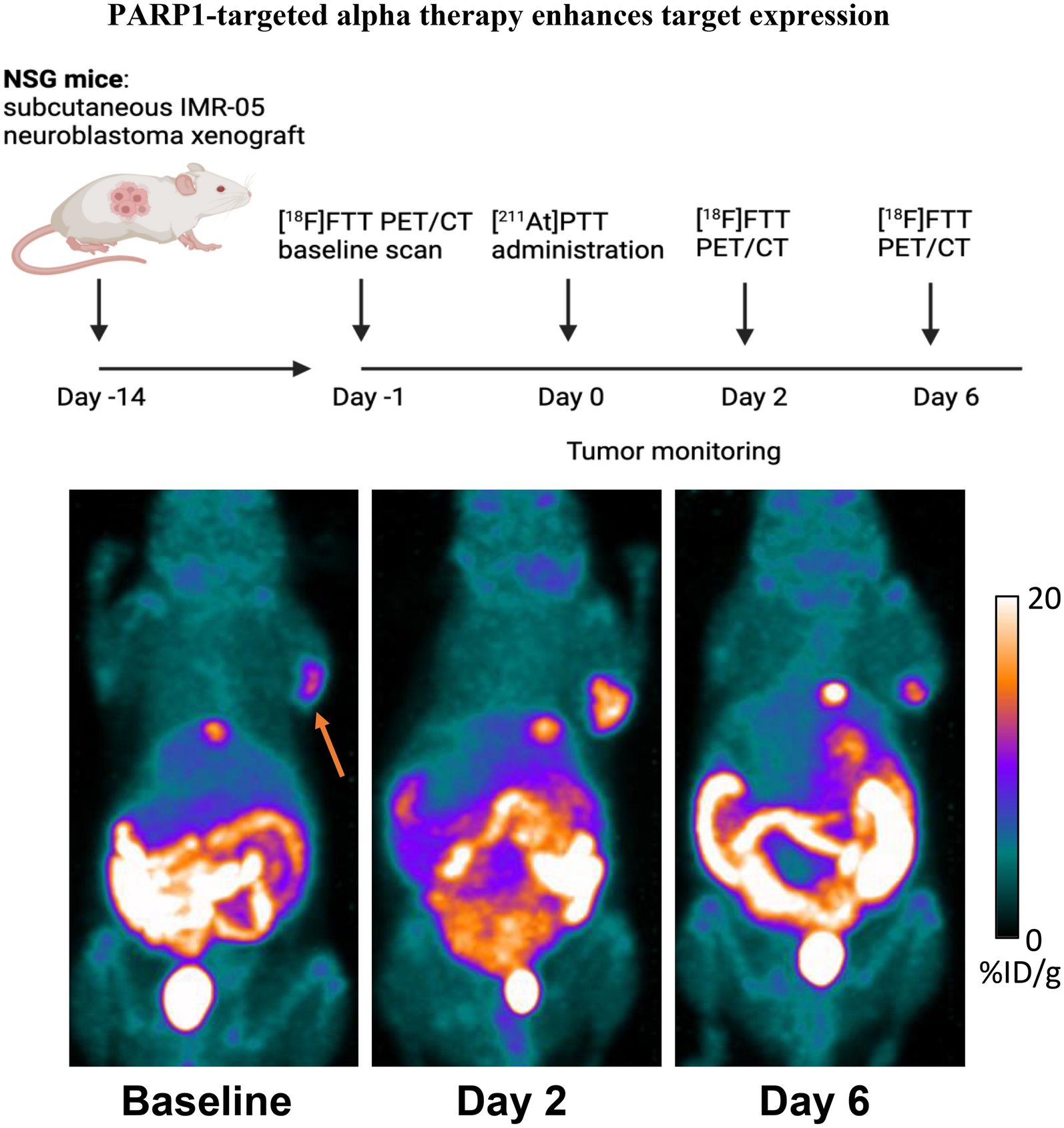

We investigated whether [211At]PTT therapy induces transient upregulation of PARP1 expression in neuroblastoma xenografts and whether this effect could be quantitatively visualized using [18F]FTT PET/CT imaging. IMR-05 tumor-bearing mice (n = 9) were divided into a baseline group (n = 3, sacrificed after initial imaging) and a treatment group (n = 6) receiving [211At]PTT. Baseline measurements established pre-therapy PARP1 expression and tumor volume, while treated mice underwent longitudinal imaging and analysis. The study design for the [18F]FTT/[211At]PTT in vivo experiment is depicted in Fig. 1a. All 9 mice underwent [18F]FTT PET/CT imaging at baseline, 5 mice were imaged on day 2 (the PET images from 1 mouse were not evaluable and it was excluded), and 3 mice were imaged on day 6. PET/CT imaging with [18F]FTT with representative baseline and post-treatment images following [211At]PTT, are shown in Fig. 1b. Tumor uptake of [18F]FTT was quantified for each animal, and the percent change in tumor volume was also assessed. As shown in Fig. 1c, [18F]FTT tumor uptake was 8.6 ± 3.5%ID/g at baseline, 11.6 ± 4.8%ID/g on day 2, and 8.5 ± 4.6%ID/g on day 6. Pairwise comparisons indicated that [18F]FTT tumor uptake increased by 34.1% from baseline to day 2 (mean difference: 3.0%ID/g, p = 0.03), followed by a return towards baseline levels by day 6 (mean difference between baseline and day 6: -0.2%ID/g, p = 0.51).
Fig. 1
Preclinical imaging and therapy in IMR-05 xenograft mouse model. a Schematic of the preclinical study design evaluating the efficacy of a single 370 kBq dose of [211At]PTT with [18F]FTT PET/CT imaging. b Representative [18F]FTT PET/CT maximum-intensity projection images of tumor-bearing mice at baseline and post-[211At]PTT treatment, showing elevated tumor uptake (arrow) at day 2 compared to baseline. c Quantification of [18F]FTT tumor uptake over time, demonstrating a significant increase from baseline to day 2 (2-way ANOVA with Tukey–Kramer multiple comparisons test), followed by a return to baseline levels by day 6. Data are presented as mean ± SD (n = 3–9 per group)
Analysis of tumor size over time showed that mean tumor volumes decreased by 11.8% from baseline to day 2, and by 77.2% from baseline to day 6 post-treatment, which represented a significant response to therapy (Fig. 2a). Overall, treated mice across all groups maintained a healthy weight throughout the study, defined as 100 ± 20% of their initial body weight (Fig. 2b). The [211At]PTT treatment and serial [18F]FTT PET/CT imaging were well-tolerated, with no observable adverse effects.
Fig. 2
In vivo effect of single dose of [211At]PTT in IMR-05 xenograft mouse model. a Tumor volume measurements over time show significant reductions by day 6, as analyzed by 2-way ANOVA with Tukey–Kramer multiple comparisons test. b Mouse body weight remained stable across all time points. Data are presented as mean ± SD (n = 3–6 per group)
Immunofluorescence analysis of tumors harvested from three mice at each time point (baseline, day 2, and day 6) confirmed comparable levels of nuclear PARP1 expression at baseline and day 6, with minimal γH2AX staining observed at baseline. Specifically, at day 2, a significant increase in γH2AX staining was detected (p = 0.0004), along with overlapping increase in PARP1 expression (p = 0.0001), indicating activation of the DNA damage response (Fig. 3a and b). This transient upregulation of PARP1 expression and DNA damage response was consistent with the increased [18F]FTT uptake observed on day 2, with both PARP1 expression and [18F]FTT uptake returning to baseline levels by day 6, further supporting the strong correlation between imaging findings and molecular markers of PARP1 activity (Pearson’s r = 0.73, p = 0.02) (Supplementary Fig. S3).
Fig. 3
Immunofluorescence analysis of PARP-1-mediated DNA damage induced by [211At]PTT. a Representative images of tumor sections from mice treated with [211At]PTT, resected at the indicated time points. Scale is 50 µm. b Quantification of PARP1 and γH2AX expression in tumor sections from treated and non-treated mice. Data are presented as mean ± SD. Significant differences in PARP1 (p = 0.0001) and γH2AX expression (p = 0.0004) were observed between treated and non-treated groups on day 2 (2-way ANOVA with Tukey–Kramer multiple comparisons test)
In IMR-05 cells treated with [211At]PTT, PARP1 expression responded differently as doses increased. At the lowest dose (3.7 kBq/mL), PARP1 expression began to upregulate, peaking at 6–24 h post-treatment before declining by 48 h, while at intermediate doses (9.25, and 18.5 kBq/mL) PARP1 expression peaked at 6 h, and at the highest dose (37 kBq/mL) expression peaked at 3 h. At 3.7 kBq/mL, expression increased relative to untreated controls by 1.64-fold (± 0.80) at 3 h, 2.53-fold (± 1.03) at 6 h, and 1.76-fold (± 0.65) by 48 h. At 9.25 kBq/mL, expression increased by 2.33-fold (± 0.60) at 3 h, 3.16-fold (± 1.08) at 6 h, and 1.81-fold (± 0.76) by 48 h. At 18.5 kBq/mL, expression increased by 2.50-fold (± 1.07) at 3 h, 3.29-fold (± 1.26) at 6 h, and 1.17-fold (± 1.09) by 48 h. In contrast, the highest dose (37 kBq/mL) induced an early peak at 3 h with an increase of 3.13-fold (± 0.99), followed by an increase of 2.37-fold (± 1.05) at 6 h and 0.88-fold (± 1.20) by 48 h, reflecting greater cytotoxicity (Fig. 4a). This balance of PARP1 overexpression, with lower doses eliciting a delayed peak and the higher dose driving an earlier peak, highlights the potential for fractionation to optimize therapeutic outcomes.
Fig. 4
PARP1 expression and total RNA yields in IMR-05 cells treated with [211At]PTT a Relative PARP1 gene expression (2−ΔΔCt values, fold change relative to untreated control, normalized to B2M) across doses (3.7, 9.25, 18.5, and 37 kBq/mL) at 3, 6, 24, and 48 h. b Total RNA yields over the same time points and doses, compared to untreated controls, exhibiting an early peak at 6 h followed by a sharp decline by 24 and 48 h. Data represent the mean ± standard error of four replicates (n = 4) per condition.
Similarly to PARP1 expression, total RNA yields in IMR-05 cells treated with [211At]PTT varied over time (Fig. 4b). In untreated controls, RNA yields rose steadily from 3 to 48 h due to cell proliferation. In treated cells across all doses (3.7–37 kBq/mL), RNA yields increased peaking at 6 h, before declining by 24 and 48 h, indicative of progressive cell death. These data suggest that timing and dose fractionation could modulate PARP1 expression to enhance efficacy while minimizing toxicity, though further studies are needed to determine the optimal regimen for fractionated dose administration.
Comments (0)