
Remember me



A retrospective chart review was performed on 106 Wilson patients who had undergone LT at the affiliated hospitals of Shiraz University of Medical Sciences over 6 years. One-hundred and six adult and pediatric recipients were included in the analysis, with a mean follow-up duration of 21 ± 1.8 months, based on the LT date. The mean age of adult and pediatric recipients was 33.1 and 10.8 years, respectively. Chelation therapy was administered to all patients before transplantation. In the pediatric patients, the majority (87.9%) received Penicillamine, while a smaller percentage (9.3%) were treated with Trientine. Among adult patients, Penicillamine was the medication of choice for chelation therapy. Liver biopsies were performed in a subset of patients to support the diagnosis of Wilson disease when clinically feasible. In patients with severe coagulopathy or encephalopathy, the diagnosis was established based on clinical, biochemical, and radiological criteria, in accordance with standard practice. Following transplantation, histological evaluation of liver explants was conducted in all patients, providing confirmation of Wilson disease and assessment of liver pathology. All liver transplants were performed with ABO-compatible donors. In 4% of cases, compatibility was partial, involving subgroup matches within the ABO blood group system. Of 106 patients, 22 cases had living donor LT (LDLT), and 84 by deceased donor LT (DDLT). None of them needed a second liver transplant. All patients underwent liver transplants by a standard protocol using the piggyback, standard, left lobe, or segmental operation technique. No intraoperative complications were documented among all patients. All patients received immunosuppressive therapy, which included high-dose steroids (prednisolone), early start of Calcineurin inhibitors (tacrolimus), and in some cases mTOR inhibitors (sirolimus). Recipients, donor demographics, and clinical characteristics are summarized in Table 1.
Table 1 Demographic, clinical, and transplant-related characteristics of Wilson disease patients (n = 106)Preoperative clinical characteristicsA definite diagnosis of Wilson disease was made in all 106 patients based on a broad combination of laboratory tests, liver biopsy and clinical features including 24 h urine copper, a severe coagulopathy, serum level of ceruloplasmin, Kayser-Fleischer rings (KF rings), presence of ATP7B gene mutation, and neurological symptoms. In this context, “severe coagulopathy” referred primarily to liver-related coagulopathy associated with chronic advanced liver disease or cirrhosis due to Wilson disease. While hemolytic anemia is a recognized manifestation of copper toxicity, it was not specifically used as a diagnostic criterion for Wilson disease in this study. All the patients presented with a decreased level of serum ceruloplasmin (mean: pediatrics, 1.37 ± 2.1; adult, 1.32 ± 6.1) and an increase of 24-h urinary copper excretion (mean: pediatrics, 225.9 ± 0.9; adult, 276.1 ± 3.6). The KF rings were observed in 40.6% of pediatric and 25% of adult patients. In most of the patients, alanine aminotransferase (ALT) activity was elevated moderately if at all raised (range 14–682 U/L); the same was the result for aspartate aminotransferase (AST) activity (range 17–980 U/L). The mean of WBC and PLT was lower than average. However, prothrombin time (PT), INR, and total bilirubin were high in pediatrics (18.9 ± 0.9, 1.45 ± 0.1, and 4.4 ± 0.3, respectively) and adult patients (19.7 ± 1.3, 1.50 ± 0.1, and 2.2 ± 0.3, respectively). The onset presentation in 98% of patients was hepatic in nature. In 2% of patients, primarily adults, a neurological presentation was observed, which was combined with the hepatic form and included symptoms such as rigidity and ataxia in varying combinations. The detailed onset clinical presentations were as follows: 98 (100%) hepatic, 2 (25%) neurological and hepatic features (observed only in adults). The most common indication of LT in the pediatric and adult Wilson patients was acute liver failure with 54.1% and 75% respectively. The critical laboratory data are listed in Table 2.
Table 2 Key laboratory and clinical findings for Wilson patients (n = 106) pre- and post-transplantPostoperative main findingsPost-transplantation, the average serum ceruloplasmin level and urinary copper excretion returned to normal, with serum ceruloplasmin increasing to 15.6 mg/dL and urinary copper decreasing to 32.3 µg per 24 h after 2 months. Other factors including AST, ALT, and ALK also decreased (61.1, 49.9, and 156.3 IU/L, respectively). The mean of PT, PLT, WBC, BUN, Alb, and INR in all patients was normal. All differences between pre- and post-transplantation data in both adults and pediatric patients were highly significant, except for the creatinine level in adults (p = 0.87). Hence, the difference in the presence vs. absence of KF rings in adults was insignificant, possibly due to the small sample size. Established cirrhosis was observed in the majority of patients (n = 96, 98%) on explant liver histopathological examination (Table 2).
Postoperative neurological outcomesAlthough many patients experienced improvements in neurological manifestations post-transplantation, a subset developed new neurological symptoms or experienced a relapse of pre-existing ones. Specifically, seven patients without neurological symptoms prior to the transplant developed new symptoms, including mild encephalopathy, tremors, and dysarthria. Six months post-transplant, four patients developed mild encephalopathy, two exhibited tremors, and one developed dysarthria. Additionally, among the seven patients with pre-existing neurological symptoms, manifestations such as rigidity and ataxia improved following LT.
Postoperative mortality and survival ratesDuring the four-year follow-up post-transplant, a total of 16 out of 106 patients passed away due to both hepatic and non-hepatic causes. No mortality was observed within 30 days post-transplantation. In pediatric patients, mortality occurred in 6 cases (6.1%) within 6 months, 3 cases (3.1%) within 1 year, and 2 cases (2.0%) within 3 years. In adult patients, mortality was observed in 3 cases (37.5%) 6 months, 1 case (12.5%) within 1 year, and 1 case (12.5%) within 3 years. Of those who died due to hepatic causes, 2 patients had coronary artery disease, 3 had pulmonary hypertension, and 7 experienced chronic rejection. While coronary artery disease and pulmonary hypertension are typically considered cardiovascular and pulmonary conditions, they are often associated with liver disease, particularly in patients with cirrhosis or those who have undergone liver transplantation. Coronary artery disease can be exacerbated by liver disease, and pulmonary hypertension is commonly observed in patients with advanced liver disease, often as a complication of portal hypertension. Non-hepatic causes of death included a recurrence of hepatocellular carcinoma (HCC) after liver transplantation in one patient, an infection in one, renal complications in one, and a neurological issue in one. Although HCC is a hepatic malignancy, we have categorized it as a non-hepatic cause of death because it occurred as a recurrence after the liver transplant, indicating a post-transplant malignancy rather than a direct progression of underlying liver disease.
Additionally, the role of chronic and acute rejection episodes in relation to patient mortality should be considered, as both chronic and acute rejection can contribute to graft failure and related complications, potentially leading to patient death. 9 out of 16 had episodes of acute rejection and 7 out of 16 patients had chronic rejection. It was observed that all these patients had elevated levels of AST, ALT, and urinary copper post-LT.
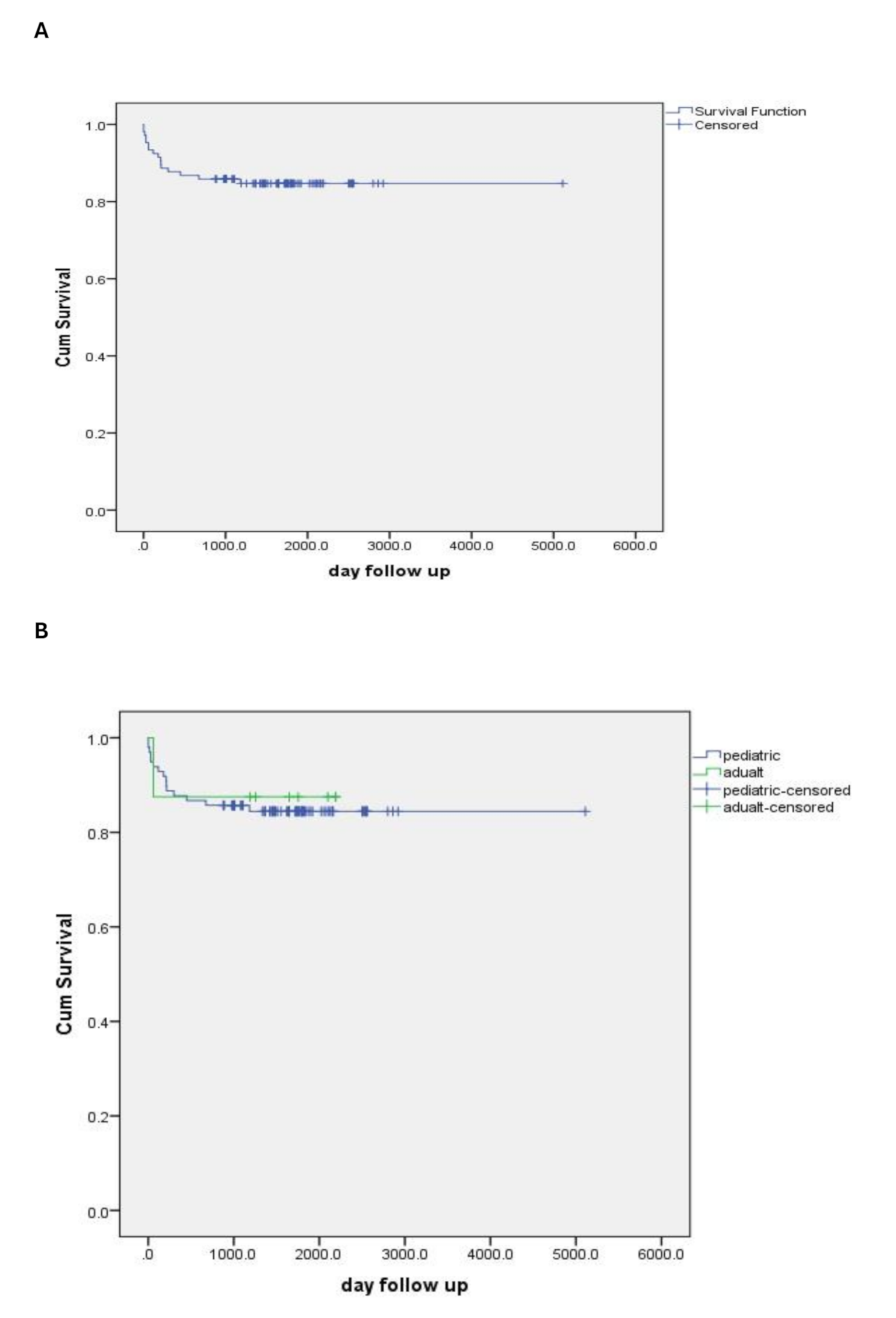
The results demonstrated a favorable prognosis for LT in patients with Wilson disease, with a survival rate exceeding 4 years based on follow-up data for patients. For pediatric patients with Wilson disease, the survival rates at 6 months, 1 year, and 3 years were 97.0%, 96%, and 94.5%, respectively. Meanwhile, adult patients with Wilson disease achieved survival rates of 100%, 100%, and 75% at 6 months, 1 year, and 3 years, respectively (Fig. 1).
Fig. 1
(A) Kaplan–Meier curve depicting overall patient survival following liver transplantation. (B) Kaplan–Meier survival curves stratified by patient group: pediatric patients (blue line) and adult patients (green line)
In the multivariable Cox regression analysis including all patients, none of the examined variables (age at transplantation, gender, donor type, or patient category) were significantly associated with post-LT mortality (P > 0.05). Due to the small number of adult patients (n = 8), a separate Cox regression analysis was performed on the pediatric group (n = 98). Similarly, no baseline characteristics and PELD were identified as statistically significant predictors of survival within the pediatric cohort. These results suggest that, in our cohort, post-transplant survival was not significantly influenced by the evaluated baseline factors.
Comments (0)