
Remember me



A total of 35 participants were included in the study, including 10 pediatric patients with BBS, 13 adult patients with BBS, and 12 caregivers. Baseline characteristics are summarized in Table 1 and Supplementary Table 2, Additional file 1. Pediatric patients had an even gender distribution and a mean age of 12 years (range 6–18). Adult patients were mostly female (62%) and had a mean age of 23 years (range 18–52). All caregivers were parents to children, who had a mean age of 11 years (range 6–18), most of whom were female (67%). The proportion of single parents was 19%, and no grandparents or siblings were involved in direct care in this study cohort. In all three groups, the patients were predominantly German-speaking and of German origin. 46% of patient received their diagnosis of BBS between 0 and 6 years of age, 38% received their diagnosis after the age of 6 years and for 17% of patients, age at diagnosis was not reported.
Table 1 Patient characteristicsAt the time of the survey, all patients were receiving treatment with setmelanotide under care in a specialized center, including pediatric and adult nephrologists and endocrinologists. In addition, in some cases, BBS disease symptoms were supervised and managed in parallel by a general practitioner (15% of adult patients), an ophthalmologist/otolaryngologist (8% of adult patients), or an outpatient pediatrician (33%).
Impairment due to disease symptoms before starting setmelanotide treatmentSurvey participants were asked to recall disease symptoms prior to starting setmelanotide treatment. Insatiable hunger was the most common symptom reported by pediatric patients (80% responded with either 4 or 5 on a 5-point scale, where 1 indicates “does not apply” and 5 indicates “applies to a high degree”), followed by being overweight (50%). For most of the symptoms perceived prior to treatment, a higher percentage of adult patients responded with a 4 or 5 than pediatric patients, and being overweight was reported as a symptom by 69% of adult patients (see Supplementary Fig. 1, Additional file 2). Insatiable hunger in adult patients prior to treatment start could not be reported due to a technical mistake in the survey. The symptoms prior to treatment that were most commonly reported by caregivers were patients being overweight (92%) and having insatiable hunger (83%). It is important to recognize that vision loss was also a significant impairment reported by 92% of adult patients, 75% of caregivers and 30% of pediatric patients (see Supplementary Fig. 1, Additional file 2).
Expectations and concerns before starting setmelanotide treatmentWhen asked to recall their expectations prior to starting therapy, most pediatric patients expected setmelanotide therapy to make them less hungry (90%), reduce body weight or become thinner (90%), and improve QoL (90%) (see Supplementary Fig. 2, Additional file 2). 40% of pediatric patients expected treatment to reduce the burden on their family. Adult patients expected setmelanotide treatment to reduce feelings of insatiable hunger (92%), improve QoL (54%), and reduce body weight (77%). Compared with pediatric patients, adult patients had lower expectations for psychosocial improvements (e.g. minimizing family burden, social exclusion, or bullying). Caregivers generally had greater expectations for treatment than pediatric or adult patients, particularly for improvements in cognitive ability (58%) and absenteeism (25%; see Supplementary Fig. 2, Additional file 2).
Key concerns before starting treatment with setmelanotide among pediatric patients included fear of injections (60%), insufficient effectiveness (30%), side effects (20%), and being left alone with the treatment/injection (20%; see Supplementary Fig. 3, Additional file 2). In adult patients, top concerns prior to treatment included side effects (62%), insufficient effectiveness (31%), and difficult injection preparation (31%). Similarly, caregivers reported that their main concerns were related to side effects (67%), injection fears (50%), insufficient effectiveness (50%), difficult drug preparation (42%), and the time required to administer the drug (33%).
Effects of setmelanotide treatmentAll patients reported treatment effects of setmelanotide, mostly within days (pediatric patients 40%; adult patients 54%; caregivers 42%) or weeks of starting therapy (pediatric patients 60%; adult patients 38%; caregivers 58%). 8% of adult patients only noticed effects of setmelanotide treatment after a few months.
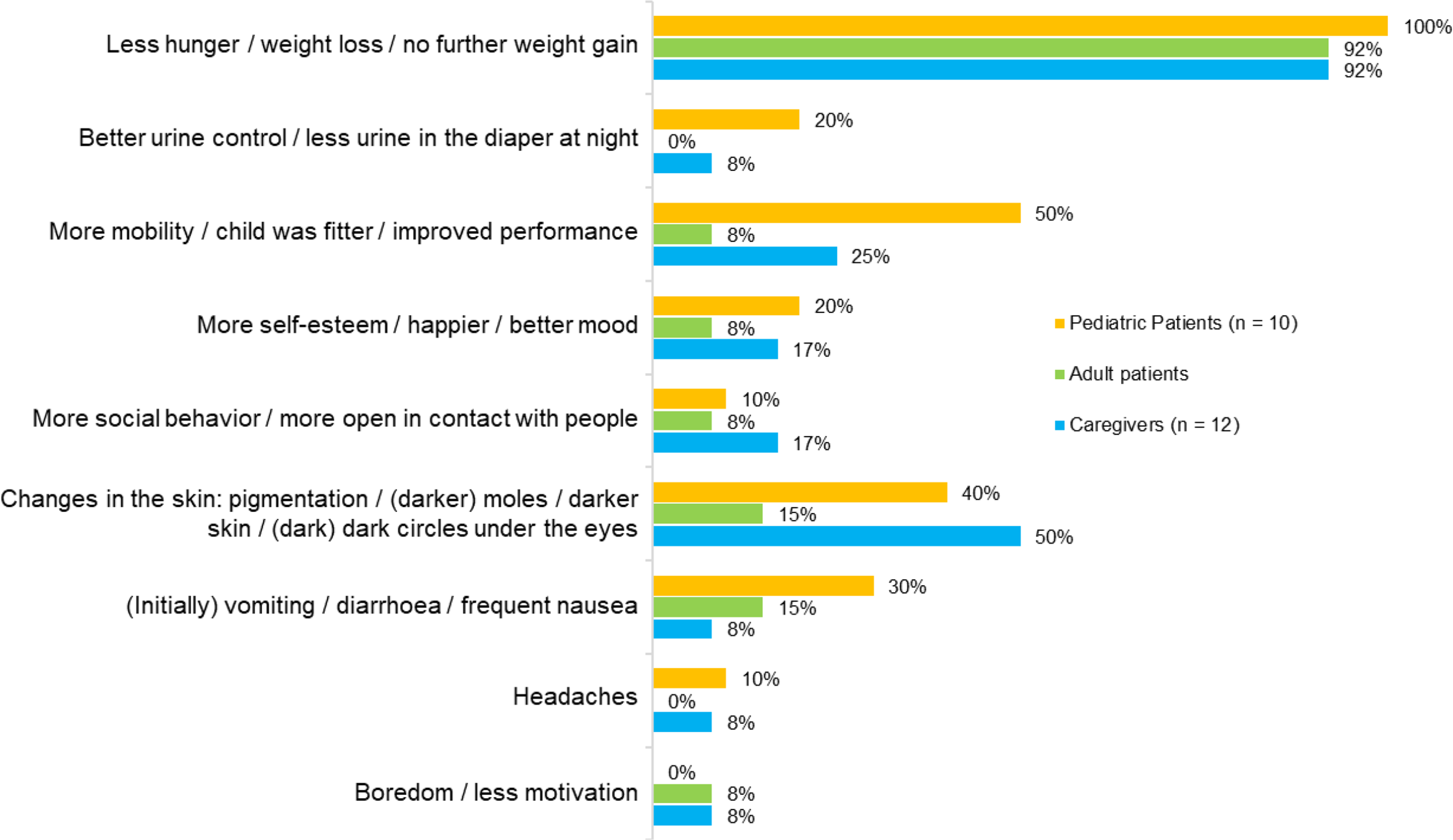
When asked what the initial perceived changes after starting treatment with setmelanotide were, the survey participants predominantly indicated a reduction in feelings of hunger or weight loss/no further weight gain (Fig. 1). Mean BMI z-score ± SD at the start of setmelanotide treatment was 3.12 ± 0.89, which was reduced by − 0.47 ± 0.37 after 6 months.
Fig. 1
Initial perceived changes after starting setmelanotide therapy* *Changes were noticed within a few days at the earliest, a few weeks at the latest
Most patients (≥ 92% of respondents across all three survey groups) reported feeling satiated after meals. Approximately 60% of pediatric patients and caregivers reported a reduction in snacking between meals, compared with 31% of adult patients. Caregivers were more likely to report reductions in seeking food at night (58% compared with 30% and 31% for pediatric and adult patients, respectively) and acting aggressively when food was not available on time (67% compared with 40% and 38%, respectively) (Fig. 2).
Fig. 2
Changes in the feeling of hunger after starting setmelanotide therapy. Proportion of study participants reporting 4 or 5 on a scale where 1 = “does not apply” and 5 = “applies to a high degree”
In pediatric patients, the most reported improvements with setmelanotide therapy were improved mobility (90%), reduced hunger (80%), reduced body weight (80%), and better mood (70%; Fig. 3). In adult patients, the most common improvements were reduced hunger (69%), reduced body weight (62%), and better mood (38%). Adult patients were less likely to report improvements in energy (23% compared with 50% and 42% for pediatric patients and caregivers, respectively) and mobility (23% compared with 90% and 58%, respectively). Caregivers were more likely to report an increase in social participation (58% compared with 10% and 15% of pediatric and adult patients, respectively) and a decrease in family conflicts (42% compared with 20% and 23%, respectively).
Fig. 3
Overall improvements after starting setmelanotide therapy
Figure 1 also summarizes the adverse events perceived when starting treatment. The most commonly reported change was a change in skin pigmentation (pediatric patients 40%; adult patients 15%; caregivers 50%). Gastrointestinal symptoms, such as nausea, vomiting, and diarrhea, were reported by 30% of pediatric patients but only 8% of caregivers.
Across the three survey groups, most respondents felt that they coped well with the daily injections (pediatric patients 100%; adult patients 85%; caregivers 92%). Those who did not feel they coped well (two adult patients, one family member) cited fear of injections or itching at the needle site as issues. A total of 75% of caregivers felt that their lives were significantly (42%) or partially (33%) easier after their relative started therapy, and 25% perceived little or no change in their own lives.
Representative free text responses regarding the changes observed after starting treatment are shown in Table 2; full responses are shown in Supplementary Table 3, Additional file 1. Overall, pediatric patients frequently mentioned feeling fitter and less hungry, but some also noted pigmentation changes and initial vomiting; adult patients mentioned reduced hunger and feeling more relaxed; and caregivers mentioned stabilization of body weight but also darkening of skin.
Table 2 Selected responses regarding changes observed after starting treatment with setmelanotideSupport programs offered at the start of setmelanotide treatmentFew respondents used additional educational support, in addition to the specialist nurse support service, provided by a patient association (pediatric patients 10%; adult patients 15%; caregivers 8%). When asked why they chose to use the specialist nurse service, most respondents cited reasons related to home care, help with injections and dosing, access to certified nurses, and the recommendation of the treating physician (Fig. 4A).
Fig. 4
Patient and caregiver perceptions and utilization of the specialist nurse support (A) Nature of support provided by the specialist nurse support service. Proportion of study participants reporting 4 or 5 on a scale where 1 = “does not apply” and 5 = “applies to a high degree”. (B) Change in frequency of care over time by the specialist nurse support service. (C) Duration of care provided by the specialist nurse support service from start of treatment and at last follow-up
The aim of the specialist nurse support service was to train patients and their carers to manage their care independently. At the start of therapy, support from the specialist nurse support service was provided daily or at least once per week in most cases (Fig. 4B). At last follow-up, between 30 and 42% of the respondents were no longer visited by the specialist nurse support service, or required visits only as needed (Fig. 4B).
The median duration of specialist nurse support service was approximately 5 months, although some patients have been using the service for significantly longer (Fig. 4C). The median time to independent injection was 1 month among adult patients and caregivers and was longer in pediatric patients (5 months; Fig. 4C).
The overall support package provided by the specialist nurse support service (i.e. technical instruction, professional and social expertise, overall home care) was unanimously rated as excellent by both patients and caregivers. Most patients (pediatric patients 100%; adult patients 92%) and caregivers (92%) would recommend the specialist nurse support service to others (Table 2 and Supplementary Table 3, Additional file 1), and most patients and caregivers did not express any further need for support.
Comments (0)