Animals
Adult male and female mice with a C57BL/6J background (Envigo, Horst, The Netherlands), wild-type or defective in Trpm8 [5] were bred in the animal facility at Universidad Miguel Hernández (UMH, Elche, Alicante, Spain) and placed in an isolated room in the same institution at least one week before starting the experimental procedures. Trpm8 knockout mice were a gift from Dr F. Viana (Instituto de Neurociencias de Alicante, Alicante, Spain). Care was taken to minimize the number of animals used and the stress they experienced. Housing conditions were maintained at 21 ± 1°C and 55 ± 15% relative humidity in a controlled light/dark cycle (light on between 8:00a.m. and 8:00p.m.). Animals had free access to food and water except during manipulations and behavioural assessment. Behavioural tests were conducted in a progressive order, starting with the least stressful paradigm and moving to the most stressful, to minimize potential influences between tests when animals were exposed to more than one. The testing sequence began with nociception assessment, followed by the evaluation of anxiety-like behaviour, and concluded with the assessment of depressive-like phenotypes. All procedures were conducted with approval from the UMH Ethical Committee and the regional government (code: 2022 VSCPEA0078-2), adhering to European Community guidelines (2010/63/EU).
Model of chronic migraine
Mice received 10 mg/kg nitroglycerin (50 mg/50 mL Nitroglycerin, Bioindustria LIM, Novi Liguri, Italy) or its vehicle (5% dextrose and 0.105% propylene glycol in pure water) every other day for 9 days (five injections total), administered at 10 mL/kg intraperitoneally (i.p.), as previously described [13].
Drugs
(1R,2S,5R)−2-Isopropyl-N-(4-methoxyphenyl)−5-methylcyclohexanecarboxamide (WS12; 3040/50, Tocris, Bristol, UK), N-(3-aminopropyl)− 2--N-(2-thienylmethyl) benzamide hydrochloride (AMTB; Tocris), testosterone (#T1500, Merck, Darmstadt, Germany) and rapamycin (#J62473.MF, ThermoFisher, Waltham, Massachusetts, United States) were used in cellular studies, all dissolved in 0.01% dimethyl sulfoxide (DMSO, Merck). Used concentrations were based on previous works showing cellular responses in calcium imaging and electrophysiology [7, 8, 13]. In behavioural experiments, rapamycin was administered dissolved in DMSO at 2 mL/kg as previously described [36], at a dose of 1 mg/kg i.p. for the inhibition of nitroglycerin-induced mechanical sensitisation [14], and at a dose of 10 mg/kg to explore inhibition of depressive-like behaviour [15].
Behavioural assessmentNociception
Cold plate
Cold response latencies were assessed with a Cold/Hot plate test with a 16.5 x 16.5 cm arena set at 0°C (Bioseb 760,112, PanLab, Harvard Bioscience, Cornellà, Barcelona, Spain). Latencies to forepaw withdrawal and licking were recorded as raw latencies in seconds, and cut-off for animal responding was established at 90s.
Mechanical sensitivity
Punctate mechanical sensitivity to von Frey filament stimulation was quantified through the up–down paradigm, as previously reported [13]. Filaments equivalent to 0.04, 0.07, 0.16, 0.4, 0.6, 1 and 2 g were used, applying first the 0.4 g filament and increasing or decreasing the strength according to the response. Filaments were bent and held for 4–5 s against the plantar surface of the hind paws and clear paw withdrawal, shaking or licking were considered nociceptive-like responses. Four additional filaments were applied since the first change of response (from negative to positive or from positive to negative), and the sequence of the last six responses was used to calculate the withdrawal threshold.
Anxiety-like behaviour
Marble burying task
Mice were placed in clean translucid cages (42.5 × 27.5 x 30 cm) with 5 cm sawdust bedding overlaid by twenty-eight glass marbles distributed in a 4 × 7 arrangement. Mice were allowed to explore the cage for 30 min and the number of marbles buried (> 2/3 of the marble covered by the bedding) was counted.
Novelty-suppressed feeding
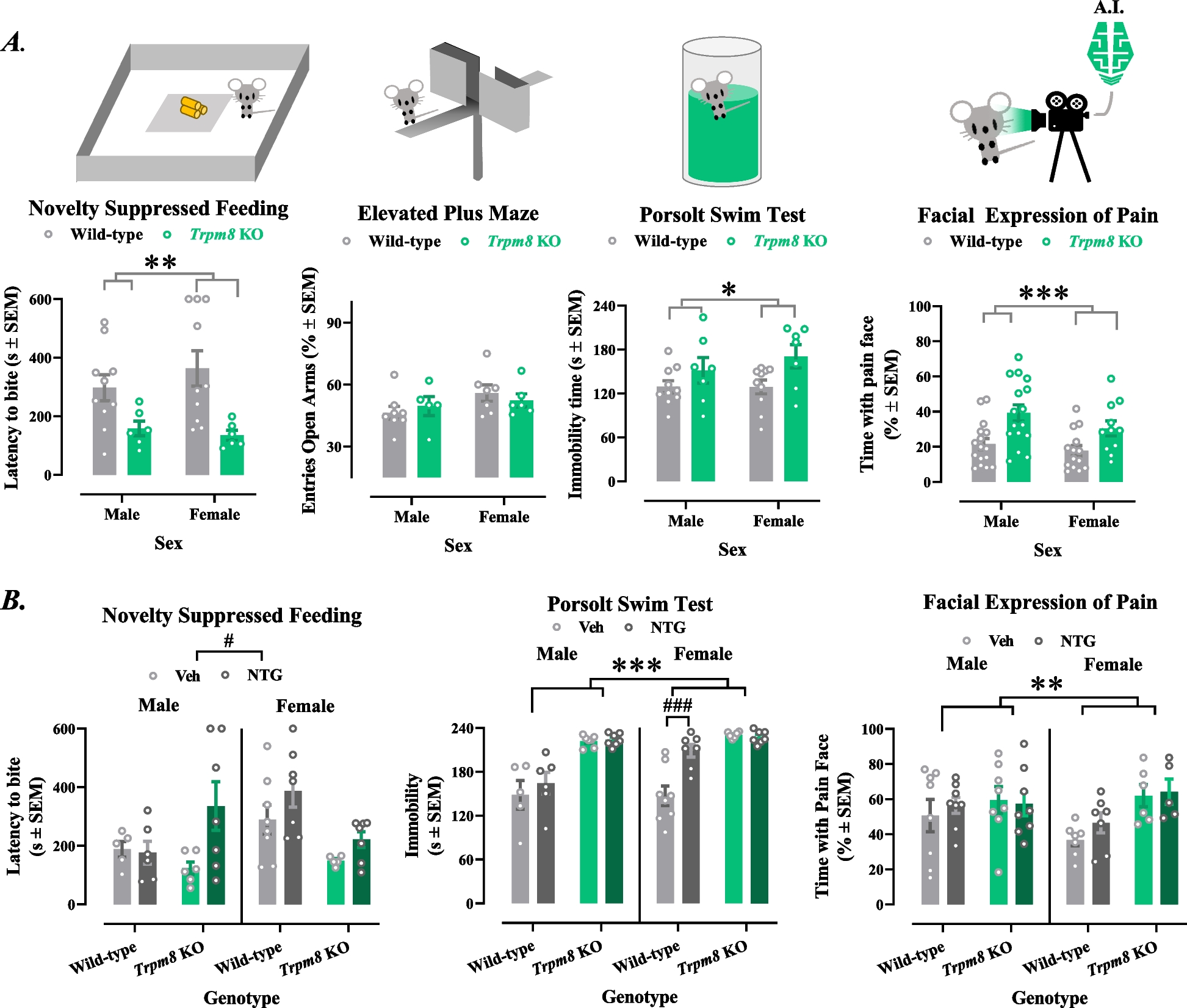
Briefly, animals were food-restricted for 24 h and placed in a 51 × 51 cm arena filled with 5 cm sawdust, with three food pellets placed in a 12 × 12 cm filter paper situated in the centre. The test ended either when the animal began chewing or when 10 min transpired. Immediately afterwards, animals were placed in their home cage and the amount of food consumed in 5 min was measured as a relative measure of hunger (mg of pellet consumed).
Elevated plus maze
Anxiety-like behaviour was evaluated with an elevated plus maze made consisting of four arms (27 x 6 cm), two open and two closed, set in cross from a neutral central square (5 × 5 cm) elevated 40 cm above the floor. Light intensity in the open and closed arms was 45 and 5 lx, respectively. Mice were placed in the central square facing one of the open arms and tested for 5 min. Percentage of entries into the open and closed arms was determined.
Depressive-like behaviour
The Porsolt Swim test was used to evaluate depressive-like behaviour [37]. Mice were placed for 6 min into transparent Plexiglass beakers (ENDOglassware, 2000 mL CBB020, Akralab SL., Alicante, Spain) filled with 1800 mL of water at 22 ± 0.2°C to a depth of 22 cm. Time of immobility was assessed afterwards for the last 4 min. Immobility was considered when the animal made no movements in order to escape (swimming, climbing walls). Water was changed between subjects and beakers cleaned.
Facial expressions of pain
An artificial intelligence tool, specifically a convolutional neural network trained to analyse video recordings of mouse faces was used to score facial expressions of pain in mice. The procedure has been previously described elsewhere [12]. Briefly, mice were placed individually in custom-made test compartments (50 x 120 x 60 mm) with black walls and a mesh-bottomed platform (0.5 cm2 grid) elevated 1.1 m above the ground. Each compartment was arranged in arrays of four and positioned at the edge of the platform, with one wall open facing a high-resolution infrared video camera (1440 x 1024 pixels, Kuman RPi camera, USA). Cameras were equipped with two infrared light-emitting diodes and positioned 25 cm from the test compartments to encourage the mice to face the visual cliff and, consequently, the camera. Each camera could simultaneously record two mice and was controlled by a Raspberry Pi Zero single-board computer (Kubii, France). Recordings were stored on USB drives for later transfer and analysis. No experimenters were present during testing, except during the first 1–2 min when mice were being placed into the compartments. Video recordings lasted a minimum of 15 min, but only the 5 to 10 min window was analysed to exclude potential artifacts caused by the researcher’s presence at the beginning and to avoid sleep-related features beyond the 10 min (e.g., partially closed eyes). The neural network, based on Google’s InceptionV3 model, was trained with facial images of mice highlighting features such as the ears, eyes, cheeks, and nose. We included 245 to clearly exemplify"pain"from animals treated intraperitoneally with cyclophosphamide (300 mg/kg), and 300 images labelled as"no pain” from control mice [38]. After over 30,000 training iterations, the model was able to evaluate each frame from new video recordings, assigning a probability value between −1 (no pain) and 1 (pain). We considered that a facial expression denoted pain when the probability value was greater than 0.1. Scripts for DeepLabCut and InceptionV3 were written in Python (v3.5). Network training and video scoring were performed remotely on an Ubuntu Linux computer equipped with an NVIDIA 2080Ti GPU.
Generation of iPSC sensory neurons
We followed the protocol described previously [34] to obtain sensory neurons from human Pluripotent Stem Cells (hPSCs). Briefly, female human pluripotent stem cells (Healthy Control Human iPSC Line, Female, SCTi003-A, #200–0511, STEMCELL Technologies, Cambridge, UK, CB25 9 TL) were cultured under feeder-free conditions using Essential 8 (E8) medium (Thermo Fisher Scientific) on vitronectin-coated plates (Thermo Fisher Scientific). Cells were passaged using 0.5 mM EDTA in PBS without calcium or magnesium (Thermo Fisher Scientific) for 5 to 6 min to dissociate the hPSC colonies. Cells were maintained in a humidified 5% CO2 atmosphere at 37°C. For neuronal differentiation, hPSCs were plated at 1.5 × 10⁵cells/cm2 on vitronectin-coated 6 well plates in E8 medium containing CEPT cocktail (50 nM Chroman 1, 5 μM Emricasan, Polyamine supplement (1:1000 dilution) and 0.7 μM Trans-ISRIB (#7991, BioTechne)) to improve viability. 24 h later cells were switched to Essential 6 (E6) medium (Thermo Fisher Scientific) containing 2 µM A83-01 (Transforming Growth Factor-β inhibitor) and 0.2 µM CHIR98014 (GSK-3β inhibitor and WNT signalling pathway activator). On day 3, cells were passaged to a single cell suspension with Accutase (STEMCELL Technologies) and seeded at 5.5 × 10⁶ cells/well in 6 well AggreWell 800 plates (STEMCELL Technologies). Cells were maintained in E6 medium containing 0.5 µM CHIR98014, 2 µM A83-01, 1 µM DBZ (γ-secretase inhibitor), and 25 nM PD173074 (FGFR inhibitor). CEPT cocktail was included for the initial 24 h during nocisphere formation. On day 14, resulting nocispheres were dissociated using a MACS EB dissociation kit following manufacturers guidelines (#130–096–348, Miltenyi Biotec) and plated on poly-L-lysine/laminin-coated dishes in DMEM/F12 medium, supplemented with N2 supplement, B27 supplement (w/o Vitamin A), 1 µM PD0332991 (CDK4/6 inhibitor) and neurotrophic factors (BDNF/GDNF/NGF/NT-3; 25 ng/mL each) as described before [34]. By day 28, BRN3 A⁺(POU4 F1) and Tuj-1⁺ (Tubulin βIII) nociceptor-like neurons were obtained.
Immunocytochemistry
Cultures were washed with 1X PBS (D8662, Merck) three times. Afterwards, cells were fixed with 4% paraformaldehyde (#28909, Thermo Fisher Scientific) for 20 min at room temperature. Permeabilization was achieved with 0.1% v/v Triton 100X (P8787, Merck) for 5 min and blocking with 5% bovine serum albumin (#A7906, Merck) for 30 min, both in 1X PBS. Cells were labelled with primary antibodies mouse anti-BRN3 A 1:100 (#MAB1585, Millipore Sigma, Merck KGaA, Darmstadt, Germany), rabbit anti-TUJ1 1:400 (#5568, tubulin beta-3, Cell Signalling Technology, London, UK) and/or as previously suggested [39] mouse anti-TRPM8 Clone OTI7 A11 1:100 (#TA811228S, Origene Technologies GMBH, Herford, Germany, generous gift from E. de la Peña, Instituto de Neurociencias, San Juan, Alicante, Spain) and incubated for 1 h at room temperature. Secondary antibodies Donkey anti-mouse-488 1:200 (#A-21202, Thermo Fisher Scientific) and Donkey anti-Rabbit-555 1:200 (#A-31572, Thermo Fisher Scientific) were incubated for 1 h at room temperature protected from light. Slides where mounted with ProLong Gold antifade reagent with 4′,6-diamidino-2-phenylindole (DAPI, #P36931, Thermo Fisher Scientific) and images acquired with a confocal microscope (LSM 880, ZEISS, Jena, Germany).
Calcium imaging
Fluo4-AM (F14201, Molecular Probes) was dissolved in DMSO at a concentration of 10 mM and used at 2 µM to load the cells for calcium imaging experiments. D28 iPSC sensory neurons were incubated with Fluo4-AM for 30 min at 37°C in standard extracellular solution (in mM: 140 NaCl, 3 KCl, 2.4 CaCl2, 1.3 MgCl2, 10 HEPES, and 5 glucose, adjusted to pH 7.4 with 1 M NaOH). Cells were washed three times with extracellular solution and equilibrated for 30 min prior to imaging. Fluorescence measurements were obtained on an LSM 880 confocal fluorescent microscope using a 20 × objective. Basal fluorescence was captured every 3 s over a 60 s period prior to application of stimulants with images captured for a further 3 min. Mean fluorescent intensity values were recorded per cell and normalised to pre-simulation. Data expressed as ΔF/F0 using the equation: ΔF/F0 = (Fmax-F0)/F0.
Statistical analyses
Behavioural and Calcium Imaging data were analysed using GraphPad Prism9 (GraphPad Software Inc., USA). Sample Sizes were based in previous works evaluating similar behavioural paradigm or calcium transients [13, 16, 29, 36]. For the behavioural experiments in naïve mice, 2-way Analysis of Variance (ANOVA) was used, with factors “genotype”, “sex” and their interaction, followed by post-hoc Tukey recommended tests to compare between experimental groups. When mice were exposed to nitroglycerin, data were assessed with 3-way ANOVA, adding the factor “treatment” and the interactions. Time-courses were analysed with 3-way (Time, Treatment, Genotype) or 2-way (Group, Time) Repeated measures ANOVA followed by Tukey. Calcium Imaging data were analysed with One-way ANOVA (WS12 vs WS12 + AMTB vs. KCl) followed by Tukey or with Kruskal Wallis tests (Testosterone vs. Testosterone + AMTB; Rapamycin vs. Rapamycin + AMTB) followed by Dunn’s Multiple Comparison Tests. Differences were considered statistically significant when P < 0.05. Outliers (± 2SD from the mean) were excluded. Artwork was designed using GraphPad Prism, Excel and Power Point. Experimenters were blinded to the key factors being assessed in each behavioural paradigm. Specifically, these factors included genotype in experiments in naïve mice, nitroglycerin or vehicle treatment in the migraine model experiments, and rapamycin vs. vehicle in experiments assessing the effects of rapamycin. In experiments with three experimental groups, only the treatment condition for wild-type mice was blinded. Blinded treatments were allocated randomly through the Random tool of Excel. Raw data and statistical analyses are provided in Supplementary material 2.



Comments (0)