This study included a demographically and geographically diverse sample of twelve combined U.S. pediatric and pregnancy cohorts from across the U.S. Maternal PFAS plasma or serum concentrations were available from 1999–2020 and decreases in legacy PFAS over time were observed in this U.S. sample of pregnant women. Observed decreases are likely due to reductions in U.S. manufacturing from a series of phase-outs to eliminate PFOA, PFOS, PFNA and PFHxS by 2015 [7, 8]. Our study found that PFAS concentrations differed substantially by race, ethnicity, and education.
Out of the 14 PFAS evaluated in this study, mothers of Black race had lower levels of PFOA, PFOS, PFHxS, the sum of four PFAS, PFOSA, EtFOSAA, PFDoDA, and PFPeA and higher levels of PFBS and PFHxA, compared with White mothers. Race has been identified as an important correlate of PFAS exposure [22, 23, 33], including among pregnant women in the U.S. [34, 35]. Consistent with observations in this study, a study of a cohort of pregnant women living in Cincinnati, Ohio (not an ECHO cohort) also found that non-Hispanic Black women had lower serum concentrations of PFOA, PFOS, PFHxS, and PFNA compared with White women [36]. Lower concentrations of PFOA, PFOS, PFHxS, PFNA, and PFDA were also observed among Black Americans in a U.S. population-based study [25].
Our study found that Asian mothers had higher levels of PFNA, PFDA, PFUnDA, and PFPeA compared with mothers reporting White race. Levels of PFNA and PFDA among individuals of Asian race were also found to be higher than White individuals in a U.S. population study [25], and a study in midlife women found higher PFNA concentrations among Asian American women compared to White [23]. Higher observed levels of certain PFAS among Asian Americans have been thought to result from their greater fish consumption [26, 37]. We found that increased fish consumption was associated with higher levels of PFNA, PFDA, and PFUnDA, and adjusting for fish consumption did not attenuate the higher levels observed among Asian mothers. Despite increased exposure to some PFAS from fish consumption, health benefits associated with fish consumption may counter negative effects of PFAS [38], and this should be considered when developing dietary guidance for pregnant women.
Hispanic ethnicity was associated with lower levels of PFOA, PFOS, PFHxS, the sum of four PFAS, NMFOSAA, EtFOSAA, PFHpA, PFBS, and PFHxA and increased levels of PFPeA compared with non-Hispanic ethnicity. Hispanic ethnicity has also been shown to be an important predictor of lower PFAS exposure [22], including specifically among Mexican-Americans compared with non-Hispanic Whites [22, 25]. Lower PFAS levels are also reported among Hispanics born outside of the United States [22, 23]; our study was not able to evaluate country of birth.
Higher levels of maternal education were associated with higher serum levels of PFOA, PFOS, PFHxS, PFNA, and the sum of four PFAS as well as higher exposure to PFOSA and lower exposure to PFHxA compared to those with less than high school level of education. Higher education has been previously associated with higher levels of PFAS [22, 23, 39], including among a cohort of Chinese pregnant women [21]. Relatedly, income has been demonstrated to be an important predictor of PFAS concentration [22, 36], including among U.S. pregnant women from seven county-level cohort locations across the country [34]. Higher educational attainment and increased income are closely correlated which may explain, at least in part, the observed association with increased PFAS concentrations among those with the highest educational attainment in this study. However, maternal education may also impact dietary and consumer product use, despite income. Indeed, we observed increases in several PFAS associated with college education were attenuated when adjusted for weekly fish consumption. We also found that adjustment for breastfeeding attenuated increases in PFOA, PFOS, PFHxS, PFNA, and the sum of four PFAS with higher maternal educational attainment. Maternal education is strongly linked with breastfeeding rates and duration [40], and also results in decreased maternal body burdens of PFAS (and higher body burdens among infants), suggesting breastfeeding plays a mediating role in observed relationships with maternal education and PFAS exposure.
Factors that result in differences in PFAS concentrations among racial, ethnic, and socioeconomic groups are not well characterized [39] but could include differences in diet and use of consumer goods [26, 34, 41] and differences in local sources of PFAS contamination [34]. Dietary and consumer use patterns vary by sociodemographic factors, and diet may account for 10 to 20% of variation in PFAS exposure [42]. Fish intake, fast food consumption, microwave popcorn are several identified dietary sources of PFAS [23, 34, 36]; while beans, vegetable and fruit consumption have been associated with decreased PFAS levels [21, 43]. Sources of exposure to PFAS can include both food and food-packaging [44]. The US Food and Drug Administration announced that manufacturers had voluntarily agreed to end the use of grease-proof packaging that contains PFAS, although it may take several more years before old supplies are expended [45]. Personal care products [46] and consumer products such as use of stain repellants [36] have also been associated with higher PFAS serum concentrations, and patterns of personal care and consumer products use may also vary among racial, ethnic, and economic groups.
Geographic location is an important determinant of PFAS exposure [23]. Regional differences could be in part explained by contaminated drinking water sources [34, 47]. For example, former or current U.S. military installations, industrial sites, and wastewater treatment facilities have also been identified as sources of PFAS contamination of nearby water systems and wells [48]. USEPA drinking water standards have been finalized for six PFAS [12], and their implementation will likely lead to further reduction in PFAS exposure, particularly given that even low levels of PFAS in drinking water can have a large impact on body burdens [2]. Indeed, reduced PFAS body burdens are observed in communities which have reduced PFAS levels in contaminated drinking water sources [5]. In addition to contaminated drinking water, exposure to PFAS in some communities may be compounded by higher exposures from local agricultural products due to use of PFAS contaminated biosolids used on farmland [49]. A more detailed locational description of each cohort would allow the opportunity to evaluate spatial proximity to sources of PFAS contamination, but this information is unavailable in the public-use, deidentified ECHO-wide dataset.
Few studies have evaluated sociodemographic differences among concentrations of several of the less-studied PFAS evaluated in this study, including both longer-chain and shorter-chain PFAS. In our study we found longer-chain PFAS including PFOSA, EtFOSAA, PFHpA, and PFDoDA and shorter-chain PFAS including PFBS, PFHxA, and PFPeA were associated with categories of maternal race, ethnicity, and education. Long-chain perfluoroalkyl acids (PFAAs), defined as perfluoroalkyl carboxylates (those having a carboxylate functional group) having 8 or more carbons (e.g., PFOA, PFNA) and perfluoroalkyl sulfonates (those having a sulfonate functional group) with 6 or more carbons (e.g., PFHxS, PFOS [50]), have half-lives of several years (Supplementary Table 1) and have been phased out due to concerns about their biological persistence and potential health effects (Post, Gleason et al. 2017). In their place, alternatives including short-chain PFAAs and other types of PFAS with fewer carbons are increasingly used [2]. These shorter-chain PFAS generally have shorter half-lives (e.g., PFBS: 35 days, PFHxA: 32 days [51]), which, all other things being equal, are expected to result in lower health risks [52]. While we were not able to identify a human half-life estimate for several of the PFAS included in our study, (Supplementary Table 1), we may anticipate that the half-lives of those with long-chain lengths could potentially be several years. As long-chain PFAAs are phased-out, the importance of biomonitoring for alternative PFAS will be integral for understanding our human exposure burden [25, 53].
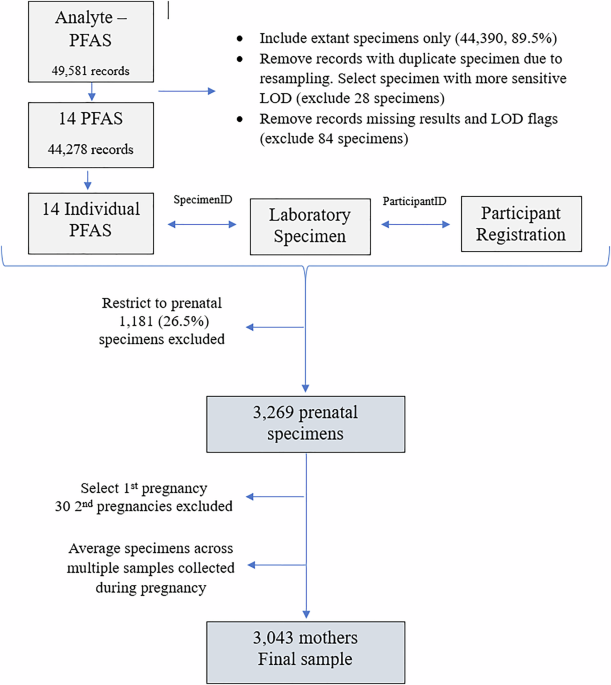
Our study has some limitations. Samples from different cohorts were not analyzed with the same PFAS laboratory analytical protocols, and the combined dataset includes samples collected throughout pregnancy trimesters and at birth. Given PFAS concentrations are dynamic throughout pregnancy and impact of trimester of sample collection on PFAS concentration varies by PFAS congener [9], which could lead to issues of comparability across the cohorts. To account for any impact of these differences, trimester of sample collection was included in multiple imputation models used to estimate values below the LOD, and we adjusted for trimester and cohort in multivariable models.
Additional analyses of dietary survey data collected during pregnancy were limited to fish consumption in this study. Future studies evaluating source of fish (marine, freshwater, or recreationally caught) and species of fish are warranted to contribute to guidance for women who are pregnant or plan on becoming pregnant on choice of fish to include in their diets. Additional analysis of other dietary sources and use of consumer products are also warranted for understanding sources of PFAS exposure to pregnant women. Although this analysis provides some information on several less-commonly studied PFAS (including PFHpA, PFHxA, PFPeA), the low detection frequency of these PFAS limits our comparisons of exposure levels among different sociodemographic groups.


Comments (0)