Our study provides the most direct evidence to date that colonic length gradually increases in middle-age and older adults. On average, we observed an overall 7.6 cm per decade increase in colonic length, albeit with differences between women and men. Previous and cross-sectional barium enema and CTC studies without longitudinal follow-up had indirectly shown a general trend for longer colons in older adults[6, 12]. Our findings also suggest that the more mobile, intraperitoneal segments (i.e., the transverse and sigmoid colon) account for the majority of this elongation. This seems plausible since the retroperitoneal and extraperitoneal segments are more fixed and presumably less able to lengthen over time. The fact that the cecum has variable mobility and peritoneal extension may also explain why the cecal/ascending segment demonstrated intermediate average lengthening (1.1 cm) between that of the descending colon and rectum (0.3 cm for both) and the transverse and sigmoid colon (4.0 cm and 2.1 cm, respectively). In addition, a previous cadaveric study [1] demonstrated that the traditionally “fixed” retroperitoneal colonic segments often had variable mobility, which could provide more nuanced results.
Previous cross-sectional studies have also noted that females tend to have longer colons [6, 12]. In our study, women had significantly longer colons at the initial index CTC compared with men (202.1 cm vs. 194.0 cm), despite a slightly younger average age (53.2 years vs. 55.2 years). Interestingly, we also found that men demonstrated a faster rate of colonic elongation over the follow-up interval (0.88 cm/year vs. 0.31 cm/year), which essentially closed the gender gap at the final CTC examination (205.4 cm vs. 206.1 cm). Longer colons have also been previously associated with thinner patients[6] and constipation[9]. As such, the relative contributions of sex versus diet are difficult to tease out and warrant further investigation. Constipation is a highly prevalent condition that can adversely affect quality of life[13,14,15]. As such, the relationship between colonic redundancy and constipation also merit further consideration. Regardless, these colon length findings may also have relevance for optical colonoscopy. For example, an increased rate of incomplete colonoscopy has been noted in thinner women [16]. Not surprisingly, longer colons in general are also associated prior a history of incomplete colonoscopy, as measured by CTC [7].
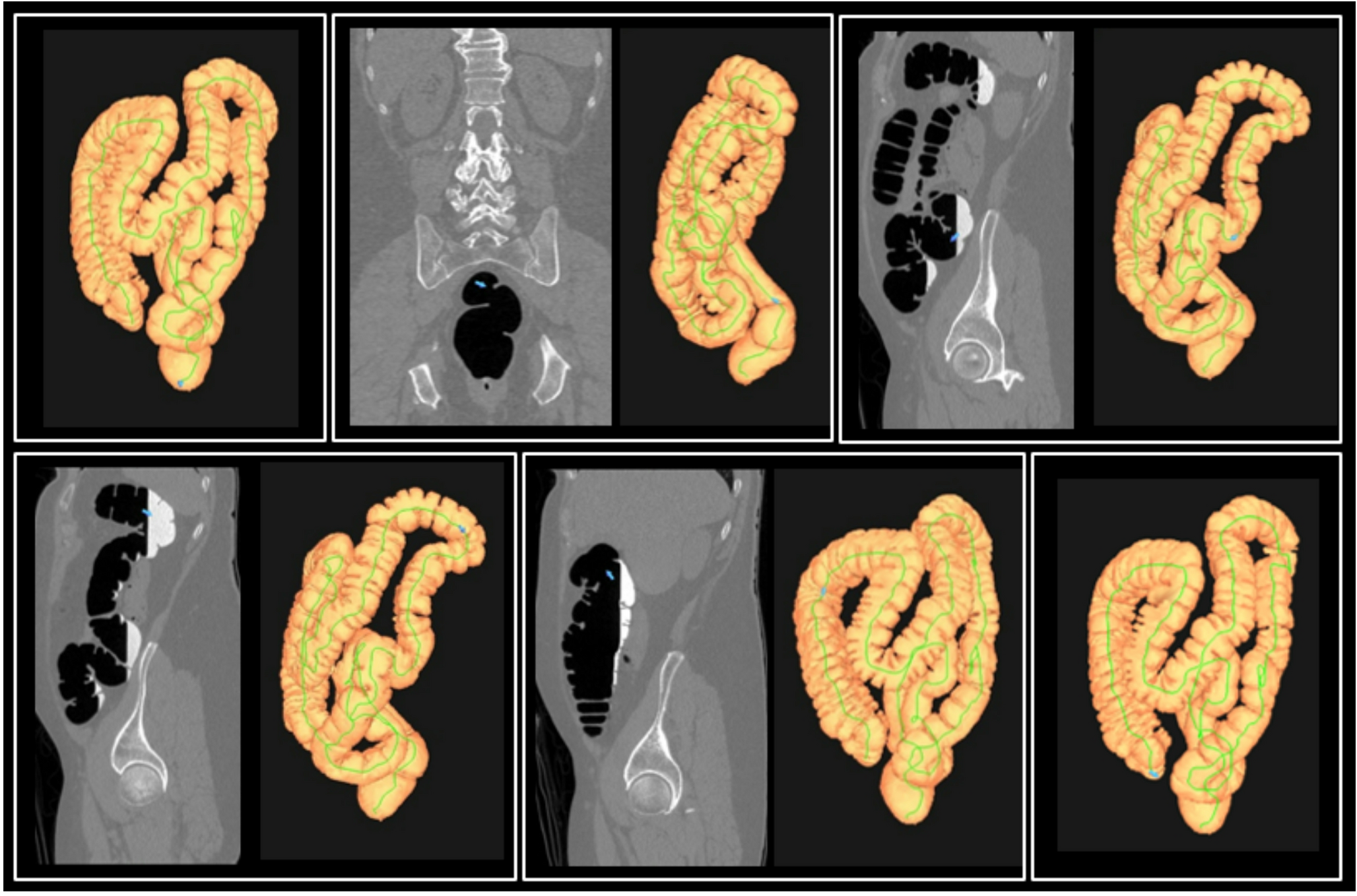
Our work demonstrates the advantages of using CTC to accurately measure colon length, which complement other relative advantages of CTC for colorectal cancer screening that have been previously enumerated [17,18,19,20]. Specifically, CTC allows for precise assessment of the prepared and distended colon in three-dimensional space, easily accounting for the challenging anatomy with an automated software tool that provide a luminal centerline. Traditional methods for measuring colonic length are much more challenging and imprecise. Cadaveric assessment is limited by the obvious physical access issues and post-mortem rigidity[1]. Laparotomy suffers from similar access issues, which are compounded by adhesions and extraperitoneal segments [3]. Contrast enema examinations provide only planar two-dimensional estimation of a complex 3D structure [2, 12]. Finally, colonoscopy is limited by the effect of pleating and telescoping of the bowel, which artificially shortens the colon [5]. Given these limitations, all of these other modalities are generally inaccurate and tend to underestimate the true colonic length. Typical mean colonic lengths measured at optical colonoscopy, laparoscopy, and autopsy are generally foreshortened in the range of 110–130 cm [1, 3,4,5], whereas at CTC-based mean colonic length in along a 3D luminal centerline is approximately 170 cm, ranging from 150 to 190 cm dep upon the specific population [4,5,6,7, 9].
We acknowledge limitations to our investigation. This is a single-center experience involving a predominately White Midwestern U.S. population. We also do not have data on patient bowel habits, such as frequency of bowel movements. We can therefore not specifically comment on the impact of race, ethnicity, geography, or constipation upon colorectal length based on our data. We also did not consider patient BMI, weight change, or history of abdominal surgery. Beyond CTC itself, there is no reliable reference standard to measure colorectal length with which to compare our results. Differences in colonic distention could conceivably impact length measurements. However, because the degree of luminal distention per unit length was slightly less on the final CTC examination compared with the initial one, if anything the degree of elongation over time may be slightly underestimated. Finally, in retrospect it might have been interesting to separate the length measurements for the ascending colon and cecum to see if the variable mobility of the latter accounted for the slightly increased elongation relative to the descending colon and rectum.
In summary, serial in vivo colonic examination with CTC demonstrates a measurable increase in colonic length in middle-age and older adults of approximately 7–8 cm per decade on average. The more mobile intraperitoneal colonic segments (transverse > sigmoid) appear to account for most of this elongation and relevant differences between the sexes were observed.

Comments (0)