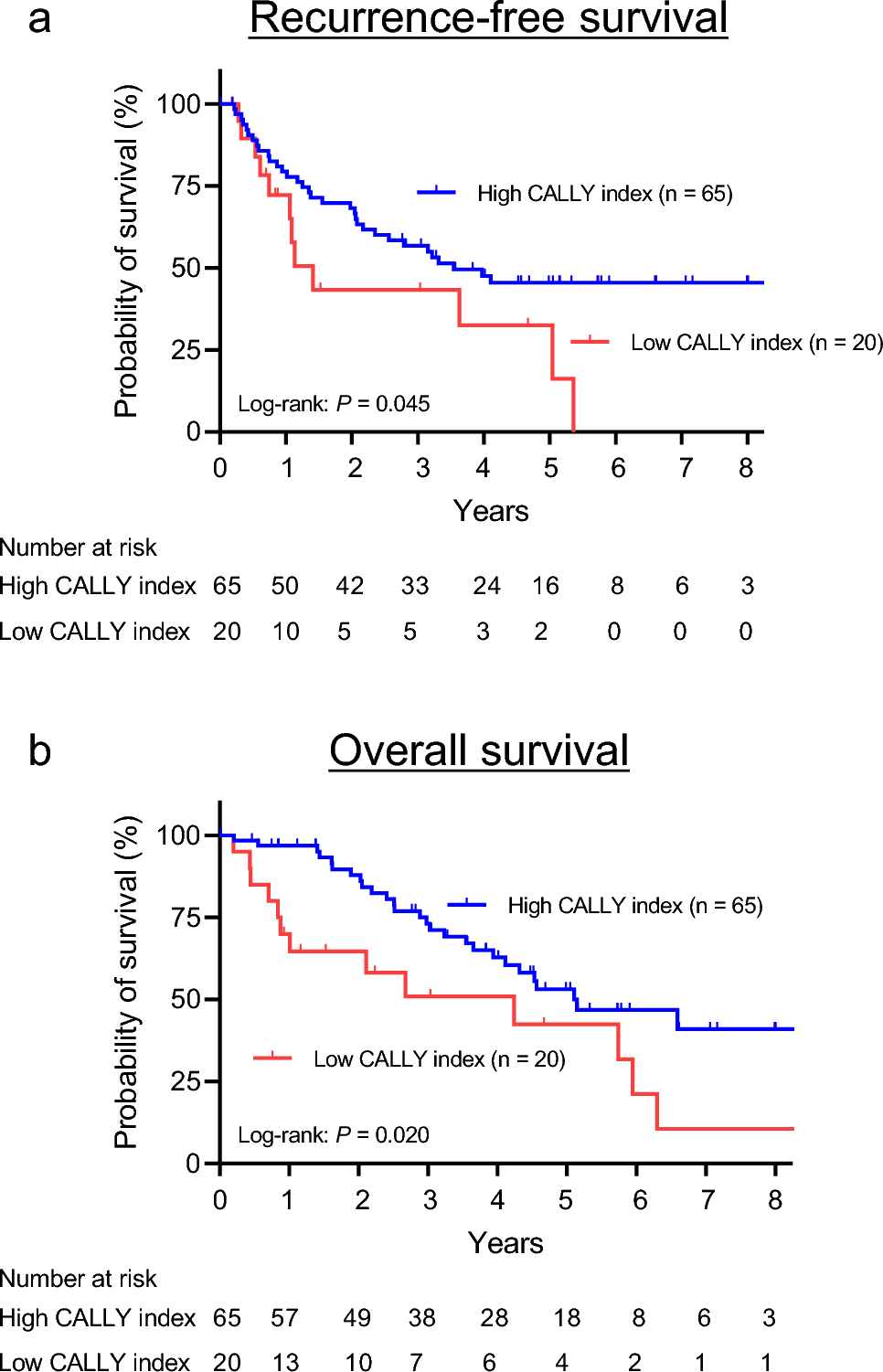
In this study, we investigated the usefulness of the CALLY index, a composite index reflecting systemic inflammatory, nutritional, and immune status, by comparing it with similar indices to identify its effectiveness in predicting prognosis in patients undergoing surgery for PDAC. We found that the CALLY index was an independent predictor of a poor OS.
The biological rationale for the prognostic ability of the CALLY index is its comprehensive components. For example, NLR, which was also an independent prognostic factor in this study, serves as a powerful indicator of the inflammatory and immune status of the host through the presence of neutrophils and lymphocytes [7]. Meanwhile, the CALLY index assesses inflammation using CRP, an acute-phase marker, to evaluate the nutritional status—a key factor affecting the prognosis of patients with cancer—using albumin and measures immune status using lymphocytes. Therefore, the uniqueness and superiority of the CALLY index lie in its ability to simultaneously measure three interrelated biological factors: inflammation, nutrition, and immunity. Furthermore, these three biomarkers are part of routine preoperative blood tests and their calculation is simple. They involve no special costs or procedures; thus, their high practicality makes them easy to implement in clinical settings. This is a significant advantage of this indicator. This study initially focused on individual factors such as neutrophil count, lymphocyte count, and albumin levels (Supplemental Fig. 1, Supplemental Fig. 2). The addition of CRP, which reflects inflammation, was expected to improve the accuracy of the CALLY index compared to the PNI as a conventional indicator; however, it did not significantly improve the AUC. When interpreting these results, several biological limitations should be acknowledged. PDAC is widely recognized as a ‘cold tumor’ characterized by an ‘immune-desert’ microenvironment and T-cell exclusion [28]. These unique immunological features may weaken the correlation between peripheral lymphocyte counts and intratumoral immune activity compared with other gastrointestinal cancers. Consequently, the prognostic impact and predictive superiority of systemic immune-based markers, including the CALLY index, may be more constrained in PDAC.
A notable finding of this study was that the low CALLY index group demonstrated significantly higher CA 19 − 9 levels. CA 19 − 9 is widely recognized as a marker of tumor activity and burden [29]. This association indicates that the CALLY index may not only assess the systemic condition of the host but also indirectly reflect the underlying biological malignancy of the tumor. CA19-9 is the gold standard marker for gastrointestinal cancers; however, its usefulness is limited in patients lacking the Lewis antigen. In contrast, the CALLY index is a simple marker applicable to all cases. Furthermore, while CA19-9 reflects tumor-related factors, the CALLY index reflects host-related factors and the host reserve capacity. For patients with PDAC, evaluating the systemic status using the CALLY index in conjunction with CA19-9 is clinically important as it may help predict the tolerability and feasibility of continuing adjuvant chemotherapy. Although a subgroup analysis limited to CA 19-9-positive cases (n = 68) showed less definitive results than the total cohort (Supplemental Fig. 3, Supplemental Tables 1 and 2), we consider it clinically essential to evaluate all PDAC cases using the CALLY index to provide a comprehensive assessment of the host’s systemic state. In this study, the ROC AUC for the CALLY index in predicting 5-year survival was 0.65, and the hazard ratio was 2.23. These values indicate that the CALLY index is a moderate prognostic predictor. Therefore, the CALLY index is considered useful not as a standalone diagnostic marker but rather as an auxiliary tool for evaluating a patient’s overall condition when used in combination with tumor markers and other indicators. In recent years, the CALLY index has been useful in predicting the prognosis of various gastrointestinal cancers, including gastric, esophageal, and colorectal cancers. Supplemental Table 3). The optimal cutoff value for the CALLY index in this study was 4.0, which is higher than the values reported in previous studies (generally 1.7 to 3.5). This difference may be attributed to the selection criteria. All patients in this study had resectable PDAC and underwent upfront R0 resections. Such patients generally have better nutritional reserves and lower inflammatory responses than those with advanced or unresectable cancer, which may have led to an elevated cut-off value. Furthermore, while the 5-year OS was used as the primary ROC endpoint to reflect standard surgical outcomes, we confirmed that the optimal cutoff was 4.0 when the 3-year OS was used as the endpoint, suggesting the stability of this value within our cohort. Nevertheless, whether this cutoff is universal remains to be validated, and further large-scale, multi-institutional studies are required to establish the most appropriate threshold across the different clinical stages of PDAC. Research on the CALLY index for PDAC is limited, and this study provides important evidence to support its usefulness in PDAC.
The prognostic predictive ability of the CALLY index has a significant potential in clinical practice, as demonstrated in this study. Investigation of the preoperative CALLY index may enable the preoperative identification of high-risk patients simply and objectively—patients who cannot be fully captured with conventional staging systems, including the tumor–node–metastasis classification. For example, in patients with a low preoperative CALLY index, it provides valuable information for developing personalized treatment plans, including actively considering the addition of neoadjuvant chemotherapy, selecting more effective postoperative adjuvant therapies, and increasing postoperative surveillance. Future research is expected to clarify how the CALLY index dynamically changes pre- and post-treatment, including surgery or chemotherapy, and how this relates to evaluating treatment effectiveness and long-term outcomes. As more findings accumulate, the CALLY index will become an even more important biomarker for pancreatic cancer diagnosis and treatment.
This study is associated with several limitations. First, this was a single-center retrospective review, and the possibility that unknown biases in the case selection may have affected the results cannot be ruled out. Second, the sample size of 120 cases was relatively small, which potentially lacks sufficient statistical power, particularly for subgroup analyses. Third, the cutoff value (4.0) for the CALLY index, identified using the ROC curve in this study, was specific to our cohort; hence, the optimal cutoff may differ in other patient populations, ethnic groups, or survival periods. Therefore, further validation is warranted to confirm the universality of this cut-off value. Finally, this study spans a long inclusion period, from 2007 to 2019, during which treatment strategies for PDAC have evolved substantially. These temporal changes limit the validity of the analysis of all patients in a single cohort. Furthermore, to overcome these limitations and firmly establish the clinical utility of the CALLY index, a large-scale, prospective, multicenter study will be crucial to validate our findings.
In conclusion, this study revealed that the preoperative CALLY index is an independent prognostic factor for OS in patients undergoing surgery for PDAC. It reflects preoperative systemic inflammatory, nutritional, and immune status. The CALLY index is a useful and convenient tool that complements traditional clinicopathological factors and helps improve risk stratification and personalized treatment strategies for patients with PDAC.



Comments (0)