
Remember me

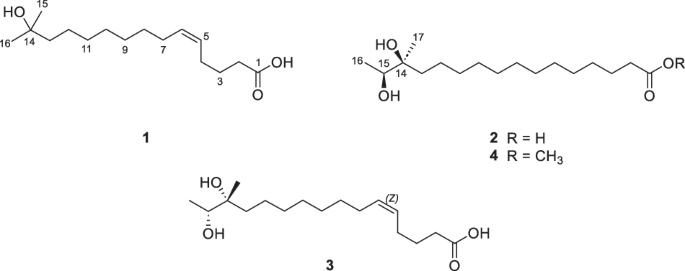
Compound 1 was obtained as a pale-yellow oil, and its molecular formula was deduced as C16H30O3, based on analysis of HR-FAB-MS data [M + H-H2O]+ at m/z 253.2162 (calcd for C16H29O2, 253.2168, Fig. S6). The 1H NMR spectrum of 1 revealed two olefinic protons at δH 5.41 (1H, ttd, H-6) and 5.35 (1H, ttd, H-5); ten methylene groups at δH 2.28 (2H, td, J = 7.4, 4.6 Hz, H-2), 2.08 (2H, m, H-4), 2.05 (2H, m, H-7), 1.65 (2H, m, H-3), 1.43 (2H, m, H-13), and 1.30–1.39 (10H, m, H-8–12); and two methyl groups at δH 1.17 (6H, s, H-15, H-16). The 13C NMR and HSQC spectra displayed 16 carbon signals, comprising of one carboxylic carbon at δC 177.8 (C-1); two olefinic carbons at δC 131.9 (C-6) and 129.7 (C-5); one oxygenated quaternary carbon at δC 71.5 (C-14); ten methylene carbons at δC 44.9 (C-13), 34.4 (C-2), 31.4 (C-12), 30.8 (C-10), 30.6 (C-9), 30.3 (C-8), 28.1 (C-7), 27.5 (C-4), 26.1 (C-3), and 25.4 (C-11); and two methyl carbons at δC 29.1 (C-15, C-16) (Fig. S1and S2).
The structure of compound 1 was elucidated using 2D NMR spectroscopic data analysis (Fig. 2a, Fig. S3–S5). The COSY crosspeaks H-2/H-3/H-4/H-5/H-6/H-7 together with HMBC correlations from H-2 to C-1, C-3, C-4; from H-3 to C-1, C-2, C-4, C-5; and from H-4 to C-2, C-3, C-5, C-6, confirmed the presence of olefinic carbons between C-5 and C-6. Furthermore, HMBC correlations from the geminal methyl singlets H-15 and H-16 to carbons C-13 and C-14 established the connectivity of the C-13/C-14/C-15/C-16 fragment. The attachment of a hydroxy group at C-14 was confirmed by its chemical shift (δC 71.5) and the molecular formula of 1. The geometry of the olefinic protons was assigned as Z based on the observed coupling constant (3JHH = 11.3 Hz), consistent with typical values for cis-configured double bonds. Thus, the structure of 1 was assigned as (5Z)-14-methyl-14-hydroxypentadec-5-enoic acid (gambaoic acid A).
Fig. 2 The alternative text for this image may have been generated using AI.
COSY and key HMBC correlations of compound a 1, b 2, and c 3
Gambaoic acid B (2) was isolated as a dark yellow oil, and its molecular formula was deduced as C17H34O4 by HR-FAB-MS data [M + H-H2O]+ at m/z 285.2431(calcd for C17H33O3, 285.2430, Fig. S12). The 1H NMR spectrum of compound 2 showed one oxygenated methine at δH 3.56 (1H, q, J = 6.5 Hz, H-15); twelve methylene groups at δH 2.28 (2H, t, J = 7.4 Hz, H-2), 1.60 (2H, m, H-3), 1.40 (2H, m, H-13), and 1.31–1.39 (18H, m, H-4–12); and two methyl groups at δH 1.12 (3H, d, J = 6.5 Hz, H-16) and 1.08 (3H, s, H-17). The 13C NMR and HSQC spectroscopic data displayed 17 carbons signals, comprising one carboxylic carbon at δC 177.7 (C-1); one oxygenated quaternary carbon at δC 75.7 (C-14); one oxygenated methine at δC 74.1 (C-15); twelve methylene carbons at δC 39.2 (C-13), 35.0 (C-2), 31.6 (C-11), 30.8 (C-10), 30.7 (C-7, C-8, C-9), 30.6 (C-6), 30.4 (C-5), 30.2 (C-4), 26.1 (C-3), and 24.4 (C-12); and two methyl carbons at δC 21.6 (C-17) and 17.6 (C-16) (Fig. S7 and S8). The COSY correlation between H-15 and H-16 was observed. Moreover, HMBC correlations from H-15 to C-13, C-14, C-16, C-17; from H-16 to C-14, C-15; and from H-17 to C-13, C-14, C-15 confirmed the assignment of the dimethyl-diol moiety (Fig. 2b, Fig. S9–S11). Therefore, the gross structure of 2 was determined as 14-methyl-14,15-dihydroxyhexadecanoic acid, designated gambaoic acid B.
Compound 3 was obtained as a dark yellow oil with its molecular formula determined as C17H32O4, based on HR-ESI-TOF-MS data, showing an ion peak at [M–H]–m/z 299.2226 (calcd for C17H31O4, 299.2222, Fig. S18). The 1H and 13C NMR spectroscopic data of 3 closely resembled those of compound 1 (Fig. S13–S17), with notable differences in the oxygenated methine group H-15 (δH 3.56, δC 74.1) and the methyl doublet H-16 (δH 1.12, δC 17.6). Furthermore, the structural assignment was supported by COSY correlations between H-15 (δH 3.56) and H-16 (δH 1.12), as well as HMBC correlations from H-15 to C-17 (δC 21.6); from H-16 to C-14 (δC 75.7), C-15; and from H-17 to C-13 (δC 39.2). The Z geometry of the double bond was established based on the coupling constant value (3JHH = 11.3 Hz). Consequently, compound 3 was identified as (5Z)-14,15-dihydroxyhexadec-5-enoic acid (gambaoic acid C) (Fig. 2c).
Gambaoic B methyl ester (4) was isolated as a dark yellow oil, with its molecular formula determined as C18H36O4, based on HR-ESI-TOF-MS data, showing [M+Na]+ at m/z 339.2507 (calcd for C18H36O4Na 339.2511, Fig. S24). The 1H NMR spectrum of 4 was nearly identical to that of 2 except for the appearance of a methoxy group at δH 3.65 (3H, s, H-18) (Fig. S19–S23). This group was attached to the carbonyl group at C-1, based on the observation of HMBC correlation from H-18 to C-1. Thus, compound 4 was identified as the methyl ester derivative of gambaoic acid B (2).
To determine the relative configurations of compounds 2 and 3, quantum mechanics-based computational analyses were carried out using DP4+ statistical calculations [14]. The conformers of two sets of diastereomers (2a and 2b; 3a and 3b) were investigated using Spartan 18 software (Fig. 3). Subsequently, the structures of the low-energy conformers (with relative energies below 5 kJ/mol) were further optimized using Gaussian 16 software [14]. These energy-minimized conformers analyzed by the Gauge-Independent Atomic Orbital (GIAO) method, and shielding tensor values were calculated, considering the Boltzmann distribution of each conformer [18, 19].
Fig. 3 The alternative text for this image may have been generated using AI.
Structures of diastereomers of compounds 2 and 3
By comparing the experimental chemical shift values with the calculated shielding tensor values in DP4+ analysis, our computational analysis indicated that compound 2 corresponded to diastereomer 2a with a 100.00% probability across all data. For compound 3, the DP4+ results based on the experimental 1D NMR data indicated that diastereomer 3a was the most likely configuration, with a 99.99% probability.
The absolute configurations of compounds 2 − 4 were then assigned by comparing the calculated and observed specific rotations. The observed and calculated specific rotation values for 2 and 4 (calculated [α]D + 8.05 for 2a with 14S, 15S; observed [α]D25 − 64.00 for 2, [α]D25 − 29.56 for 4) supported the 14 R and 15 R configurations. Similarly, the absolute configurations of compound 3 (calculated [α]D − 18.74 for 3a with 14 R, 15 R; observed [α]D25 + 8.57) were assigned as 14S and 15S.
To explore the biological activities of the isolated compounds, 1 − 4 were tested for antibacterial activity with the minimal inhibitory concentration (MIC) assay. Compound 4 exhibited weak antibacterial activities against Gram-positive bacteria B. subtilis KCTC 1021 and K. rhizophila KCTC 1915 with MIC values of 64 μg/mL, respectively. In contrast, compounds 1 − 3 did not show any antibacterial activities against tested pathogens (Table 1).
Table 1 MIC results of compounds 1−4The cytotoxicity of compounds 2 − 4 was further evaluated in Caco-2 cells using the MTT assay after 48 h of treatment (Fig. 4). In the DMSO-treated control group, cell viability remained stable at 100% across all concentrations. Gambaoic acid B (2) induced a dose-dependent reduction in Caco-2 cell viability, with the strongest effect at 100 µM ( ~ 64%), followed by moderate decreases at 50 µM ( ~ 75–80%) and 25 µM ( ~ 80–85%). Gambaoic acid C (3) also reduced cell viability in a concentration-dependent manner but to a lesser extent, maintaining ~66% viability at 100 µM and >80% viability at intermediate concentrations, indicating a milder cytotoxic profile. In contrast, gambaoic B methyl ester (4) exhibited markedly stronger cytotoxicity, reducing viability to ~28% at 100 µM and to ~73% at 50 µM with an IC₅₀ value of 53.5 µM. Collectively, these results indicate that the methyl ester derivative (4) is substantially more potent than the corresponding acids (2 and 3) in reducing Caco-2 cell viability.
Fig. 4 The alternative text for this image may have been generated using AI.
Effects of compounds 2−4 on Caco-2 cell viability. Caco-2 cells were treated with hydroxyl fatty acids at concentrations of 1.56–100 µM for 48 h, and viability was assessed using the MTT assay. DMSO-treated cells served as vehicle control. *p < 0.05; **p < 0.01; ***p < 0.001 vs. DMSO; n=3. Statistical significance was determined using a one-tailed Student's t-test
Cancer cell invasion is a critical step in tumor progression, enabling cancer cells to penetrate surrounding tissues and spread to distant sites. This process drives metastasis, a leading cause of cancer mortality. Enhanced invasive ability is associated with poor prognosis in many cancers, including colorectal cancer [17,18,19]. Therefore, we examined the effects of compounds 2 and 3 on the invasive capacity in Caco-2 cells due to their poor cytotoxic effects (Fig. 5). Treatment with gambaoic acid C (3) significantly reduced Caco-2 cell invasion, as demonstrated by the Transwell invasion assay. After 24 h of exposure to 10 µM of compound 3, the number of invaded cells was markedly lower than in the DMSO control group (***p < 0.001), indicating a strong anti-invasive effect. In contrast, gambaoic acid B (2) at the same concentration showed no significant effect, with invaded cell numbers comparable to the control group (NS). These findings suggest that gambaoic acid C (3) possessed a distinct inhibitory effect on colorectal cancer cell invasion, whereas gambaoic acid B (2) lacks this activity. The observed difference in bioactivity between the two analogs highlights the importance of structural or functional variations and warrants further investigation into their mechanisms of action.
Fig. 5 The alternative text for this image may have been generated using AI.
Effects of compounds 2 and 3 on the invasive capacity of Caco-2 cells. Caco-2 cells were treated with 10 µM of 2 or 3, and cell invasion was assessed using a gelatin-coated Transwell invasion assay. Representative images of invaded cells stained with Diff-Quik are shown. The number of invaded cells was quantified and normalized to the DMSO control group. ***p < 0.001 vs. DMSO; NS, not significant; n=3. Statistical significance was determined using a one-tailed Student's t-test
Hydroxy fatty acids (HFAs), characterized by the presence of hydroxy groups on the aliphatic carbon chain, may occur in saturated or unsaturated forms and occasionally exhibit chain branching [20]. The isolation of gambaoic acids A − C (1 − 3), and gambaoic B methyl ester (4), from Bacillus sp. SNB-066 adds to the repertoire of bacterial-derived metabolites. Compounds with similar structural features have previously been reported from hypersaline cyanobacterial mats and from the fruit of Capsicum annuum L [21, 22]. In addition, hydroxylated unsaturated fatty acids, ieodomycins A–D, isolated from a marine-derived Bacillus sp. exhibited antimicrobial activity [23]. Collectively, these findings place compounds 1–4 within an expanding class of hydroxylated bacterial fatty acid metabolites. The structural diversity of microbial fatty acids, particularly from marine Bacillus strains, continues to broaden our understanding of microbial biosynthetic potential. Further study of their biosynthetic pathways and biological functions may provide valuable insights for natural product-based drug discovery, particularly in identifying novel pharmacophores from marine microbial metabolites.
The limited availability of isolated material restricted additional biological evaluation in the present study. Future studies involving large-scale fermentation or chemical synthesis will enable more comprehensive biological characterization.
Comments (0)