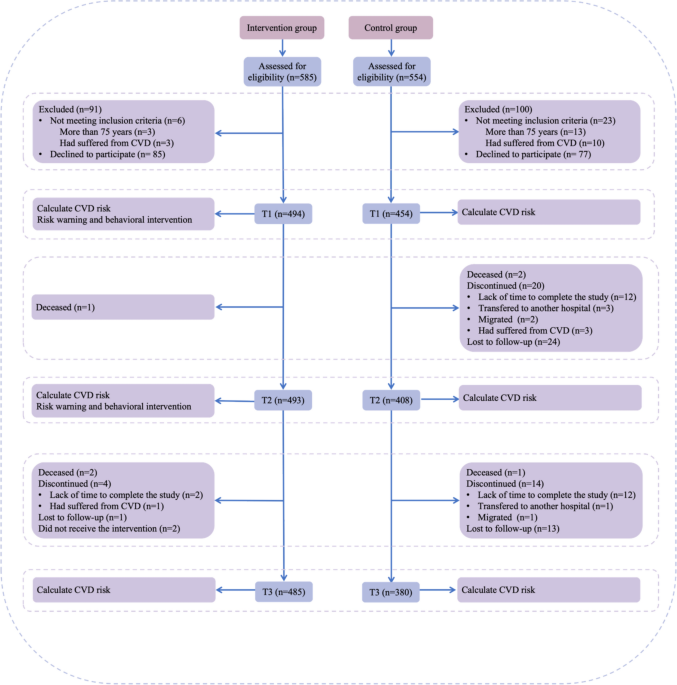
This study is one of the first multicentre trials in China targeting reducing CVD risk among PLWH. We found a high CVD risk burden and unhealthy behaviours in this population. While overall risk reduction was not statistically significant in this short-term period, the intervention effectively improved knowledge and showed trends toward healthier behaviours. These findings suggest that risk warning and behavioural intervention may be a useful strategy for improving CVD risk awareness among PLWH, but longer follow-up and more intensive behavioural support may be needed to achieve sustained behavioural change and meaningful CVD risk reduction.
CVD Risk of PLWH
PLWH tend to exhibit a higher prevalence of traditional CVD risk factors compared with the general population. In our study, the smoking rate among PLWH was 29.43%, which is similar to 33.9% (95% CI: 31.4%–36.5%) reported among HIV-positive men in a previous study [33]. By contrast, data from the 2018 China Adult Tobacco Survey, which included 19,376 participants aged > 15 years, showed a lower smoking rate of 26.6% in the general population [34]. The alcohol consumption rate among PLWH in our study was 36.81%, slightly higher than the national average of 32.5% [35]. Previous evidence has suggested that HIV-related stigma may contribute to increased rates of smoking and alcohol use among PLWH [36].
In terms of physical activity, only 30.06% of PLWH in our study met the recommended standards. Although limited data are available on physical activity levels among PLWH in China, existing research has shown that aerobic exercise can improve vascular endothelial function, myocardial performance and mental well-being in this population [37, 38]. Furthermore, dietary nutrition was also suboptimal among our participants, particularly in the intake of potatoes, fruits and fluid milk. Although some studies have reported that a diagnosis of HIV can motivate individuals to improve health behaviours, with up to 59% reportedly improving their diet after diagnosis [39]. A large cohort study showed that almost half of PLWH had poor dietary nutrition quality [40]. Research from China has consistently shown that PLWH tend to have unbalanced dietary patterns, characterized by insufficient intake of vegetables, fruits, aquatic products, eggs and milk, potentially owing to factors such as poor appetite or limited attention to dietary health [41, 42].
The 5-year CVD risk in our study population was 2.33%, which is comparable to the 2.42% reported in the original D:A:D study [20]. However, the proportion of PLWH with a 10-year CVD risk > 10% reached 10.97%, indicating a substantial long-term risk. This finding is consistent with previous studies conducted in China using the D:A:D(R) model: in 2017 and 2020, two studies among treatment-naive PLWH found that 3.3% (32/973) and 17.26% (65/365) of participants had 5-year and 10-year CVD risk > 10%, respectively [10, 43]. Moreover, a 2022 study evaluating 601 PLWH receiving long-term ART found that 10-year CVD risk > 10% was observed in 4.3% of those on long-term ART and 6.3% of treatment-naive individuals [44].
Overall, our findings reveal that PLWH experience a disproportionately high burden of modifiable CVD risk factors – such as smoking, alcohol use, physical inactivity and poor dietary habits – compared with the general population. This highlights a critical gap in existing HIV care, where CVD prevention remains insufficiently addressed. These results underscore the urgent need for targeted interventions that not only improve knowledge but also promote sustainable behaviour change.
The Effect Evaluation of the Intervention
The intervention group demonstrated a significantly higher CVD cognitive level compared with the control group, indicating that the intervention effectively improved CVD-related knowledge among PLWH. Although research on CVD cognitive interventions in PLWH remains limited, existing evidence underscores their importance. For instance, a study in the USA found that 76% of PLWH were aware of CVD risk factors, attributing this heightened awareness to targeted public health interventions aimed at reducing CVD burden in this population [22]. Conversely, in settings lacking such interventions, PLWH often exhibit poor CVD awareness. A cross-sectional study in Kenya revealed that most PLWH had limited knowledge of CVD risk factors and underestimated their personal susceptibility to CVD in 2015 [45]. These findings collectively emphasize the critical role and demonstrated efficacy of cognitive interventions in enhancing CVD awareness among PLWH.
After the intervention, the intervention group exhibited a greater reduction in both smoking and drinking rates compared with the control group. Additionally, while the proportion of nutrition meeting recommended standards remained stable in the intervention group, it declined in the control group; however, these differences were not statistically significant. Notably, the intervention group demonstrated significant improvements in two key areas: a greater reduction in alcohol consumption frequency and sedentary time, both of which showed statistically significant differences. These findings suggest that, although the short-term intervention did not lead to complete smoking or alcohol cessation among PLWH, it effectively reduced the frequency of health risk behaviours. In the future, longer follow-up may be needed to determine whether these intermediate changes translate into clinically meaningful reductions in CVD risk.
Several explanations may account for the absence of statistically significant reductions in CVD risk in this study. First, the participants in this study were relatively young, and only about one-fifth of the participants were aged more than 50 years after PSM. Since the elderly tended to suffer from CVD, younger PLWH may perceive that they were at lower risk of having CVD and ignore health risk behaviours. Second, some PLWH do not focus on health risk behaviours in their daily life because they believe that they will die from HIV in the future and tend to smoke or use alcohol to reduce pain and stress [46, 47], which may also be the reasons for no statistical differences in smoking and alcohol consumption in this study. Third, the intensity and format of the intervention may not have been sufficient to produce measurable short-term changes in clinical CVD risk. For example, the Swiss HIV Cohort Study randomized trial showed that providing computerized CVD risk profiles to physicians, in addition to risk-factor management guidelines, did not significantly improve CVD risk score, suggesting that risk assessment or feedback alone may be insufficient to change CVD risk factors[48]. Similarly, the Australian HealthMap program highlighted that CVD risk management in HIV care may require broader self-management support, such as interactive shared health records, access to personal health information, health coaching and repeated patient–provider engagement [49]. Moreover, owing to the short follow-up period of this study, there may be a delayed effect of behavioural change. Although the CVD cognitive level of PLWH in the intervention group improved, it may be difficult to translate cognition into behaviours in a short period of time, which makes it difficult to show an obvious effectiveness. Indeed, an intervention among rural drinking population also showed that after the intervention, the adjusted abstinence rate of the intervention group was 1.13 times higher than the control group without statistical difference; however, the frequency of alcohol use in the intervention group was less than the control group with statistical difference [50], which was consistent with the results of this study. These studies suggest that future interventions may need to incorporate more continuous and interactive support to achieve clinically meaningful CVD risk reduction.
There are some limitations in this study. First, owing to the large scale of PLWH, only part of the AIDS-designated hospitals in Zhejiang province were included in this study as study sites, which may influence the representation of the findings. Second, owing to the inconsistent time interval between the biochemical index tests of PLWH in each study site, the TC and HDL values of T2 and T1 were assumed to be the same among some PLWH, which may also affect the CVD risk. Third, some participants were deceased, discontinued and lost to follow-up, which may have overestimated or underestimated CVD risk and related outcomes. Fourth, because this was a non-randomized controlled trial, residual confounding could not be fully excluded. Although PSM improved baseline comparability between groups, it also excluded a non-negligible number of participants with less comparable baseline covariate profiles, which may limit the generalizability of the matched-sample findings. Therefore, we additionally performed multivariable GEE analyses using the full pre-matched samples. The sensitivity analysis generally supported the main findings, although the statistical significance of some secondary behavioural outcomes varied across analytic approaches. In addition, although the GEE models accounted for within-participant correlation owing to repeated measurements over time, the participants within each PSM pair may not be fully independent, this may have influenced the estimated standard errors and confidence intervals. Therefore, the statistical significance of some matched-sample findings, particularly behavioural outcomes, should be interpreted cautiously.



Comments (0)