2.1 Study Design and Participant Population
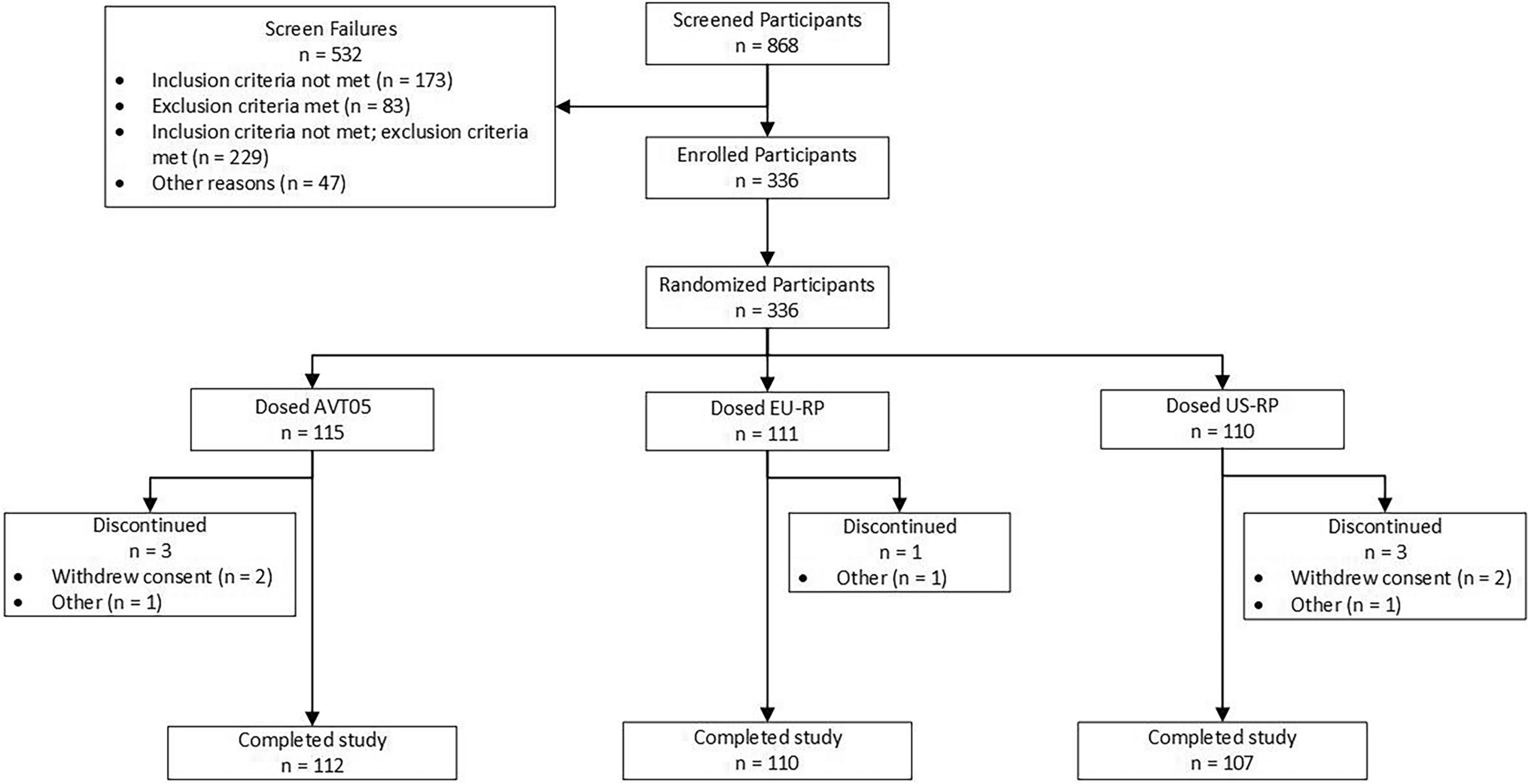
This was a randomized, double-blind, three-arm, parallel-group study assessing the pharmacokinetics, safety, tolerability, and immunogenicity of a single dose of AVT05, a biosimilar to RP golimumab, compared with EU-approved and US-licensed RP (EU-RP and US-RP, respectively) in healthy adult participants (NCT05632211). While there is no evidence of ethnicity influencing the PK profile of golimumab [12], approximately 10% of participants enrolled were Japanese, in order to meet a specific requirement from the Pharmaceuticals and Medical Devices Agency. The study took place between 28 Dec 2022 and 03 Oct 2023 at four study sites across New Zealand, South Africa, and the UK.
Participation in the study was approximately 15 weeks, comprising a 4-week screening period, an 11-week treatment and assessment period, and an end-of-study visit on Day 75. Key inclusion criteria included healthy participants being male or female, aged 18–55 years, with a body mass index of 18.0–30.0 kg/m2. To be considered ‘Japanese,’ participants had to have been born in Japan, have a Japanese passport, not lived outside Japan for more than 5 years, and have four Japanese grandparents. Participants with previous exposure to any TNF-α inhibitors, including golimumab, previous or concurrently clinically relevant pathologies, presence of chronic obstructive pulmonary disease, a current active infection, including localized infections, or any recent history (within the week prior to study drug administration) of active infections, cough or fever, or a history of recurrent or chronic infections, a positive test for tuberculosis or a known history of active or latent inadequately treated tuberculosis, and any clinically significant laboratory abnormalities were not eligible for the study.
An unblinded statistician prepared the computer-generated randomization list prior to the beginning of the study. Randomized participants were stratified as follows: male, female, Japanese, non-Japanese ≤ 80 kg, and non-Japanese > 80 kg. All of the investigators, site staff, the sponsor, and participants were blinded to treatment. The only exceptions were the pharmacist and the unblinded dosing team on site. All participants underwent inpatient observation at the study site from the evening of Day −1 until after collection of the 24 h post-dose samples and study assessments on Day 2. Dose modification was not allowed in this study. Participants returned to the study site for an ambulant visit to conduct assessments on Days 3, 4, 5, 6, 7, 8, 9, 10, 11, 12, 15, 22, 29, 36, 43, 50, 57, and 64 with an end of study visit on Day 75.
The study was conducted in accordance with the protocol, the ethical principles derived from international guidelines including the Declaration of Helsinki, applicable International Council for Harmonization of Technical Requirements for Pharmaceuticals for Human Use Good Clinical Practice guidelines, New Zealand Medicines and Medical Devices Safety Authority (Medsafe) regulations, South African Health Products Regulatory Authority regulations, Medicines & Healthcare products Regulatory Agency, and all other applicable laws and regulations. In addition, the study was approved by three independent ethics committees: Health and Disability Ethics Committee (New Zealand, 2022 FULL 12984), Health Sciences Research Ethics Committee (South Africa, UFS-HSD2022/1730/2802), and London Bridge Research Ethics Committee (UK, 22/LO/0659).
2.2 PK Analysis
All randomized participants who received any amount of the investigational product (IP) and had at least one evaluable PK parameter were included in the PK population. Prior to the PK analysis, and per the judgment of the blinded pharmcokineticist, participants with dosing deviations that could potentially affect the PK profile were excluded from the PK population. These could include, but were not limited to, incorrect administration time or dosing, intravenous versus SC injection, or incorrect injection location.
Venous blood samples for the determination of golimumab concentrations in serum were collected on Days 1 (within the hour prior to dosing and at 8 and 12 h post-dose), 2, 3, 4, 5, 6, 7, 8, 9, 10, 11, 12, 15, 22, 29, 36, 43, 50, 57, 64, and 75. Samples were analyzed using an appropriate sandwich assay on 96-well microtiter plates using Meso Scale Discovery electrochemiluminescence technology, an appropriate validated bioanalytical method. The lower limit of quantification was 12.5 ng/mL [13,14,15].
Serum golimumab concentrations were listed by participant and summarized using descriptive statistics (N, mean, standard deviation, coefficient of variation %, median, minimum, maximum, geometric mean, and geometric coefficient of variation %) by treatment group and nominal PK sampling timepoint. Individual (overlaid) and arithmetic mean (per treatment) concentration–time profiles on linear and logarithmic scales were displayed graphically. All serum golimumab concentrations that were below the limit of quantification were labeled as such in the concentration data listings. Serum concentrations of golimumab that were below the limit of quantification were designated a value of half of lower limit of quantification for the summary of concentration–time data, except for pre-dose below the limit of quantification values, which were assigned a value of zero. The lower limit of quantification/2 provided a balance of reliable PK data and reportable values that could be used in the statistical biosimilarity analysis, and is in line with scope of the present study [16,17,18].
Pharmacokinetic parameters of serum golimumab were derived using non-compartmental methods with Phoenix® WinNonlin® Version 8.3 or higher (Certara, LP Princeton, NJ, USA) and/or SAS® Version 9.4 or higher (SAS Institute, Inc., Cary, NC, USA). The primary endpoint was the assessment of PK similarity in terms of Cmax and AUC0–inf between AVT05 and RP, as well as between EU-RP and US-RP. Secondary PK parameters included area under the concentration–time curve from time zero to the last quantifiable concentration (AUC0–t), terminal elimination rate constant, terminal elimination half-life, apparent volume of distribution (Vz/F), and apparent clearance (CL/F). Body-weight adjusted PK parameters were also derived and summarized by treatment group.
2.3 Safety Analysis
The safety population comprised all randomized participants who received any amount of the IP. Safety endpoints comprised incidence, type, and severity of adverse events (AEs) [including adverse drug reactions], injection-site reactions, clinical laboratory assessments, vital signs, electrocardiograms, and physical examination findings.
From the time of signing the informed consent form (ICF) until the end of the participant’s involvement in the study, all AEs/serious AEs (SAEs) were recorded. Whether related or unrelated, all SAEs were recorded and submitted to the sponsor and/or designee within 24 hours of site awareness. Each (S)AE was given an assessment of severity (mild, moderate, severe) according to the investigator’s judgment. In addition, clinically significant abnormalities in protocol-specified laboratory parameters were also graded for severity according to Common Terminology Criteria for Adverse Events Version 5.0 and were recorded as AEs. The causal relationship of the AE to the IP or study procedures was assessed by the principal investigator (PI; or medically qualified delegate). For AEs or SAEs that were reported before or on Day 75, follow-up of ongoing events that were considered related to the IP continued up to the time of database lock. Adverse events were coded using the Medical Dictionary for Regulatory Activities central coding dictionary Version 25.1.
Following IP administration, injection sites were monitored for pain, tenderness, erythema, and swelling. If an injection-site reaction was observed, the physician characterized and documented the reaction as an AE and an AE of special interest. Review of the injection site continued until the AE was resolved. Each injection-site reaction was categorized using the US Food and Drugs Administration Toxicity Grading Scale: Grade 0 (absent), Grade 1 (mild), Grade 2 (moderate), Grade 3 (severe), and Grade 4 (potentially life threatening) and the severity of each resulting AE was also recorded.
Study enrollment and dosing were to be paused if any of the following scenarios occurred: if one or more participant experienced a SAE that was considered at least possibly related to the IP, if two or more participants experienced severe non-SAEs that were considered at least possibly related to the IP, independent of within or out of the same System Organ Class, or if the sponsor or investigator considered the presence of an unfavorable benefit-risk ratio based on emerging safety data.
2.4 Immunogenicity Analysis
The immunogenicity population comprised all randomized participants who received any amount of the IP and had at least one evaluable post-dose immunogenicity result (i.e. positive or negative for presence of anti-drug antibodies [ADAs]). Immunogenicity endpoints comprised the incidence and titer of ADAs, as well as the incidence of neutralizing antibodies (NAbs) in ADA-positive samples.
For the immunogenicity assessments, serum samples were collected on Days 1 (within the hour prior to dosing), 9, 15, 29, 57, 64, and 75, screened for antibodies binding to golimumab, and the titer of confirmed positive samples were reported. Antibodies were further characterized and/or evaluated for their ability to neutralize the activity of the IP. The immunogenicity assessments were analyzed using validated, highly sensitive electrochemiluminescence methods (ADA: one bridging assay using labeled AVT05 as the capture/detection reagent; NAb: one competitive ligand binding assay using labeled AVT05 as the capture reagent [19]). Specific parameters can be provided upon request. To enable interpretation of the immunogenicity data, serum samples tested for the presence of antibodies were also evaluated for concentration of golimumab.
Individual immunogenicity sample collection and ADA results (including NAb results, if available) were listed for all participants in the immunogenicity population. Anti-drug antibodies and NAbs were reported as the frequency of presence per timepoint and included all participants in the immunogenicity population.
2.5 Statistical Analysis
The primary PK endpoints for this study were Cmax and AUC0–inf. Sample size calculations were performed using SAS Version 9.4 and were based on PK parameter summary data from Ling et al., which evaluated the single-dose pharmacokinetics of SC golimumab in healthy Japanese and Caucasian male participants [12]. Based on this study, the inter-participant coefficient of variation % was assumed to be 35.0% for AUC0–inf and 37.7% for Cmax.
Assuming a true geometric mean ratio (GMR) of 95%, 101 evaluable participants per treatment group would provide a power of 95.5% for each individual comparison of Cmax and a power of 97.4% for each individual comparison of AUC0–inf. Considering a non-evaluable rate of 10%, the total sample size of 336 participants (112 per treatment group) provided an overall study power of 80.5%. Of the 336 participants, at least 10% (33 participants, 11 per group) of participants of Japanese origin were planned to be enrolled.
An analysis of covariance statistical model was used to assess PK similarity in this study. The model used natural log-transformed values of Cmax and AUC0–inf. Treatment and sex as factor were included as fixed effects, and body weight at baseline was included as the continuous covariate.
The LS means, the LS treatment difference, and the 90% CIs for the treatment differences derived from the log-transformed parameter values were generated from the statistical model for each endpoint. The point estimates for the ratio of test/RP for the geometric LS means and 90% CIs for each comparison were generated by back-transforming the LS treatment differences and corresponding CIs to the original scale.
For each of the pairwise comparisons (AVT05 to US-RP, AVT05 to EU-RP, and EU-RP to US-RP), PK similarity was demonstrated if the 90% CIs of the GMR for both AUC0–inf and Cmax were contained entirely within the prespecified margins of 80.00% and 125.00%.
Exploratory analyses of PK similarity were performed for various subgroups and the results interpreted descriptively. No formal statistical inference for subgroups was made.



Comments (0)