
Remember me


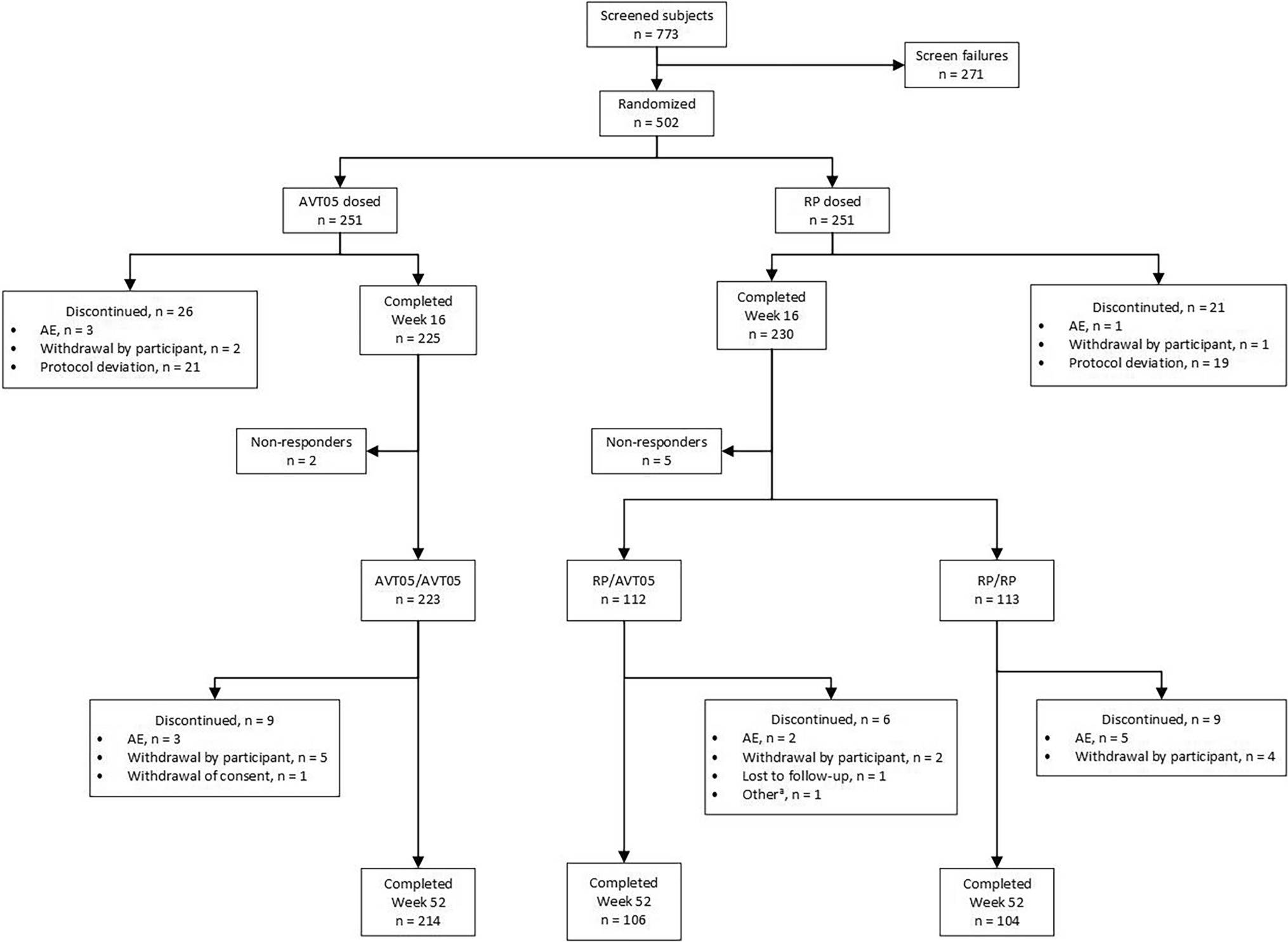
Of 773 participants screened for eligibility, 502 participants were randomized 1:1 into two groups (AVT05/RP; 251 participants in each group; Fig. 1). Of the randomized participants, 225 (89.6%) from the AVT05 group and 230 (91.6%) from the RP group completed Week 16 of the study. Forty-seven (9.4%) participants (26 [10.4%] in the AVT05 group and 21 [8.4%] in the RP group) discontinued, the primary reasons being protocol deviation (21 [80.8%] and 19 [90.5%]), adverse event (3 [11.5%] and 1 [4.8%]), and withdrawal (2 [7.7%] and 1 [4.8%]). At week 16, there were two and five non-responders in the AVT05 and RP groups, respectively.
Fig. 1
Disposition of participants in the study. aOther reason for study discontinuation was a positive QuantiFERON-TB test. AE adverse event, RP reference product golimumab
At Week 16, responders from the RP group (n = 225) were re-randomized 1:1; 113 continued RP (RP/RP group) and 112 switched to AVT05 (RP/AVT05 group). All participants who were originally randomized to receive AVT05 continued to receive AVT05 (AVT05/AVT05 group; n = 223).
The demographics and baseline characteristics of the participants were well balanced between the AVT05 and RP treatment groups (Table 1). No significant differences were observed between the groups with respect to age and weight.
Table 1 Demographics and baseline characteristics of participantsAfter re-randomization at Week 16, similar demographic and baseline characteristics were observed across the treatment arms. Additional data on baseline disease characteristics are presented in Table S2 of the ESM.
Regarding treatment compliance, patients received their study treatments per the protocol. At Week 12, treatment compliance was above 90% in both the AVT05 and RP groups. At EOS, compliance remained high: 97% in the AVT05/AVT05 group, 96% in the RP/AVT05 group, and 92% in the RP/RP group.
3.2 Efficacy Results3.2.1 Primary EndpointThe primary endpoint was assessed using the full analysis set, excluding data from participants who experienced protocol-defined ICEs. A total of 44 (8.8%) participants (25 [10.0%] participants in the AVT05 group and 19 [7.6%] participants in the RP group) had ICEs, leading to full or partial exclusion of data from the primary endpoint analysis.
Intercurrent events included, but were not limited to, prohibited concomitant medications prior to Week 16 that would impact the primary endpoint, receiving treatment from an incorrect treatment group prior to Week 16, discontinuation from the study drug prior to Week 16, additional protocol deviations: for example, invalid baseline DAS28-CRP or a change in the dose of concomitant medications prior to Week 16. Intercurrent events were determined in a blinded data review meeting prior to the database lock.
The least squares (LS) mean change (standard error [SE]) in DAS28-CRP from baseline to Week 16 was similar for the AVT05 and RP groups (−2.89 [0.058] and −2.98 [0.058], respectively). The LS mean difference (SE) was 0.09 (0.082). The 95% CI for the LS mean difference was completely contained within the equivalence margin of [− 0.6, 0.6] for the EMA. Similarly, the 90% CI for the LS mean difference was completely contained within the equivalence margin of [− 0.6, 0.54] for the FDA. These data support the demonstration of comparative efficacy between AVT05 and RP groups at week 16 (Table 2).
Table 2 Change from baseline in DAS28-CRP up to Week 16. Baseline is defined as the last non-missing value (scheduled, unscheduled, or repeated) before the participant received the first dose of investigational product (Day 1). Two-sided 90% and 95% CIs for the difference in LS means between AVT05 and RP groups are obtained from a mixed-effects model for repeated measures including the treatment, visit, and treatment by visit interaction as fixed effects, and baseline DAS28-CRP as a continuous covariate. An unstructured covariance structure is used to model the within-participant error and an adjustment to the degrees of freedom is made using the Kenward Roger’s approximation. All missing data including actual missing DAS28-CRP and the data excluded because of intercurrent events are not imputed but are handled by a mixed-effects model for repeated measures under the assumption of missing at randomTwo sensitivity analyses supported the robustness of the primary endpoint estimates (Tables S3 and S4 of the ESM). The first sensitivity analysis repeated the primary endpoint analysis without excluding any data because of ICEs. The LS mean difference (SE) for AVT05 versus RP was 0.09 (0.082), and both the 95% CI and the 90% CI were within the same pre-defined equivalence margins as the primary endpoint. The second sensitivity analysis repeated the primary endpoint analysis excluding data following ICEs or additional protocol deviations that impacted the assessment of the primary endpoint. The LS mean difference (SE) for AVT05 versus RP was 0.09 (0.082), and both the 95% CI and the 90% CI were within the same pre-defined equivalence margins as the primary endpoint.
For the subgroup analysis, the point estimates for the treatment difference in DAS28-CRP change from baseline up to Week 16 did not reveal any major differences across the subgroups of age group (< 65 years, ≥ 65 years), sex (male, female), baseline DAS28-CRP (≤ 5.1, > 5.1), ADA status up to week 16 (positive, negative), and NAb status at Week 16 (positive, negative). The point estimates for all assessed subgroups were completely contained within the equivalence margin of [− 0.6, 0.6] for the EMA (Fig. 2) and [− 0.6, 0.54] for the FDA, further supporting the overall finding of clinical similarity between the two treatment groups.
Fig. 2
Forest plot of 95% confidence intervals (CIs) of a change from baseline in Disease Activity Score-28 using C-Reactive Protein (DAS28-CRP) up to week 16. Two-sided 95% CIs for the difference in least squares means between AVT05 and reference product golimumab (RP) groups are obtained from a mixed-effects model for repeated measures including the treatment, visit, and treatment by visit interaction as fixed effects, and baseline DAS28-CRP as a continuous covariate. An unstructured covariance structure is used to model the within-participant error and an adjustment to the degrees of freedom is made using the Kenward Roger’s approximation. ADA anti-drug antibody, N number of participants with non-missing change from baseline in DAS28-CRP at week 16, NAb neutralizing anti-drug antibody
3.2.2 Secondary EndpointsFigure 3 shows the change from baseline in DAS28-CRP, by visit. The DAS28-CRP decreased from baseline over time up to Week 16, with comparable scores for the AVT05 and RP groups at Weeks 4, 8, 12, and 16. The DAS28-CRP remained broadly stable from Week 16 to EOS with comparable scores for the AVT05/AVT05, RP/AVT05, and RP/RP groups at Weeks 24, 32, 40, 48, and 52 (Fig. 4).
Fig. 3
Mean (± standard deviation [SD]) change from baseline in Disease Activity Score-28 using C-Reactive Protein (DAS-28 CRP) to Week 16 by visit. Baseline is defined as the last non-missing value (scheduled, unscheduled, or repeated) before the participant received the first dose of investigational product (Day 1). Participants with an invalid DAS28-CRP at baseline (n = 39) are excluded from this figure. RP reference product golimumab
Fig. 4
Mean (± standard deviation [SD]) change from baseline in Disease Activity Score-28 using C-Reactive Protein (DAS-28 CRP) from Week 16 to end of study by visit in ‘Responder’ participants. Baseline is defined as the last non-missing value (scheduled, unscheduled, or repeated) before the participant received the first dose of investigational product (Day 1). Participants with an invalid DAS28-CRP at baseline (n = 39) are excluded from this figure. RP reference product golimumab
The percent change from baseline in DAS28-CRP was comparable for the AVT05 and RP groups at Weeks 4, 8, 12, and 16 and was further comparable for the AVT05/AVT05, RP/AVT05, and RP/RP groups at Weeks 24, 32, 40, 48, and 52 (Table S5 of the ESM). There was no clinically meaningful difference in the percentage of participants achieving ACR20, ACR50, and ACR70 between the AVT05 and RP groups at Weeks 4, 8, 12, and 16 and between the AVT05/AVT05, RP/AVT05, and RP/RP groups from Week 16 till EOS.
Both CDAI and SDAI scores decreased from baseline over time up to Week 16, with comparable scores for the AVT05 and RP groups at Weeks 4, 8, 12, and 16. The CDAI and SDAI scores remained broadly stable after re-randomization at Week 16 to EOS, with comparable scores for the AVT05/AVT05, RP/AVT05, and RP/RP groups at Weeks 16, 24, 32, 40, 48, and 52 (Tables S6 and S7 of the ESM).
Changes from baseline in all individual CDAI and SDAI components were all comparable across treatment groups to Week 16, and from Week 16 to EOS, including in participants who switched treatments. These comprised swollen joint count, tender joint count, participant-assessed disease activity, pain and activity level, physician-assessed disease activity, and CRP (SDAI score only). These findings support the demonstration of comparable efficacy of AVT05 and RP in terms of secondary efficacy points at Week 16, persisting to EOS, including in participants who switched treatments.
3.3 PK ResultsOverall, the PK profiles in the AVT05 and RP groups were comparable up to Week 16, and from Week 16 to EOS. Trough concentration increased per visit from baseline to Week 16, then with a dip at Week 40 that was comparable across all treatment arms, and plateauing again by EOS at Week 52 (Fig. 5).
Fig. 5
Mean (± standard error) of serum trough pharmacokinetic concentration versus time from baseline to Week 16 (two treatment arms; panel [a]) and from Week 16 to Week 52 (three treatment arms; panel [b]). RP reference product golimumab
3.4 ImmunogenicityUp to Week 16, 119 (54.1%) participants in the AVT05 group and 127 (58.3%) participants in the RP group had treatment-emergent binding ADAs. Of these, 55 (46.2%) participants in the AVT05 group and 62 (48.8%) participants in the RP group had treatment-emergent NAbs (Table 3).
Table 3 Confirmed positive antibody incidence (safety analysis set)From Week 16 to EOS, 19 (21.3%) participants in the AVT05/AVT05 group, 9 (25.7%) participants in the RP/AVT05 group, and 8 (18.2%) participants in the RP/RP group had treatment-emergent binding ADAs. Of these, 1 (5.3%) participant in the AVT05/AVT05 group, 3 (33.3%) participants in the RP/AVT05 group, and 1 (12.5%) participant in the RP/RP group had treatment-emergent NAbs (Table 3).
Box plots of ADA titers by visit are presented up to Week 16 and from Week 16 to EOS in Fig. S1 of the ESM. There was no clinically meaningful difference between treatment arms, including in participants who switched treatment.
3.5 SafetyUp to Week 16, the incidence of any reported TEAE was comparable (38.2% and 41.8% in AVT05 and RP groups, respectively). Most TEAEs were Grade 1. One Grade 5 TEAE was reported in the RP group. Serious TEAEs (1.6%; n = 4: 4 events and 0.8%; n = 2: 2 events) were reported in the AVT05 and RP groups, respectively. There were 4 (1.6%) and 1 (0.4%) participants with TEAEs in the AVT05 and RP groups, leading to early discontinuation from the study, all of which were serious. Treatment-emergent adverse events of special interest occurred in 19.1% of participants in the AVT05 group and 15.1% in the RP group (Table 4).
Table 4 Overview of TEAEs (till EOS)Treatment-related adverse events were reported in 7.6% and 11.2% in the AVT05 and RP group. Treatment-related serious adverse events were 0.4% in each group. Similarly, both discontinuation/ early termination (ET) because of treatment-related adverse events were 0.4% in each group (Table 4).
From Week 16 to EOS, the incidence of any reported TEAE was comparable (51.1%, 58% and 57.5% in AVT05/AVT05, RP/AVT05, and RP/RP, respectively). Most TEAEs were Grade 1. Two Grade 4 TEAEs were reported in the RP/RP group. There were 2.7%, 1.8%, and 6.2% serious TEAEs reported in the AVT05/AVT05, RP/AVT05, and RP/RP groups. Treatment-emergent adverse events leading to discontinuation from the study treatment phase were 0.9%, 1.8%, and 4.4% in the AVT05/AVT05, RP/AVT05, and RP/RP groups. Serious TEAEs leading to ET from the study were reported to be 0.4% and 1.8% in the AVT05/AVT05 and RP/RP groups; however, there was none in the RP/AVT05 group. There were 25.6%, 32.1%, and 28.3% TEAEs of special interest reported in the AVT05/AVT05, RP/AVT05, and RP/RP groups (Table 4).
From Week 16 to EOS, treatment-related adverse events occurred in 6.7%, 10.7%, and 15.9% in AVT05/AVT05, RP/AVT05, and RP/RP treatment groups. Only one treatment-related serious adverse event was reported in the RP/RP group. Treatment-related adverse events leading to either discontinuation or ET from the study were reported in two participants in the RP/AVT05 group and in one participant in the RP/RP group but none in the AVT05/AVT05 group. There were no treatment-related serious adverse events leading to ET from the study in any group (Table 4).
Up to Week 16 and by System Organ Class (SOC), TEAEs were generally well balanced between the groups. The most common TEAEs by SOC were infections and infestations and investigations. No SOC was more common in the AVT05 group than in the RP group (Table S8 of the ESM). The most common (occurring in > 5% of participants in any group) TEAEs by Preferred Term were urinary tract infection.
From Week 16 to EOS and by SOC, TEAEs were generally well balanced between the groups. The most common TEAEs by SOC were infections and infestations, investigations, and musculoskeletal and connective tissue disorders (Table S8 of the ESM). From Week 16 to EOS, the most common TEAEs by Preferred Term were upper respiratory tract infection, urinary tract infection, and nasopharyngitis.
Up to Week 16, the most common serious TEAEs were neoplasms benign, malignant and unspecified (including cysts and polyps), and renal and urinary disorders (each reported in one participant in each group). All serious TEAEs had an outcome of recovered/resolved except for infectious pleural effusion (one participant in the AVT05 group), which had an outcome of recovered/resolved with sequelae, and metastatic neoplasm (one participant in the RP group), which had a fatal outcome.
From Week 16 to EOS, the most common serious TEAEs by SOC were infections and infestations, gastrointestinal disorders, and musculoskeletal and connective tissue disorders. The most common serious TEAEs by Preferred Term were pneumonia and rheumatoid arthritis.
The only participant who died in the RP group before Week 16 had a Grade 5 TEAE of metastatic neoplasm that started on day 92 and was conservatively assessed as related to the study treatment, and for which the IP was withdrawn. The TEAE had a fatal outcome on day 117. From Week 16 to EOS, no participants died.
There were no clinically significant changes in laboratory parameters from baseline up to Week 16. Vital sign parameters were comparable between the AVT05 and RP groups and were generally stable over time.
Electrocardiograms were evaluated at baseline, Week 24, and at Week 52. Electrocardiograms generally remained stable from baseline to EOS. No TEAEs related to electrocardiogram parameters were reported up to Week 16 or from Week 16 to EOS.
Comments (0)