Key findings
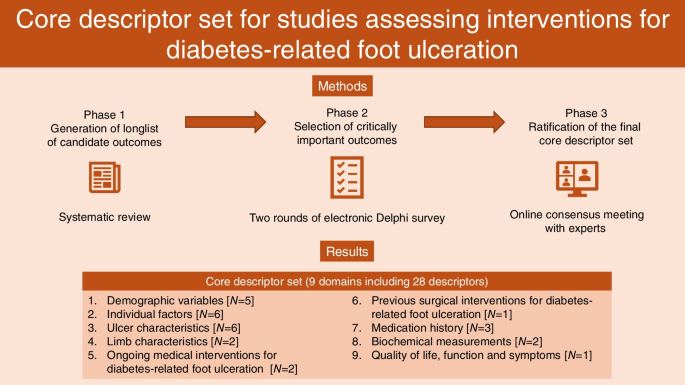
This CDS is a result of a large interdisciplinary and international effort to standardise the key participant and disease characteristics when reporting studies assessing interventions for diabetes-related foot ulceration. This CDS is the minimum list of descriptors to be reported but does not provide specific guidance on how these descriptors should be measured, nor prohibits individual studies from including additional descriptors based on their individual design.
CDS in the context of previous work
This CDS was created using the internationally recognised and validated COMET framework [13] that has guided development of CDS in other disciplines [10,11,12]. The development process has been reported in line with COS-STAR guidance [14]. The International Working Group on the Diabetic Foot has previously published recommendations on what participant and disease characteristics ought to be described and what outcomes should be included when reporting studies addressing management of diabetes-related foot ulceration [19]. These recommendations, however, were an expert opinion rather than a formal study using a defined methodology. Nonetheless, 15 out of 17 recommended descriptors included in that opinion letter featured in our CDS, with the two exceptions being the number of ulcers and presence of foot deformity. This suggests overall alignment of this CDS with the expert international opinion. Our group has previously published a core outcome set for studies assessing interventions for diabetes-related foot ulceration [5] to standardise outcome reporting across trials. The addition of this CDS further strengthens our international efforts to improve the overall quality of the evidence underpinning clinical practice by allowing comparison of studies evaluating similar populations.
Ratification of the final CDS
The consensus meeting allowed for in-depth interdisciplinary discussion among experts, bringing a range of perspectives and clinical backgrounds. The panel aimed to ratify a balanced CDS that included a wide range of descriptors to encourage comprehensive characterisation of the study population while remaining useable and practicable. The final ratified CDS includes 28 descriptors spanning nine domains, which is comparable with sets in other disciplines including between 19–37 descriptors across six to eight domains [10,11,12].
Participant characteristics
Our final CDS includes basic demographic characteristics, such as sex, age, race and ethnicity, the reporting of which has been required by leading research funders globally to help achieve health equity. The NIH Revitalisation Act of 1993, with subsequent amendments in 2000 and 2007, stipulated that female sex and members of the minority groups should be included in clinical research [20]. Since 2017, the world leading clinical trials database, ClinicalTrials.gov, has additionally mandated reporting of race and ethnicity for all registered studies on their platform [21]. Furthermore, since 2025, the NIHR in the UK has mandated demonstration of equal sex inclusion throughout research lifecycle [22]. To tackle possible age discrimination in research, 42 main research funders and charities in the UK have released a joint statement to promote inclusion of older adults in clinical research [23].
The two additional descriptors included in this domain were BMI and history of smoking. Previous studies demonstrated J-shaped association between BMI and risk of diabetes-related foot ulceration [24] and underweight individuals with established foot ulcers have been found to have higher mortality and increased risk of limb loss [25]. Cigarette smoking has been linked to increased oxidative stress worsening diabetes-related neuropathy and impairing all four phases of wound healing [26] as well as higher major amputation risk [25].
Individual factors
The key individual factors included in our CDS have been linked to high risk of ulcer recurrence and were found to be important predictors of all-cause mortality [27,28,29,30]. Inclusion of history of prior diabetes-related foot ulcer was essential as approximately 40% of ulcers recur within 1 year of healing [30] and those with recurrent ulcers were found to have had a minor amputation, and to have a longer duration of diabetes and diabetes-related neuropathy [27, 28]. Time to ulcer recurrence was found to be longer in individuals with no prior history of ulceration [29].
The optimal reporting of renal disease as a comorbidity generated significant discussion during the consensus meeting. The Delphi survey contained four separate descriptors referring to renal disease, including diabetes-related nephropathy, dialysis, kidney disease and renal function. On balance, the consensus meeting group felt that the burden of renal disease would be most effectively captured as chronic kidney disease stage. This approach is in keeping with how renal disease has been reported in clinical trials over the past two decades [31].
Ulcer and limb characteristics
Given the multitude of classification and scoring systems for diabetes-related foot ulceration, with only a minority being developed in large multicentre studies, having undergone external validation and assessment of reliability, none were included in this CDS. Instead, individual descriptors relating to ulcer and limb characteristics were identified through the Delphi process and subsequently ratified in the consensus meeting. The selected descriptors could be, however, retrospectively translated into the key classification systems recommended by the International Working Group on the Diabetic Foot: SINBAD system, Infectious Diseases Society of America/IWGDF (IDSA/IWGDF) classification and the WIfI system [18].
Previous or ongoing medical interventions for diabetes-related foot ulceration
Our CDS includes current use of antibiotics, as antimicrobial therapy has a synergistic effect when delivered in conjunction with other interventions and is recommended following surgical debridement of severe soft tissue infections [32]. Prompt treatment of infection in the context of diabetes-related ulceration is essential in reducing the risk of sepsis and limb loss [33]. Despite this, the Concordance in Diabetic Foot Ulcer Infection 2 (CODIFI2) study showed that 16.1% of individuals with suspected infection are not on any antimicrobial therapy [34].
Furthermore, we recommend reporting of any current use of offloading modalities when characterising the study population, as offloading therapy is frequently delivered together with other interventions [35].
Previous surgical interventions for diabetes-related foot ulceration
While many surgical interventions for diabetes-related foot ulceration exist, our CDS only incorporates amputation. This descriptor, however, includes both minor (either ipsilateral or contralateral) and contralateral major amputation. History of minor amputation is a predictor of ulcer recurrence [27, 28], and previous contralateral major amputation affects suitability for various offloading modalities [36] and is linked to 70% of the 5 year mortality rate [30]. History of revascularisation was not included in the final set, as it was felt that it would not necessarily reflect current perfusion status, which is already captured by descriptors in the limb characteristics domain.
Medication history
In addition to the inclusion of standard glucose-lowering agents such as insulin and oral glucose-lowering medications, the consensus group recommended the inclusion of novel non-insulin injectable agents. While these were not identified through our systematic review, an increasing number of studies have recently addressed the impact of novel injectables on diabetes-related foot ulcer healing [37].
Biochemical measurements
The two biochemical measurements included in the CDS are glycaemic management and eGFR. Understanding the effectiveness of glycaemic management in the studied population is essential when evaluating wound healing, as chronic hyperglycaemia may promote persistent inflammation in diabetes-related foot ulcers through modulation of numerous metabolic pathways [38]. eGFR was felt to be the most universally used measure of renal function [39] that is likely to be recorded routinely for individuals with diabetes-related foot ulcers. It has been incorporated into the CDS alongside chronic kidney disease stage as it was argued that chronic kidney disease may be present despite normal eGFR [39]. Thus, these two measures were included to effectively capture the burden of renal disease in most clinical studies.
Quality of life, function and symptoms
Health-related quality of life was ratified as the most informative descriptor to capture the level of independence with activities of daily living and emotional burden of the disease. Furthermore, as it is featured in our previously published core outcome set for studies evaluating the interventions for diabetes-related foot ulceration [5], direct impact of the intervention on the health-related quality of life could be measured and economic evaluations undertaken.
Strengths and limitations
Our CDS is a result of an international effort involving clinicians and researchers from 36 countries across six continents using recognised COMET methodology [10,11,12,13]. The study participants represent a wide spectrum of clinical disciplines, including podiatry, diabetology, and vascular and orthopaedic surgery, providing a range of perspectives. Our multidisciplinary expert consensus group involved in the ratification of the final CDS was composed of leaders in the field of diabetes-related foot disease who are heavily involved in the development of international guidelines on prevention, classification and management of diabetes-related foot ulcers. Furthermore, we involved a person living with diabetes throughout the lifecycle of our study. With their help, we were able to ensure that descriptors that may be important to them were not eliminated during the descriptor rationalisation stages of the study. Additionally, they provided insight into how certain descriptors may be perceived, prompting us to ensure that even if not included in the final CDS, they would be captured within similar descriptors (e.g., the level of independence with the activities of daily living could be captured in health-related quality of life).
Despite strong methodology, our study is not without limitations. Even with our best efforts to maximise the response rate in the second survey round, it was ultimately only completed by 68% of study participants. This may represent overall fatigue with respect to survey-based studies and lack of time due to competing commitments. Nonetheless, the observed response rate is comparable with that in other Delphi studies [5, 10, 12]. Similar to our previous experiences [5] and those of other groups [40], study participants struggled to be highly selective when rating individual descriptors during the Delphi stage of the project. As a result, 41 (43%) of descriptors were rated as critical and were highlighted for consideration in the CDS. Only one descriptor was found to be unimportant and therefore excluded, and after two rounds of Delphi, the remaining 53 (56%) descriptors did not reach consensus and required further discussion. To ensure that the final CDS was practicable and relevant in research practice, the steering group had to rationalise the list of candidate descriptors prior to the consensus meeting to allow for a thoughtful and in-depth discussion of the final contents of the CDS. This approach has been successfully used before by our group during the development of a core outcome set for interventions for diabetes-related foot ulceration [5].
Impact and implementation strategy
This CDS was developed to standardise characterisation of participants when reporting clinical studies evaluating treatments for diabetes-related foot ulceration. It is designed to be used in conjunction with our previously developed core outcome set, which defined a minimum list of outcomes that should be measured when evaluating interventions for diabetes-related foot ulcers [5].
This work will be shared with key international societies and interest groups fostering research in diabetes-related foot ulceration. Adoption of this CDS in research practice will help tackle variability in meta-analysis and contribute to clearer disease characterisation and classification.





Comments (0)