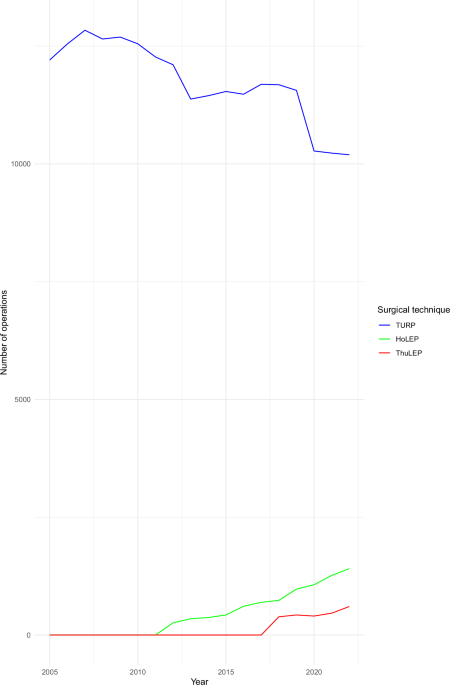
The present nationwide analysis from Germany provides comprehensive data on the perioperative outcomes and trends of TURP, HoLEP, and ThuLEP in patients with PCa. Our findings demonstrate that laser enucleation techniques offer significantly better perioperative outcomes compared to TURP, including lower rates of transfusions, ICU admissions, and postoperative urinary retentions. Accordingly, patients with PCa undergoing HoLEP or ThuLEP display similar perioperative outcomes compared to those without PCa undergoing HoLEP or ThuLEP. Notably, the use of HoLEP and ThuLEP has increased steadily in recent years, comprising approximately 17% of all PCa cases by 2022, while TURP cases have slightly declined. Still, TURP is the operation of choice for managing LUTS in patients with PCa.
It is important to emphasize that HoLEP, ThuLEP, and TURP can be utilized in various clinical scenarios of PCa, ranging from incidental, low-risk cases to those with locally advanced or metastatic disease. Laser enucleation is based on identifying and following the surgical plane, which might not be feasible in patients with infiltrating PCa [13]. Based on the previous notion, available evidence indicates that the enucleation time, as well as the surgical performance (g/min), are worse in patients with PCa compared to patients with no PCa [14]. Nevertheless, it seems that the latter does not negatively affect the short- and long-term outcomes of laser enucleation. Indeed, previous studies indicate that laser enucleation offers adequate symptom improvement and a good safety profile, even in patients with locally advanced PCa [10, 14].
On the contrary, our findings suggest that TURP is associated with worse perioperative outcomes in patients with PCa compared to both patients with PCa undergoing laser enucleation as well as to those without PCa undergoing TURP [15]. Indeed, TURP in patients with PCa was associated with the highest rates of perioperative complications. The latter might be explained by the fact that TURP is selected in cases where laser enucleation is unfeasible or at least technically challenging, such as in patients with locally advanced PCa, emergency operations, or multiple comorbidities [16]. In an attempt to overcome this selection bias, we present a high-volume cohort with multiple patient-level analyses, comparing both PCa versus no PCa patients, as well as TURP versus laser enucleation. In line with our findings, previous studies suggest that TURP is associated with worse outcomes in patients with known PCa [17, 18]. Conversely, the favorable perioperative outcomes of HoLEP and ThuLEP underline the clinical advantages of laser enucleation, especially for patients with PCa, who are often at higher risk of adverse events due to comorbidities or disease progression [19].
It should be stressed that our findings demonstrate a swift towards the use of HoLEP and ThuLEP in patients with PCa, which reflects the global trends of BPH surgery [20]. Of note, it seems that an important amount of urologists in Germany performing HoLEP and ThuLEP opt for laser enucleation even in the case of PCa. This shift suggests a growing preference for minimally invasive procedures that may maximize patient safety and recovery while maintaining efficacy even in challenging cases [21]. However, despite the increasing use of laser enucleation, TURP continues to be the mainstay for BPH surgery due to its established role in clinical practice, broader availability, and familiarity among surgeons [22]. Moreover, the use of laser enucleation may be limited by the higher initial costs associated with laser equipment, as well as by the steep learning curve for surgeons, especially in patients with PCa [23].
Our findings underscore important clinical implications. First, laser enucleation should be considered as a viable surgical option in patients with PCa [24]. The safety profile of laser techniques may reduce postoperative morbidity, facilitating faster recovery also for challenging cases [25]. Therefore, our results support a paradigm shift in surgical management of LUTS in PCa patients. Future studies should assess long-term functional and oncologic outcomes and evaluate implementation strategies for broader adoption of laser enucleation [26]. Importantly, integrating laser enucleation into standard practice will require structured training programs to overcome the steep learning curve [27]. Moreover, healthcare systems should consider investing in laser technology infrastructure, especially in high-volume centers, to maximize accessibility and patient benefit [28].
This study represents, to the best of our knowledge, the largest analysis of the perioperative outcomes and trends of TURP, HoLEP, and ThuLEP in patients with PCa. However, several important limitations should be noted. First of all, the retrospective design and reliance on billing data may introduce potential inaccuracies due to coding errors or misclassificationsm as well as due to underreporting or overreporting of some outcomes. Additionally, important clinical details such as tumor stage (incidental or advanced PCa), complete oncological status (i.e., Gleason score, tumor size, TNM classification), operative time, patient laboratory findings (including PSA levels), and detailed patient comorbidity profiles (including ASA score or Charlson Comorbidity Index) were not available for analysis. Accordingly, histopathological findings and prior PCa treatments were missing. Based on the previous notion, no subgroup analyses (e.g. advanced versus not advanced PCa) could be performed. Due to the structure of the GRAND registry, we were unable to identify or exclude repeat surgeries. As such, it is possible that a small number of patients who underwent more than one intervention over the study period may be included more than once. Still, in an attempt to overcome these limitations, we performed a holistic analysis comparing PCa versus no PCa patients, as well as TURP versus laser enucleation. Of note, the absence of long-term data on functional outcomes, recurrence rates, and patient quality of life further limits the conclusions of this study. Lastly, as the findings are specific to the German healthcare system, caution is warranted in extrapolating these results to countries with different healthcare systems and surgical practices.
Our analysis highlights the increasing adoption of laser enucleation techniques, such as HoLEP and ThuLEP. Patients with PCa undergoing laser enucleation display similar perioperative outcomes compared to those without PCa. On the contrary, TURP in patients with PCa is associated with worse perioperative outcomes compared to patients with PCa undergoing HoLEP or ThuLEP as well as compared to patients without PCa undergoing TURP. However, these findings should be interpreted with caution, as TURP is the preferred surgical approach in specific clinical contexts where laser enucleation may not be feasible or indicated, such as in patients with locally advanced disease and severe LUTS. Each surgical approach has unique advantages and limitations that must be carefully weighed based on patient-specific factors and surgeon expertise to ensure optimal clinical decision-making.

Comments (0)