
Remember me


This study employed a theory-driven, exploratory educational intervention to operationalize the presented SEARCH framework. The intervention was delivered as a short term, field-based learning activity conducted in a virtual, game-based format. The framework development and activity implementation are described below.
Framework DevelopmentThe SEARCH framework was developed iteratively. An initial set of framework domains and design principles was derived from a review of the literature on game-based learning and instructional design in health professions education. Expert input was provided through consultation within the authorship team and with local medical educators. In particular, one author (S.J) is a senior educator with over three decades of experience in higher education including experience integrating game-based learning approaches across undergraduate curricula. This author has also contributed to the development and application of institutional frameworks for student-centered effective learning and internal quality culture in higher education [37, 38]. This expertise guided the articulation of framework components.
The framework was further refined by undergoing two rounds of pilot testing. The first pilot involved the design and implementation of an in-person scavenger hunt, followed by a second pilot consisting of a small-scale virtual scavenger hunt. These pilot applications were used to examine the clarity and usability of framework components for educators, and their alignment with intended EBM learning outcomes. Feedback from each pilot iteration was reviewed through discussion and manual concept mapping, leading to the final version of the SEARCH framework presented in this study.
Scavenger Hunt PlanningEducational SettingThe activity was conducted with undergraduate medical students at Rawalpindi Medical University, Pakistan in June 2023, during summer break, to ensure maximum participation. It was conducted as part of a Virtual Research Olympiad conducted by the university’s student research society. The activity was promoted on the society’s social media platforms and students could register via an online Google form for free. It attracted participants from various national medical colleges, thereby providing a multi-institutional perspective. Participation was voluntary and the activity was conducted remotely in a fully virtual format.
Curriculum and Task DesignThe instructional content of the virtual scavenger hunt was structured around the five core steps of EBM: Ask, Acquire, Appraise, Apply and Assess. Learning topics were selected to reflect key components of undergraduate medical research literacy, including formulation of clinical questions, literature searching, study design and statistical test identification, and data interpretation. The tasks were designed as riddle-based challenges requiring participants to locate, interpret and apply information from authentic research sources, including peer-reviewed journal articles and a provided dataset. Tasks were structured into layered subtasks to mirror Kolb’s experiential learning cycle, prompting active engagement, reflection, and re-application of concepts. This is discussed further in the 'Discussion' section.
Tasks aligned with the Ask and Acquire steps focused on formulating structured clinical questions using the PICO (Population, Intervention, Comparison and Outcome) framework, identifying appropriate MeSH terms, constructing database search strategies, and retrieving relevant literature from biomedical databases. The Acquire step was further reinforced through tasks requiring interpretation of bibliographic citations and extraction of key reference details.
The Appraise step constituted the largest proportion of activities and engaged participants in identifying appropriate statistical tests, recognizing study designs, evaluating data visualizations, and extracting reported outcomes from published research articles. These tasks required learners to interact directly with primary literature and apply methodological reasoning rather than rely on surface-level recognition.
Finally, participants engaged with the Apply step through a data analysis task which required them to conduct statistical testing, interpret findings, and make evidence-informed screening recommendations. Notably, the tasks were intentionally structured to require critical thinking, contextual understanding, engaging with published literature and data interpretation which are skills that could not be easily outsourced to AI tools.
The task set underwent review and refinement through one round of pilot application using a small-scale virtual scavenger hunt. This pilot was conducted to evaluate task clarity, feasibility, alignment with intended EBM learning objectives, and appropriateness of difficulty. Feedback from the pilot implementation informed revisions to task wording, sequencing, and instructional scaffolding prior to finalization of the task set.
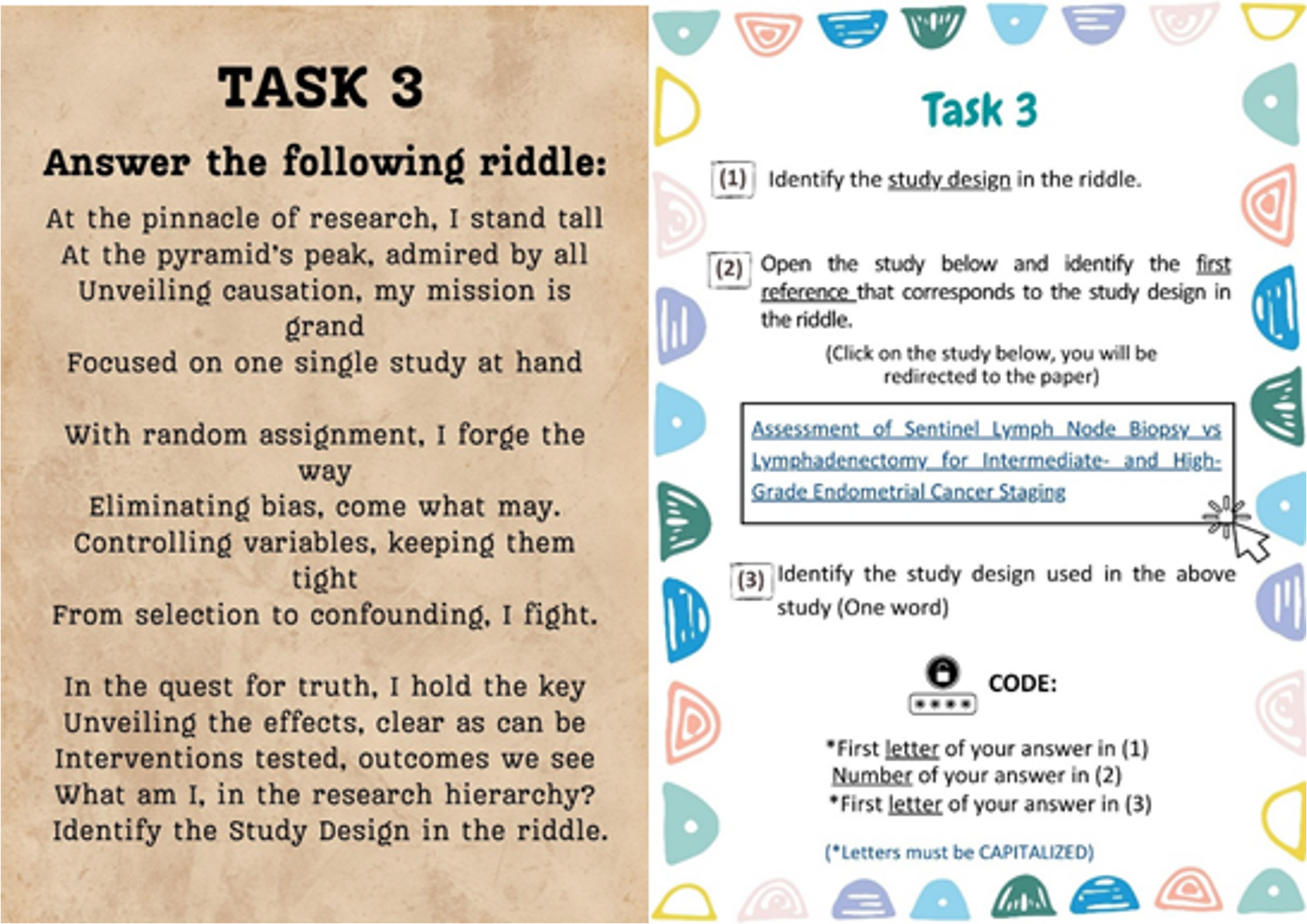
Representative examples of tasks and their associated learning objectives are provided in Appendix (Table 2), while Fig. 1 illustrates an example task and its associated subtasks.
Fig. 1
Example riddle and associated subtasks
Scavenger Hunt ImplementationParticipantsA total of 40 undergraduate medical students participated. Participants ranged from second-year to final-year students, resulting in a heterogeneous cohort with varying levels of prior exposure to research and EBM. Participants worked in pairs, forming 20 teams that collaborated throughout the activity. Upon registration, students were given the option to self-select a partner; participants who did not select a partner were randomly paired by the organizers.
ImplementationParticipants were first enrolled on an online platform that served as the communication hub for announcements and coordination. Prior to the event, participants received an introductory video outlining the objectives, rules and structure of the hunt. Supplementary instructional videos were provided to support scaffolding, and participants were permitted to consult any external online resources during task completion.
Throughout the activity, organizers provided real-time support through the communication platform, offering clarifications and hints as needed, to maintain engagement and ensure progress. Each participating pair was evaluated based on the accuracy and timeliness of their submissions. To foster a sense of achievement and encourage broad participation, all participants were awarded digital certificates of participation and top-performing participants were awarded shields.
The working of the Virtual Scavenger Hunt is discussed in detail below and depicted in Fig. 2.
Fig. 2
Blueprint of the virtual scavenger hunt
Step 1: Each pair of participants received a taskbook containing six riddles which were accompanied by subtasks. The subtasks within each riddle targeted specific research competencies, as mentioned in earlier in the 'Planning' section.
Step 2: Completion of these tasks, required participants to extract and analyze data from provided research articles and engage with shared instructional resources. Answers to these riddles and tasks were submitted through a Google form (Form 1).
Step 3: On submitting the answers, the participants were prompted to “enter the password” in a second Google form (Form 2). This password was an alphanumeric string comprising of “codes” that were obtained through solving the subtasks. Each correctly solved subtask contributed a specific alphanumeric character based on an accompanying rule (e.g., extracting a specific letter or number from the correct response). These characters collectively formed a password required to progress to the next phase of the scavenger hunt. For example, if the answer to a subtask was “Scavenger Hunt”, the accompanying rule might prompt the participant to take the first letter of the answer (i.e. the code would be the letter ‘S’). The final password would be the combination of the codes obtained from all of the tasks.
Step 4: Participants entered the assembled password into Form 2. If the password was entered correctly, participants were granted access to the subsequent phase of the activity, referred to as the “treasure chest,” which consisted of a shared drive containing a dataset and an additional taskbook. If the password was entered incorrectly, participants were notified immediately and prompted to review their previous responses and resubmit the password. No limit was placed on the number of password entry attempts.
Step 5: The second phase of the hunt, accessible only upon successful completion of the initial riddles, focused on data analysis and interpretation. Participants were required to apply statistical tests to the dataset, interpret their findings and answer a set of related questions. Responses were submitted through a final Google Form (Form 3). The participating pair who were the first to upload the correct answers were declared the winners.
Data Acquisition and AnalysisTask performance data were collected from participants’ submissions across the three Google Forms used during the activity. These included accuracy of responses to riddle-based tasks, successful completion of subtasks, and correctness of the final data analysis outputs.
Perceptual data were collected using a post-activity survey administered after completion of the scavenger hunt. The survey comprised Likert-scale items (1 = Strongly Disagree to 5 = Strongly Agree) assessing participants’ satisfaction and perceived difficulty of the activity, alongside open-ended questions inviting reflection on learning experiences and perceived educational value.
Quantitative data from task performance and Likert-scale survey items were analyzed descriptively using summary statistics to characterize overall trends in performance and demonstrated competencies. Qualitative responses were analyzed using reflexive thematic analysis following Braun and Clarke’s approach [39, 40]. Coding was inductive and iterative, with reflexivity maintained throughout.
Ethical ConsiderationsThis study was conducted in accordance with the Declaration of Helsinki and the Finnish Advisory Board on Research Integrity (TENK) guidelines. Participation was voluntary and informed consent was obtained. Confidentiality was maintained and no harm or adverse consequences were associated with participation. Furthermore, the study did not affect academic assessment or grading. The activity was organized in collaboration with the university’s student research society, under supervision and approval of the university administration and faculty members. The study was assessed by local medical education researchers and in accordance with the national research ethics guidelines specific to such interventions in Pakistan, it was determined that the study constitutes minimal-risk educational research and was thus deemed exempt from full IRB review.
Comments (0)