Feasibility rates in healthy volunteers matched those reported by Dimov et al. [10], and feasibility rates in patients aligned with findings by Bane et al. [15]. Compared to the healthy volunteers reported by Dimov et al. [10], our flowavg values in volunteer subgroup 1 were similar (~ 3 mL/s). However, our areaavg was ~ 27% larger (~ 33 mm2 versus ~ 26 mm2), while vavg and vpeak were ~ 60% and ~ 48% lower, respectively (~ 10 cm/s versus ~ 25 cm/s and ~ 21 cm/s versus ~ 40 cm/s, respectively). This may be attributed to their lower VENC (40 cm/s), enhancing MR signal in the CHA, but at a risk of aliasing.
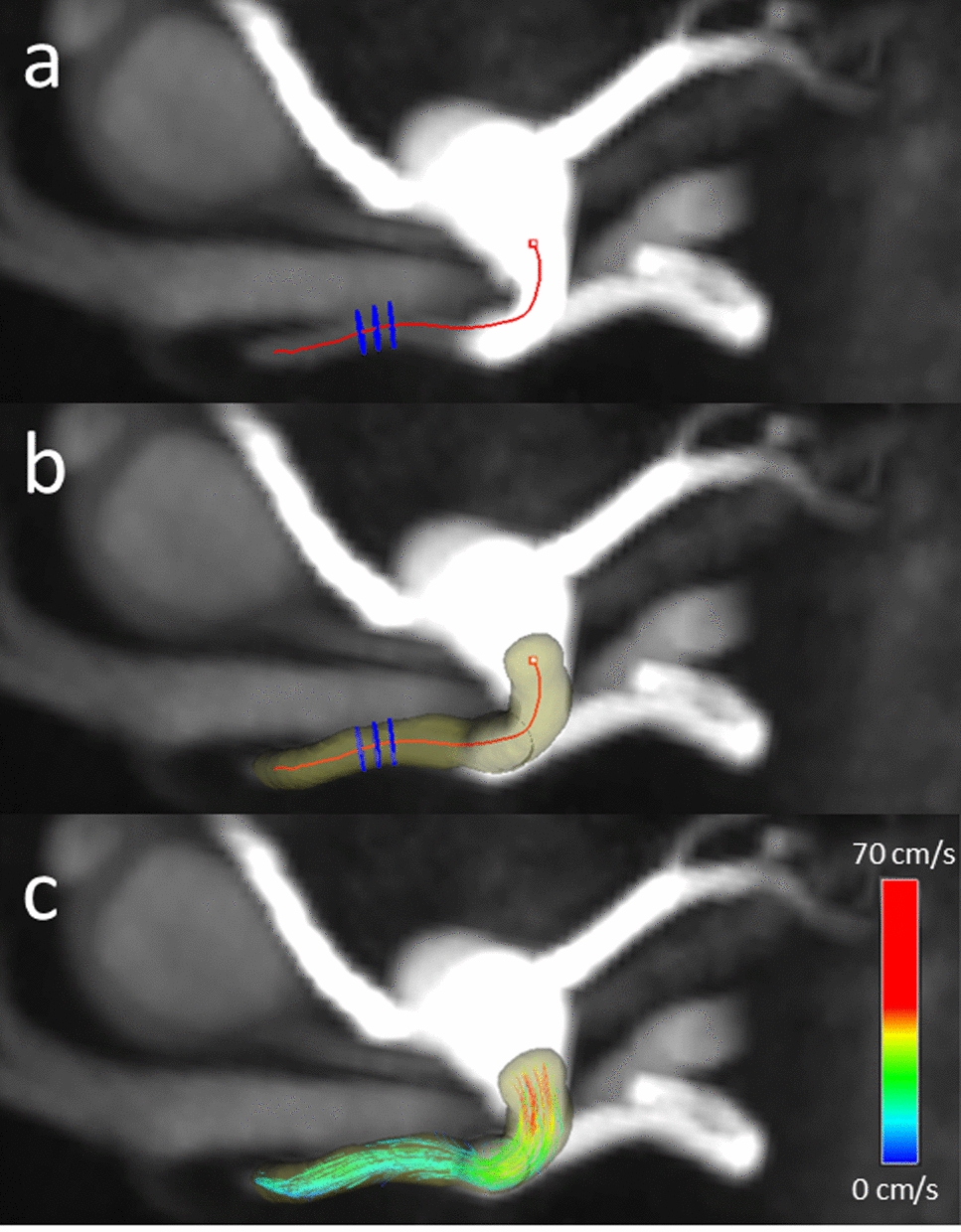
Consistent with our findings, Dimov et al. [10] reported that 4D flow overestimates areas and underestimates velocities and flow rates compared to 2D flow. However, their 2D and 4D flow sequences differed in spatial resolution and VENC, whereas ours were matched. Underestimation of HABF by 4D flow MRI can be attributed to systematic velocity underestimation and the indirect effect of vessel area overestimation, as larger segmentations include peripheral pixels with slower flow, potentially due to respiratory motion artifacts. Moreover, lower temporal resolution and fewer cardiac phases in the 4D flow acquisition, trade-offs to enable full volumetric coverage within a clinically acceptable scan time, explain the lower velocities because peak velocities were not accurately detected, as shown in Fig. 2. Software differences [16, 17], CS acceleration [18,19,20], and cardiac gating errors from magnetohydrodynamic interference [21] may also contribute to velocity underestimation of 4D flow. Thus, systematic differences between 2D and 4D flow-derived hemodynamic parameters should be considered when interpreting results, and comparisons should be made with caution.
Stankovic et al. [22] previously investigated scan-rescan repeatability of the HABF parameters areaavg, vavg, vpeak, and flowavg. We observed better repeatability across all parameters, except for vpeak. Our improved repeatability across the majority of parameters could be attributed to our shorter scan-rescan time interval, subject-specific VENC approach, increased spatial and temporal resolution, and higher number of cardiac phases. In contrast to Stankovic et al. [22], we observed that average-derived parameters were generally more stable across repeated acquisitions, likely due to the increased signal-to-noise ratio (SNR) from averaging and reduced sensitivity to cardiac gating errors and physiological fluctuations.
Several factors may have contributed to the remaining within-subject variability, including the relatively large respiratory gating window, suboptimal cardiac gating, small vessel diameter relative to voxel size, and physiological variation between scans. On average, we did, however, comply with the 5 voxels per vessel diameter rule stated in literature [12]. Inter- and intra-observer variability are expected to contribute to the remaining variability as well, but were not assessed in the current study. Bane et al. [15] evaluated inter-observer agreement of 4D flow-derived hemodynamic parameters obtained from the CHA in ten patients with portal hypertension, and found CVs of 11% for areaavg, 20% for vavg, 21% for vpeak, and 19% for flowavg, approximating half our CVtotal. Although this provides an indication of the contribution of observer-related variability to total variability, the results cannot be directly translated to our findings due to differences in acquisition protocols.
A key limitation of this study is the lack of inter- and intra-observer variability assessment, which may affect the objectivity and reproducibility of the findings. Future studies should address this by including repeated measurements by the same and multiple observers. Moreover, this study focused on patients with cirrhosis and/or hepatic malignancy due to their relevance to TARE planning. Future studies may include a broader spectrum of liver pathologies to enhance generalisability. In addition, the ability to characterise HABF may also be relevant for other intra-arterial therapies, such as chemoembolisation or bland embolisation, where flow dynamics can influence treatment distribution and efficacy.
A major advantage of the 4D flow acquisition used in this study is its relatively high spatial resolution, improving vessel visibility and enabling more accurate segmentation. However, this comes at the cost of reduced SNR. Nevertheless, as previously mentioned, repeatability in our study exceeded that reported in earlier work [22].
Despite the use of CS acceleration, the mean acquisition time of our 4D flow sequence remained relatively long at 13 min. This duration does not include the additional time required for selecting the appropriate VENC, which can add several more minutes. Such extended acquisition times pose a challenge for routine clinical implementation, where efficiency and patient throughput are critical. To address this limitation, ongoing research is exploring advanced acquisition strategies aimed at reducing 4D flow acquisition times [15, 23].
We emphasise that this study only assessed repeatability, not accuracy. While prior phantom studies have addressed accuracy [10], clinical in vivo validation remains limited due to the absence of a gold standard.
Although 4D flow MRI requires longer acquisition than 2D flow MRI, it offers several advantages and potential clinical values. The first and most important benefit is the ability to retrospectively position measurement planes, which is particularly relevant in the hepatic artery. Accurate plane positioning is essential for reliable flow measurements, yet it can be challenging due to anatomical variations, vessel tortuosity, respiratory motion, and small vessel size. Second, the 4D flow acquisition utilised in the current study does not require beath-holding, which is beneficial for patients with compromised respiratory function. Third, in the field of computational fluid dynamics to study TARE [24], 4D flow MRI can provide realistic boundary conditions, thereby improving simulation accuracy. Fourth, in the context of MRI-guided TARE [25], 4D flow MRI can provide patient-specific insights into hepatic arterial hemodynamics. This could help clinicians with treatment planning, for example by comparing HABF at various catheter positions and adjusting the microsphere injection technique accordingly [6]. This requires higher signal in distal branches of the hepatic artery, which could be achieved by applying a lower VENC, for example the 40 cm/s utilised by Dimov et al. [10]. Intraprocedural HABF measurements could also be valuable, as changes may occur due to catheter positioning or microsphere injection. However, this requires the technique to be sensitive and robust enough to detect such (potentially small) changes in HABF, warranting further investigation. Moreover, it is crucial to understand which HABF variations meaningfully affect microsphere distribution. In our previous work, average HABF rates of 7.3 ± 1.4 mL/s (~ 37.3 ± 7.2 cm/s) yielded different microsphere distribution patterns compared to average HABF rates of 9.7 ± 0.25 mL/s (~ 49.5 ± 1.3 cm/s) [6]. These differences in both flow and velocity exceed the scan-rescan variability observed in the current study (SDwithin: 0.6 mL/s for flowavg, 1.8 cm/s for vavg), indicating that these variations are reliably detectable.
To optimise 4D flow MRI for clinical use, we recommend lowering the VENC to improve the velocity-to-noise ratio and segmentation robustness. Aliasing correction techniques should be applied to mitigate associated risks. Dual- or multi-VENC strategies may extend the measurable velocity range and improve accuracy [26]. Additionally, narrowing the respiratory acceptance window could reduce motion artifacts, though this is currently not recommended due to the already prolonged acquisition time. Finally, the implementation of more robust cardiac gating techniques, particularly those less affected by magnetohydrodynamic interference, which is amplified at 3T, should be explored [21]. Imaging at 1.5T reduces this interference but at the cost of SNR, potentially compromising image quality.
In conclusion, quantifying HABF using 4D flow MRI is feasible, with image quality sufficient in the majority of cases. However, substantial scan-rescan variability exists, as reflected by coefficients of variation of up to 30%. Acquisition-related factors accounted for the largest proportion of within-subject variability (30–40%), while plane positioning contributed a smaller portion (7–11%). These findings underscore the need for future studies to develop strategies that reduce or compensate for these sources of variability.




Comments (0)