
Remember me



Three different types of elements (TP, DR, and dipole) were combined in six different array configurations and studied to determine the optimal Rx performance in the context of a highly promising clinical application for wearable coils: lower extremity MRI at 7T. Since such combinations had not been compared previously, this strategy also aimed to gain further insights into how different sub-arrays interact. Hence, the following scenarios were investigated through both simulations and MR phantom experiments: four-channel TP coil array (4TxRx TP), four-channel TP coil array with four DRs (4TxRx TP + DR), four-channel dipole antenna array (4TxRx Dipole), four-channel dipole antenna array with four DRs (4TxRx Dipole + DR), eight-channel hybrid array comprising four TxRx dipole antennas, and four TxRx TP coils (8TxRx) and the same hybrid array with four integrated DRs (8TxRx + DR).
To test our hypothesis, a cylindrical phantom comparable in terms of dimensions (diameter = 110 mm) and electrical properties (dielectric constant ɛr = 78, electrical conductivity σ = 0.65 S/m) to that of an average human lower extremity was chosen.
To provide more compelling evidence that this strategy can impact the envisioned potential clinical application, additional simulations in human voxel Hugo (and Duke, as in Supplementary Materials) were conducted for the two types of arrays used in the previous phantom simulations and MR experiments: 8TxRx and 8TxRx + DR. The positioning of each TP coil and DR was adjusted to ensure a close fit with Hugo’s (and Duke’s) calf.
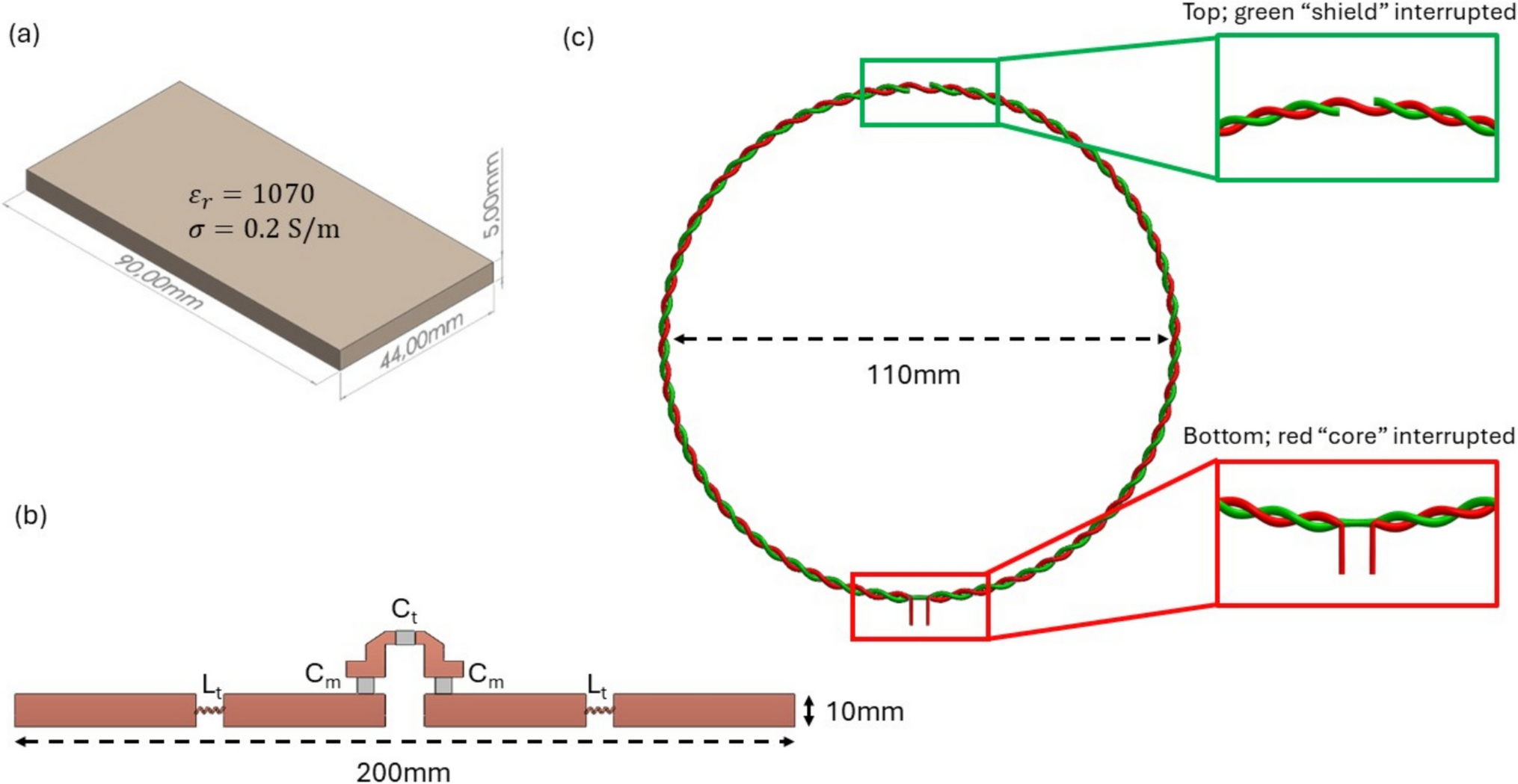
Single-element experiments: TP coil and DRThe TP coil was made by twisting two isolated (PTFE, ɛr = 2.1) wires (diameter = 1 mm) as described in the previous study [9] (Fig. 1). The cut at the top of each TP coil was approximately 5 mm. The diameter was 110 mm. A standard capacitive tuning and matching network was used to make the coil resonant at 297.2 MHz and power matched to 50 Ohms. A rectangular (90 mm × 44 mm × 5 mm) DR made of an HPM with a mass of 107 g, dielectric constant ɛr = 1070, and electrical conductivity σ = 0.2 S/m (HyQ Research Solutions, College Station, TX, USA) was used both in numerical simulations and MR phantom experiments. The resonance frequency of the low-order transverse electric (TE) mode for each DR was measured with a sniffer probe at ~ 315 MHz. The DR’s effect on the transmit field (B1+) efficiency was studied when placed at the center of the TP coil. In addition, a DR antenna using the same rectangular HPM block, with a small coupling loop (outer diameter = 18 mm) instead of the TP coil, was used as a reference design [28] as in Fig. 2.
Fig. 1
All three types of elements investigated in this study: a a dielectric resonator (DR; εr = 1070, σ = 0.2 S/m; thickness = 5 mm), b an inductively shortened dipole antenna (dipole); length = 200 mm; width = 10 mm; Lt = 210 nH; Ct = 16 pF; Cm = 1pF, and c a twisted-pair (TP) coil
Fig. 2
a Transmit field (B1+) distribution in a cylindrical phantom obtained for three single-element setups: TP coil, TP coil with an integrated DR, and a small loop-coupled DR, along with simulation/measurement division maps. The data obtained from numerical simulations were compared with MR phantom experiments at 7T. b Simulations and measurements showed that B1+ in the periphery (≤ 40 mm) was the highest for the small-loop coupled DR. Note that the DR is aligned in the same plane as the TP coil. At the same time, a small resonant loop element, inductively coupled with the DR, is separated from the DR by 6 mm
TP coil array with integrated DRsA four-channel TP coil array was constructed using four minimally overlapped (overlap/diameter ratio ~ 0.18) TP coils (Fig. 3). The array was tightly fitting to a cylindrical phantom (diameter = 110 mm, length = 200 mm) mimicking the human’s lower extremity. Each TP coil was tuned using a single capacitor in parallel (Ct: 1.0–2.1 pF) and two capacitors in series, ensuring balanced power matching (Cm: 3.6–8.2 pF). In the final array, four DRs were integrated, each positioned at the center of the TP coil. This required retuning each TP coil (Ct: 0.5–1.2 pF). During our experiments, double-sided tape was used to secure each TP coil and DR to the cylindrical phantom's plastic surface, ensuring the fixed position of each element.
Fig. 3
The photos of six multi-channel array configurations which were designed, constructed, and investigated in this study: a four-channel TxRx TP coil array without and b) with four DRs positioned in the center of each TP coil, c) four-channel TxRx dipole antenna array without and d with DRs positioned on the phantom, underneath each dipole antenna, e eight-channel TxRx dipole antenna and TP coil array, and f eight-channel TxRx dipole antenna and TP coil array with four integrated DRs. The distance between TP coils and dipole antennas was 38 mm
Dipole antenna arrayA four-channel dipole antenna array suitable for lower extremity MRI at 7T was designed to complement the TP array. The dipole antennas were distributed concentrically (diameter = 200 mm) on a polyamide PA12, 3D-printed (EOSINT P 395, EOS GmbH, Germany; with selective laser sintering (SLS)) support. The dipole’s length was 200 mm and its width was 10 mm. The copper thickness was 35 µm. Each dipole was inductively shortened using two hand-wound solenoid coils (number of turns = 4, inner diameter = 8 mm, wire diameter = 1 mm; L = 156 nH (tuning range: 132–165 nH), which were placed in the center of each arm of the antenna. Each dipole was tuned and matched to 50 Ohm using a capacitive network (Ct = 10 pF, Cm = 56 pF) without variable capacitors, and connected to a T/R switch through a coaxial cable (K_02252_D, Huber + Suhner, Switzerland) with two bazooka cable traps (cylinder length = 50 mm; cylinder diameter = 9 mm) to improve rejection of common-mode currents (below – 35 dB) [28].
Electromagnetic field simulationsElectromagnetic field simulations involving a cylindrical phantom and the Hugo human voxel model were performed in CST Microwave Studio 2025 (Dassault Systèmes, Vélizy-Villacoublay, France). In addition, to confirm our findings in Hugo, simulations in another human voxel model (Duke) using Sim4Life 8.0 (Zurich MedTech, Zurich, Switzerland) were performed and are included in the Supplementary Materials. The frequency domain solver with tetrahedral meshing was used in CST. The equation system solver accuracy of − 50 dB was used, along with an adaptive mesh enabled for a minimum of two and a maximum of five passes, and the default Gaussian excitation. The boundaries were set to open, spaced a quarter wavelength apart from the model. The number of tetrahedrons (mesh cells) was between 700.000 and 900.000 for all simulations. Simulations were performed on a Dual-Socket (2P) server equipped with two Intel Xeon E5-2600 v4 series processors (10 cores each) and 64 GB of DDR4 RAM. No GPU was used, as frequency-domain simulations are run exclusively on the CPU in CST. For the single-channel simulation, the time was about 30 min; for the four- and eight-channel arrays on the phantom, about 1–1.5 h. The human voxel model simulations took about 6 h. To evaluate transmit (B1+) and specific absorption rate (SAR), the results were normalized to 1 W stimulated power. SNR was calculated using the approach applied in the previous study [28]. Since our phantom simulations were directly compared to experiments, RF chain losses between the coil plug and the coil’s feed (T/R switches, power splitters, cables, cable traps) were measured using a network analyzer, exported as a Touchstone file, and directly incorporated into the CST co-simulation. Human voxel model simulations did not include RF chain losses. RF shimming for Hugo (and Duke in Supplementary Materials) was performed using a particle-swarm optimization method, developed earlier in our laboratory [29]. The algorithm did not consider local SAR minimization; only B1+ efficiency and homogeneity were considered in the cost function. Two different RF shims were compared: the axial RF Shim and the sagittal RF Shim. For each shim, a separate shimming region was defined (Fig. 7). The following B1 phase vectors were obtained (first four elements—dipole; other four—TPs): axial no DR = [148° 251° 0° 112° 0° 103° 202° 292°], axial with DR = [158° 256° 0° 110° 0° 97° 202° 274°], sagittal no DR = [125° 274° 306° 86° 0° 128° 171° 278°], sagittal with DR = [156° 294° 0° 108° 0° 137° 194° 309°].
Bench evaluation and RF interfaceScattering parameter (S-parameter) matrices for all arrays were evaluated using a four-channel vector network analyzer (Keysight Technologies, USA). The arrays were loaded with a cylindrical phantom filled with water and NaCl (50 mM). The phantom’s dielectric constant (ɛr = 78) and electrical conductivity (σ = 0.65 S/m) were measured using a probe for dielectric properties measurements (DAKSY; Speag, Zurich, Switzerland). To interface the MRI scanner with every four-channel TxRx array investigated in this study, a two-stage 1:4 power divider (MRI.TOOLS, Berlin, Germany; phase offset < ± 0.5°; peak power = 8 kW; average power = 100 W) was used along with four in-house developed T/R switches and four coaxial cables (two bazooka cable traps per cable) of appropriate lengths to produce a CP mode and connected to the array’s elements. The same T/R switch design was used in the eight-channel RF interface box used for the 8TxRx arrays [29].
7T MRI experimentsMR phantom experiments were performed on a whole-body 7T MR human scanner (Terra.X, Siemens Healthineers, Erlangen, Germany). For each array setup (Fig. 3), the transmit voltage amplitude in the center of the cylindrical phantom was adjusted to reach the flip angle (FA) of 90°, measured using a Turbo-FLASH B1+ mapping technique [30]: TR/TE = 5000/2.27 ms, FA = 8°, FOV = 352 × 256 mm2, resolution = (2.0 × 2.0 × 2.0) mm3. The TFL-DICOM images were processed assuming that each pixel’s signal intensity equals 0.1*FA. Then, the Vrms value at the RFPA output was used for normalization, which is now Vref in the GUI for Terra.X systems. The Vrms value was then scaled down due to RF losses (1.9 dB and extra 1.0 dB when the combiner is connected, for single-Tx mode). To generate SNR maps, the approach proposed by Kellman and McVeigh [31] was used, that is, a standard 2D-GRE acquisition (TR/TE = 3500/5 ms, FA = 45°, FOV = 256 × 128 mm2, resolution = 2.0 mm × 2.0 mm × 2.0 mm) was followed by one with the transmit voltage amplitude set to 0. The raw SNR maps were corrected for FA variations using the previously acquired TFL data and normalized to the sine(FA).
Comments (0)