While the performance of some FCs may be preserved during the installation of the MRI system and supporting services, this work demonstrates that for many FCs there will already have been a marked drop in RF attenuation levels by the time the MRI system is handed over to the customer. Consequently, repeating RF attenuation measurements after all installation works have completed may be helpful to identify if such a drop in FC performance has occurred. Additionally, this may provide a more appropriate baseline for FC attenuation levels during clinical MRI scanning. However, the lack of observed external RF interference on MR images in all cases where FC performance was found to be below specification levels at acceptance testing, even when windowing down to view noise levels, suggests that there may be a sizeable margin in practice between FC specifications and the level of performance at which external RF interference is likely to impact on clinical MRI image quality.
Of the three test locations, the MR exam room door demonstrated the most significant reduction in RF attenuation levels with age of FC. This is consistent with the door being the only one of these locations that is expected to undergo physical wear and tear, something that can be visually apparent when RF finger-strips around the edge of the door break off, compromising the connection with the door frame and thus the integrity of the FC. However, while this trend suggests that there might be an increased likelihood of an event impacting FC performance, several examples of older FCs with similar attenuation to new FCs demonstrate that repurposing an existing FC for a replacement MRI system can be appropriate. The observed reduction in RF attenuation with FC age at the window is perhaps unexpected given the anticipated lack of physical wear and tear of the FC at this location, although this may have been influenced by reduced RF attenuation levels at the MRI exam room door, which is often nearby. Subsequent analyses for all measurements (n = 51) found a significant positive correlation between attenuation measurements at the window and the door locations for both frequencies (Spearman’s rank correlation, r = 0.68 (65 MHz), r = 0.73 (128 MHz), both p < 0.001). In practice, the use of a sniffer coil is often used to more accurately locate the location of a FC leak. The lack of a significant drop in attenuation levels with FC age at the penetration panel, a position that is often further away from the MR exam room door and therefore less influenced by attenuation levels at this location, further demonstrates scope for repurposing an existing FC. Together, these observations suggest a focus on the MR exam room door for remedial work, if needed, to increase overall FC performance and additionally demonstrate the relevance of ongoing maintenance of the MR examination room door to help sustain baseline FC performance.
Differences between the open field reference and the local onsite reference measurement that were greater than the measured repeatability may be attributable to local background sources of external RF when the onsite reference measurement was higher. Conversely, physical obstructions attenuating or reflecting some of the signal, or destructive interference of reflections off of nearby surfaces that couldn’t be avoided in the geometry of the indoor space tested may have contributed to the few cases where the onsite reference measurement was lower. Differences in the reference measurements that were performed may have contributed to the few observations of improved FC performance between the cage build test and MRI acceptance testing. Additionally, the process of opening a panel in the FC to bring in the MRI scanner and the subsequent resealing of the FC along with other possible remedial works in between the cage build test and MRI acceptance testing may potentially have led to an improved FC performance in some cases.
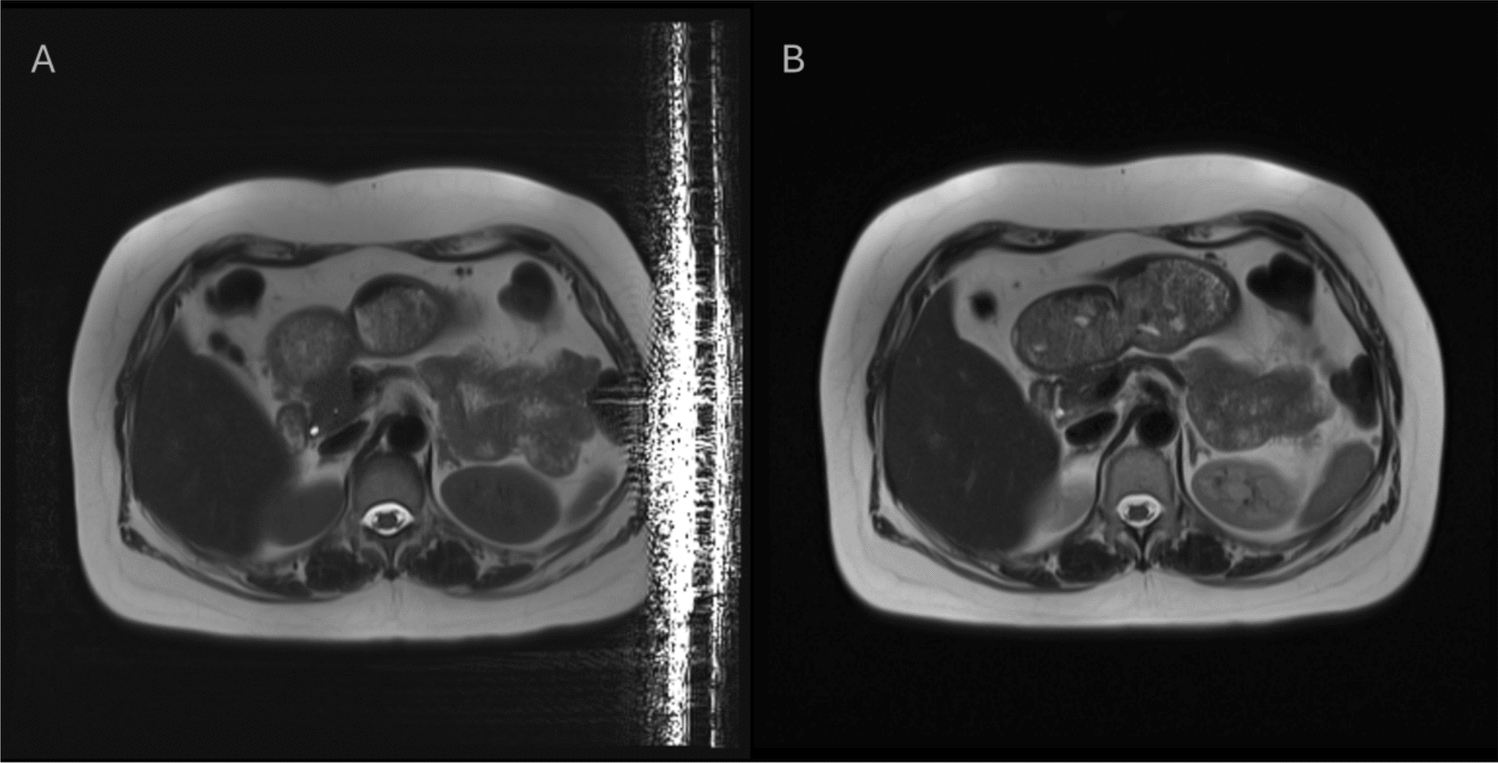
Limitations of this work include the limited sample size and the unknown history of events for each MR examination room that might have impacted individual FC performance, e.g. any servicing of the MR exam room door, damage or structural changes, including the presence of conducting cables within unnoticed waveguides. While all of the on-site measurements of background RF were within 12 dBm of the open field measurements in this work and regulatory limits on RF transmissions place general restrictions on the power level of RF transmissions, it may be helpful to perform longer term monitoring of external RF signal levels around the FCs to provide a more comprehensive assessment of background RF levels in practice. More frequent sampling would be helpful to assess intermittent sources of RF interference, such as any neighbouring MRI scanners, and longitudinal measurements on the same FCs over the lifetime of an MRI system may reveal deeper insights. Neither of these were feasible in this work. Finally, RF attenuation measurements on a newly built cage are typically performed when the RF cage is electrically floating. Physically disconnecting an RF cage from earth is not part of IEEE-299 and was not considered appropriate in this work. Consequently, the occurrence of earthing issues and their subsequent potential impact on FC performance was not explored here. This work did not explore the potential for RF emissions from the MRI system to impact on electronic equipment outside of the MR examination room due to reduced FC performance. However, to our knowledge (including a search of the MAUDE database [7] and checking for incidents reported to the MHRA) the only definite examples of this are for neighbouring MRI systems with overlapping RF frequencies, as demonstrated by Fig. 1.




Comments (0)