Recent Trends in Whole-Breast Irradiation Versus Partial-Breast Irradiation in Ductal Carcinoma in situ with Breast-Conserving Surgery 2011–2021: A National Cancer Database Study
Background
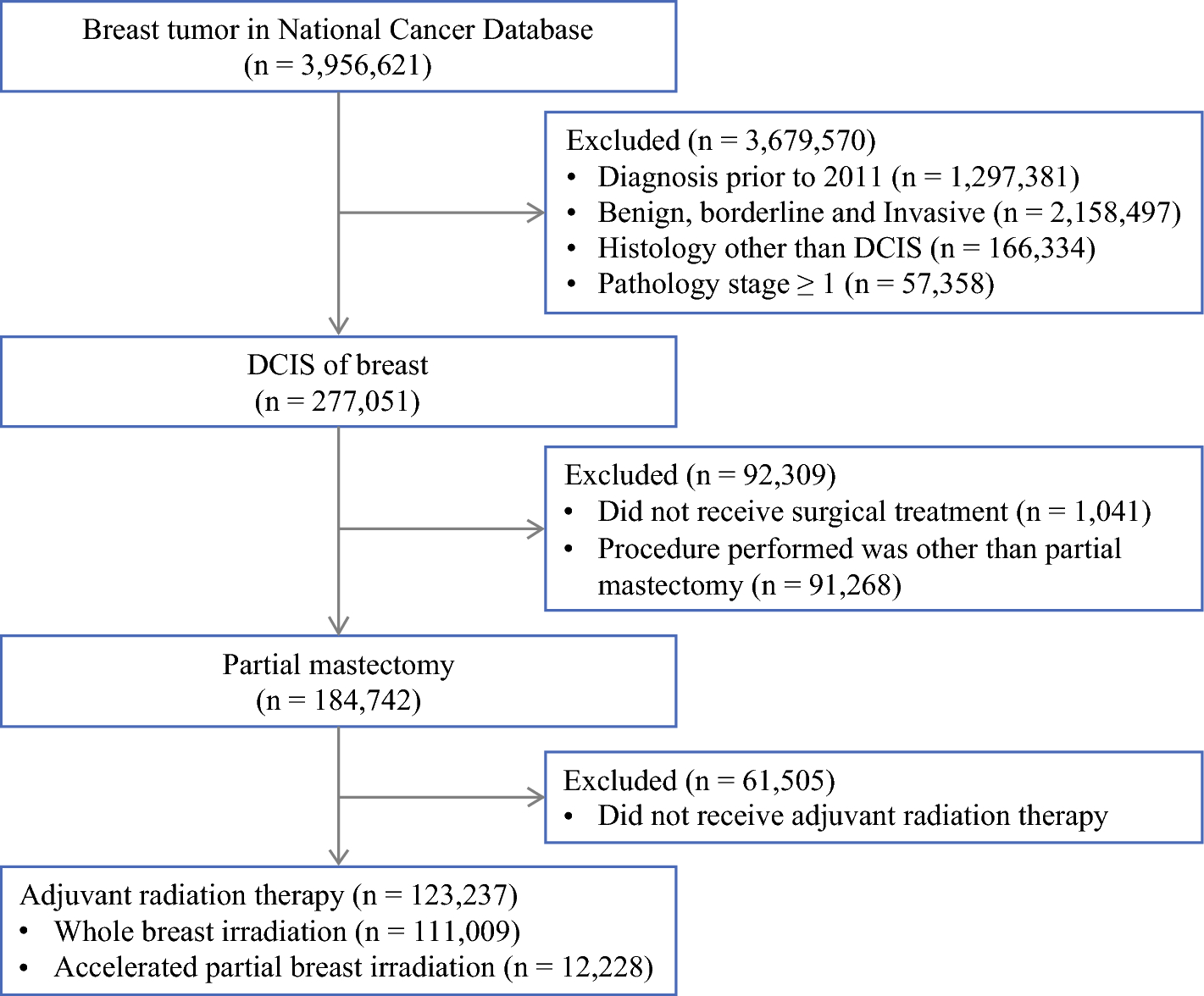
This study examined national trends in the use of accelerated partial-breast irradiation (APBI) for ductal carcinoma in situ (DCIS) and evaluated how practice patterns changed after the 2017 updated American Society for Radiation Oncology (ASTRO) consensus, which broadened the criteria for considering APBI in DCIS. The 2017 update expanded the “suitable” patient group to include DCIS cases meeting specific criteria: age 50 years or older, screen-detected lesions, low to intermediate nuclear grade, tumor size 25 mm or smaller, and resection margins 3 mm or greater.
Methods
A retrospective analysis of the National Cancer Database was performed including patients with DCIS diagnosed between 2011 and 2021. The study compared APBI utilization before (2011–2017) and after (2018–2021) the guideline update.
Results
Overall APBI utilization increased from 7.2% (2011–2017) to 13.0% (2018–2021) after the consensus update. Among patients 50 years old or older with low- to intermediate-grade DCIS (≤25 mm), APBI use rose from 8.8% to 15.5%. After 2017, the strongest predictors of APBI use were age, facility type, tumor grade and size, and estrogen receptor (ER) status. Utilization was higher among patients 50 years old or older (13.6% vs 9.7%), those treated at academic centers (15.4% vs 12.0%), those with low-grade (15.8%) and intermediate-grade (13.5%) compared with high-grade (11.4%) disease, those with tumors 25 mm or smaller (13.7% vs 9.7%), and ER-positive cases (13.9% vs 10.7%).
Conclusion
Since the updated guidelines in 2017, utilization of APBI for DCIS has increased. Key factors influencing APBI use align with the updated guidelines.

Comments (0)