
Remember me
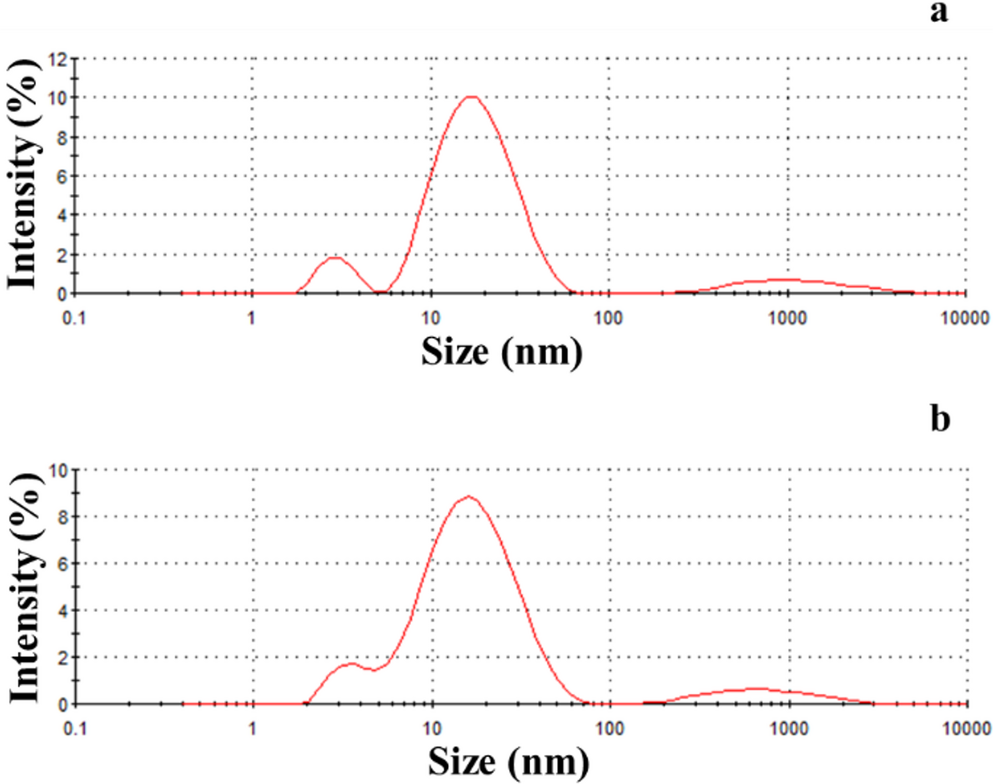
In this study AgNPs were successfully synthesized using NaBH₄ as the reducing agent and PVA as a stabilizing agent. The characterization results confirmed the formation of AgNPs with a narrow particle size and distribution. For the NP30 formulation (in the presence of 30 mL NaBH4), the average particle size, polydispersity index (PDI), and zeta potential were determined as 57.3 ± 10 nm, 0.4 ± 0.0, and − 14.3 ± 5.5 mV, respectively. In contrast, smaller particle sizes were obtained for the NP60 formulation (in the presence of 60 mL NaBH4) (Table 1). These results indicated that obtained particle sizes constitent with the accepted range reported in the literature [39,40,41,42]. These findings indicate that increasing the amount of reducing agent significantly decreases particle size, which is consistent with previous reports showing that higher NaBH₄ concentrations increase the reduction rate and lead to formation of smaller AgNPs [43]. Also, the results confirmed the previous studies that strong reducing agents like borohydride, result in small sized and negatively charged particles [44]. Supporting this observation, Roto et al. reported that AgNPs synthesized using sodium borohydride exhibited a zeta potential of −11.20 mV. This value exceeded that reported for AgNPs prepared with other commonly used reducing agents [45]. Moreover, the obtained PDI values (0.4–0.5) suggest that the synthesized AgNPs form a naturally polydisperse system, consistent with the literature [46].
Table 1 Particle size (nm), Polydispersity index (PDI) and Zeta potential (ZP) (mV) of silver nanoparticles (NP30, NP60) (n = 3, mean ± SD)The formation of silver nanoparticles was firstly confirmed by visual color changes in the solution. Upon the addition of sodium borohydride (NaBH₄), the solution rapidly changed from transparent color to yellow, indicating the reduction of silver ions [45, 46]. Also the effect of reducing agent concentration was determined. A lighter yellow was observed at lower NaBH4 concentration, while a darker yellow was observed at higher concentration. These differences demonstrated that an increased NaBH4 concentration enhances the reduction of silver ions into silver nanoparticles as described in earlier work [47]. The color differences corresponding to different NaBH4 concentrations are presented in Fig. 2A. The formation of AgNPs and their interaction with PVA was confirmed by UV-Vis spectroscopy in the range of 200–600 nm. As seen in Fig. 2B, the spectrum of both AgNPs showed a strong plasmon band in 420 nm. The higher absorption band of the 60 AgNPs suggests enhanced silver ion reduction due to the higher sodium borohydride concentration, resulting in greater nanoparticle formation as reported before [48,49,50,51].
Fig. 2
A Confirmation of AgNPs formation by color change in the presence of different amount of NaBH4B. UV-vis spectrum of AgNPs and AgNPs/PVA formulation
The plasmon resonance peak of silver nanoparticles also indicated the formation of smaller particles which confirmed by also our DLS results [50, 51]. Our findings were also consistent with the earlier published studies that the absence of aggregation-related absorbance peaks indicates the effective incorporation of AgNPs into the PVA matrix [22, 51].
Characterization of HydrogelsFourier Transform Infrared Spectroscopy (FT-IR) analysisFigure 3 presents the FTIR spectra of synthesized AgNPs, pure Chitosan, pure PVA and lyophilized hydrogel formulations. As expected, the FTIR spectrum does not show characteristic peaks corresponding to metallic AgNPs due to FTIR detects organic groups.
The FTIR spectrum of AgNPs synthesized via NaBH4 reduction showed simple characteristic peak profile at 3345 cm− 1 attributed to O-H stretching of surface adsorbed water and hydroxyl groups. Also the bands at 1341 cm⁻¹ and 1129 cm⁻¹ correspond to B-O stretching and weak 1000–900 cm− 1 peaks correspond to B-O-H vibrations come from borate species formed during NaBH4 oxidation [52].
The main characteristic FTIR bands of chitosan were confirmed at about 3300 cm− 1 and 3298 cm− 1 (overlapping of -OH and -NH stretching, respectively), 2872 cm− 1 (C-H stretching), at 1650 cm− 1(C = O stretching of amide) and 1560 cm− 1 for the -NH2 group (N-H bending of primary amine) (NHCOCH3), 1314− 1 and 1374 cm− 1(C-H bending) and 1024 cm− 1 and at about 1060 cm− 1 (C-O stretching) (Fig. 3) as indicated many previous studies [49, 51].
The FT-IR spectrum of PVA characteristic absorption peaks were also confirmed at about 3300 cm− 1(C-OH stretching), indicating strong hydrogen bonding with polymer matrix. The absorption bands which observed at 2907 cm− 1(-CH2 stretching), 1142 and 1421 cm− 1 (C = O stretching) has confirmed the typical chemical structure of PVA [53].
In the FTIR spectrum of AgNP-loaded chitosan–PVA hydrogels, several important peak changes were observed. Specific vibration bands at 1735 cm− 1 and at about 1410 cm− 1 in hydrogel spectrums indicated the carbonyl group stretching and C-H bonds for chitosan/PVA hydrogels, respectively [46, 54]. Novel peaks at about 1400 cm− 1 and in the range of 648–662 cm− 1 are attributed to the B-O stretching and O-B-O bending, respectively. These peaks indicate the formation of borate species during the NaBH4-mediated reduction and their interaction with PVA via reversible di-diol complexation, indicating by physical crosslinking within the hydrogel that consistent with previously reported PVA–borate di-diol ester mechanisms reported in the literature. The resulting borate-PVA complexes contribute to formation of hydrogen bonding between PVA and chitosan chains [55,56,57].
Moreover, all of AgNP-loaded hydrogel formulations exhibited shift and decrease of the O–H/N–H stretching band of chitosan and PVA to lower wavenumbers (3278–3297 cm− 1), indicating the formation of an extended hydrogen-bonding network [46, 55]. The chitosan-PVA hydrogel formation was also confirmed by the sharp amide peak at 1560 cm− 1. The absorption peak of chitosan NH2 groups at 1560 cm− 1 decreased while the characteristic amide sharp peaks appeared the hydrogels particularly in L60 and M60 formulations prepared in the presence of high amount of NaBH4. These amide peaks indicate interaction between PVA and Chitosan, contributing to hydrogel formation through hydrogen bonding between -OH and -NH groups [11, 53].
In 1300–1150 cm-1 region, all hydrogel formulations show bands around 1326–1329 cm− 1 and 1089 − 1070 cm− 1. These bands exhibit noticeable shifts and intensity changes, indicating polymer–polymer interactions and also the incorporation of borate species originating from the NaBH₄-mediated AgNP synthesis. These bands are correspond to B–O-related vibrations observed in the AgNP spectrum, providing indirect but consistent evidence that AgNP-associated borate species are retained within the hydrogel [46].
Moreover, additional vibration bands were appeared in the range of 2850–2918 cm− 1 suggesting interaction between AgNPs and PVA-Chitosan interaction by C-H bond and CH2 stretching [46, 57]. The incorporation of AgNPs led to a decrease in the intensity of the chitosan C = O band at 1650 cm− 1, indicating interactions between silver ions and the hydroxyl and amine functional groups of chitosan and PVA through non-covalent bonding. Also higher molecular weight chitosan may increase the AgNPs adsorption to hydrogel via interaction with of amine groups (-NH2) of chitosan and hydroxyl groups (-OH2) of PVA [38, 44, 46,47,48]. The free OH groups of PVA which has seen in the FT-IR spectrum at 3300 cm− 1 also may be represented a good site for incorporating the silver nanoparticles [46, 57,58,59].
Fig. 3
The Fourier transform infrared (FT-IR) spectra for the silver nanoparticles loaded-chitosan-PVA hydrogels, pure PVA, pure Chitosan and synthesized AgNPs
The FT-IR results confirm that NaBH4 contributed to formation of silver nanoparticles as a reducing agent. In addition, borate species which formed during the reduction contribute to physical crosslinking of the chitosan–PVA hydrogel network, enabling the incorporation of AgNPs into matrix. Moreover, the presence of AgNPs in hydrogels prepared with higher NaBH4 influenced the network structure, leading to increased flexibility, as supported by the porosity studies [46].
X-ray Diffraction (XRD) AnalysisXRD patterns of synthesized AgNPs, pure chitosan, pure PVA and the hydrogels in the 2θ range of 10–60° are presented in Fig. 4. Pure Chitosan exhibited a characteristic diffraction peak at 2θ = 20º, as we expected. Similarly, the XRD pattern of pure PVA also showed the characteristic diffraction peaks at 2θ = 20º, 23º and 40º, indicating the semi-crystallinity of this polymer [59, 60].
The XRD pattern of the synthesized AgNP showed specific diffraction peaks at 38.8°(111) and 46.8°(200) (2θ) indicates face-centered cubic metallic silver confirming the formation of crystalline AgNPs successfully via the NaBH4 reduction reaction. Also the peaks observed around 30–32° can be related with the residual Ag₂O or borate-related species from the reduction process, as reported in the literature [52]. In contrast, these characteristic AgNP peaks are not distinctly observed in the XRD patterns of the AgNP-loaded chitosan–PVA hydrogels. Instead, all hydrogel formulations showed similar diffraction patterns around 19–22° as wide peaks indicating the amorphous nature of the crosslinked polymer network (between Chitosan-PVA) These behavior is consistent with commonly reported in the literatures, when silver nanoparticles were embedded within an hydrogel matrix, their XRD signals may be weakened or masked due to low nanoparticle concentrations, strong polymer scattering and peak broadening because of small particle size [52, 60,61,62]. Therefore, does not seem the AgNPs signals in the hydrogel XRD patterns does not indicate the absence of AgNPs, but instead indicates that AgNPs are uniformly distributed within the amorphous polymer network, as also supported by our UV–Vis and DLS analyses.
Additionally, the 23º and 40º peaks which belong the PVA were disappeared in the hydrogel spectrums indicates effective crosslinking of PVA, consistent with previous studies [59,60,61]. In addition, in the presence of silver nanoparticles, PVA peak at 2θ = 20° undergoes reduction which has been widely indicated the interactions between PVA chains and AgNPs [61,62,63].
Fig. 4
X-ray diffraction (XRD) pattern of synthesized AgNPs, pure chitosan, pure PVA and the hydrogels in the 2θ range of 10–60°
Swelling StudiesHydrogels prepared with medium molecular weight Chitosan showed higher swelling degree as 878% and 894% for M30 and M60 formulations, whereas lower swelling of 640% and 647% were observed for L30 and L60 formulations at 24 h, respectively (Fig. 5). The enhanced swelling behavior of medium molecular weight chitosan based hydrogels is mainly due to their longer polymer chains and higher content of hydrophilic hydroxyl groups [2, 64]. It is also presented in a previous study that the high amount of cross-linked chains plays a critical role in controlling the swelling ratio of hydrogels [55]. Accordingly, the effect of crosslinker amount on swelling degree was determined for both molecular weighted chitosan hydrogel formulations. The initial fast swelling occurred within the first hour followed by a stable phase for almost 24 h (Fig. 5). Formulations with higher crosslinker content (L60 and M60) showed slightly reduced swelling compared to the 30-series formulations. Moreover, both 60 formulations (L60 and M60) with higher crosslinker content showed reduced swelling when compared with 30 formulations (L30 and M30). This is associated with restricted polymer chain mobility caused by increased crosslinking. The swelling profiles exhibited a rapid initial water uptake followed by a slower approach to equilibrium, indicating a two-stage swelling behavior. The initial rapid swelling is attributed to fast hydration of hydrophilic functional groups (–OH/–NH2) and capillary-driven filling of interconnected pores, while the subsequent slowdown is thought to be governed by water diffusion [65, 66].
Statistical analysis was performed using two-way ANOVA followed by Tukey’s post hoc test. Multiple comparisons indicated no differences at 0 h, while from 1 h onward M30 and M60 were significantly higher than L60 across time points (p < 0.0001) and generally higher than L30 (p ≤ 0.05 depending on time). M30 and M60 were not significantly different from each other at any time point (p > 0.05). Differences between L30 and L60 were significant mainly at early time points (1–2 h) but diminished at later times.
Fig. 5
Swelling degree of different hydrogel formulations at pH 7.4 (mean ± SE, n = 3). (Two-way ANOVA with Tukey’s post hoc test showed M30 and M60 > L60 from 1–24 h (p < 0.0001))
Overall, the results indicated that the swelling behavior is related with both crosslinker amount and Chitosan molecular weight. An increasing in chitosan molecular weight led to higher swelling degrees which excess hydroxyl groups may interact with more PVA. The observations is consistent with previous reports that hydrogels with higher amounts of hydrophilic groups showed higher swelling behavior [67, 68]. In contrast, an increase in crosslinking density lead to reduced swelling ratios, as also reported in the literature [69]. Higher crosslinker content (L60 and M60) likely restricts polymer chain mobility, limiting the accessibility of hydrophilic groups and thereby reducing water uptake. In addition, hydrogen bonding between the amine groups of chitosan and the hydroxyl groups of PVA may lead to a more compact polymer network, further decreasing the number of free functional groups available for interaction with water [70]. Moreover, the presence of silver nanoparticles may contribute to the reduced swelling behavior by interacting with the hydrophilic groups of the polymer matrix, as previously reported [46, 71]. These interactions may decrease the hydrophilicity of the hydrogel network and promote additional crosslinking, particularly in formulations containing higher molecular weight chitosan with longer polymer chains and more reactive functional groups [72, 73].
Porosity StudiesThe porosity of the hydrogels increased with increasing crosslinker amount for both chitosan hydrogel formulations as shown in Fig. 6. In contrast, the molecular weight of chitosan did not affect the porosity significantly. Among all hydrogels, L60 formulation is the most porous hydrogel with 39% porosity. A reduction in crosslinker resulted in a decrease in porosity, as expected. Differences in porosity were not statistically significant for any formulation (p > 0.05, One way ANOVA, Tukey).
Fig. 6
The porosity degree of AgNPs loaded-chitosan-PVA hydrogels (mean ± SE, n = 3), (all pairwise comparisons non-significant (Tukey, p > 0.05))
According to the results, the higher crosslinking increased the porosity of all hydrogels while leading to the formation of smaller pore structures. This change reduced the swelling capacity with an agreement that swelling results discussed earlier. Higher crosslinker amount produced more crosslinking points in polymeric chains resulting in a more porous but tighter hydrogel. In line with our findings, Agnihotri et al. indicated that the crosslinker density was important for the porous hydrogels and the crosslinker density made hydrogels efficient for incorporating the silver nanoparticles into hydrogels [46]. Although increased crosslinking often decreases mesh size, the porosity reported here reflects the preserved open pore volume after freeze-drying rather than the hydrated-state mesh size. Higher crosslinker content can strengthen the PVA-based network via “di–diol” complexation, improving pore-wall stability during freezing/lyophilization and thereby reducing collapse/shrinkage; consequently, the retained open porosity can increase even if swelling decreases [74, 75].
Morphological AnalysisMorphological analysis of hydrogels was conducted to confirm porosity. Cross-sectional images of the hydrogels are shown in Fig. 7. These representative SEM figures of freeze-dried chitosan-PVA hydrogel formulations revealed uniform and highly porous structure especially prepared with medium molecular weight of chitosan. Even all hydrogel formulations showed a highly porous structure, particularly the L60 formulation had the highest porosity (Fig. 7), which can be attributed to of its higher crosslinker amount. Similar relationships between crosslinker concentration and porosity have been reported in previous studies [66, 72]. One of the studies by Gupta et al. (2012) indicated that increasing in crosslinker density resulted with increased porosity. They also underlined that improving mechanical strength due to the formation of smaller pore that limit excessive swelling [69].
Comments (0)