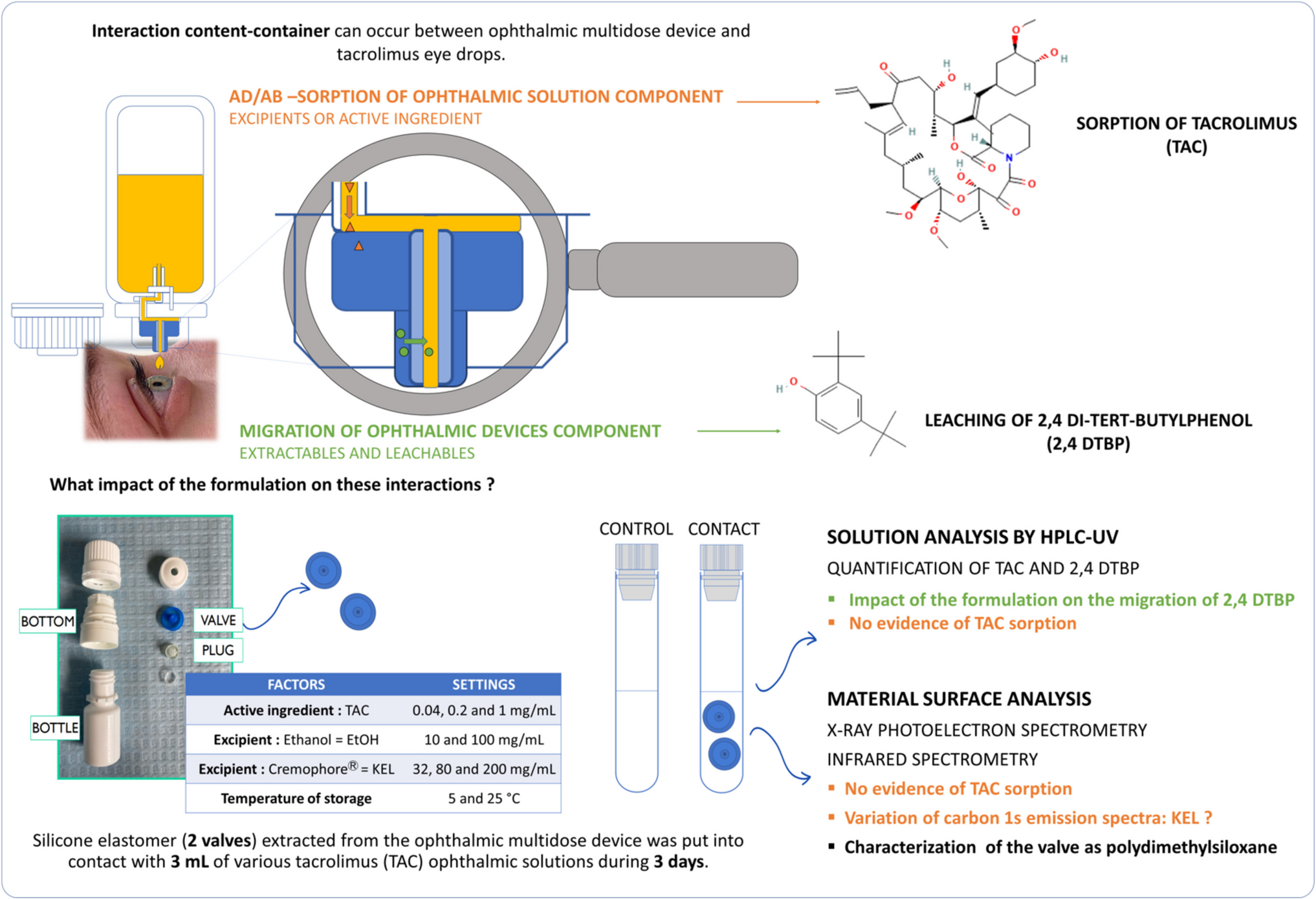
Our study presents new information about the interactions between TAC solutions and a PDMS medical device component. The results indicated that while the conditions that were studied did not affect the loss of TAC by sorption, they did influence the leachability of a compound previously identified as being 2,4 DTBP.
Indeed, during the static contact test performed in this study between TAC solutions and the silicone valves, 2,4 DTBP was extracted and detected by chromatographic analysis. However, this work highlighted that for the same proportions of excipients but with different amounts of TAC, the higher the TAC concentration, the less 2,4 DTBP leached out. Several hypotheses can be proposed to explain this very interesting observation, which to our knowledge is the first to report the role of an active substance in Limiting the extraction of a leachable compound. The first hypothesis could be that TAC adsorbs onto the surface and creates a barrier layer limiting the leaching of 2,4 DTBP, for example by occupying sites at the solid–liquid interface that otherwise could have been “exit points” of 2,4 DTBP from the PDMS matrix. This would explain why the phenomenon is more pronounced with the 1 mg/mL formulation. At lower concentrations, the barrier ability/site occupation would be reduced, thus allowing greater quantities of 2,4 DTBP to leach out. Previously published literature has already mentioned that the migration of certain compounds was reduced or stopped by blocking sites on the surface of a material. For example, Yang et al. have shown that an amyloid protein coating limits the migration of DEHP from PVC by creating a barrier (54) while Masse et al. demonstrated that the combination of a surface treatment (low-pressure cold plasma), a polydopamine coating and surface post-treatments (cold plasma or heat) significantly limited the migration of DINCH and TOTM present in PVC (55). Using the same principle, but with covalent interactions, attaching fluorine to plasticized PVC surfaces modified its properties and reduced the migration of plasticisers (56). Unfortunately, this hypothesis doesn’t seem to be fully supported by TAC quantification data, as overall, the results of these static sorption test did not show significant variations in the concentrations of TAC compared to the control group containing no valve. However, it could be plausible that a sorption phenomenon did exist in static contact, but that it was not detected because the possibly small quantity of adsorbed TAC, compared to the overall amount in solution (due to the small contact surface of the valve), was therefore masked by the analytical variability of the quantification method. Published data has shown that TAC can be the subject of reversible adsorption phenomena (24, 25, 27). Using high-performance liquid chromatography, Suzuki et al. demonstrated a loss of TAC (attributed to sorption phenomena) when a 50 µg/ml TAC solution was passed through plasticized PVC catheters (25). This sorption phenomenon was most influenced by the length of the PVC tube and its internal diameter, a low drip rate and was more marked for TAC concentrations of 50 µg/ml than for those of 100 µg/ml, thus highlighting the importance of the concentration, which was also identified by Barrieu et al. during an in-use test of tacrolimus eye drops (18). Hacker et al. also showed a reversible sorption phenomenon on silicone catheters for concentrations of 40 µg/ml (27). Their experiment was carried out by administering 50 ml of a 40 µg/ml TAC solution over 22 h through 35 to 50 cm-long catheters with internal diameters varying from 0.8 to 1.5 mm (depending on the type of catheter), representing a contact surface area varying from 9 to 30 cm2 (not including the various lumens), whereas in our case 3 ml of solution were put into static contact with two silicone valves with a unit surface area of around 5 cm2. In Hacker et al.'s study, the average ratio of TAC to contact surface was 0.0014 mg/cm2, whereas in our case it varied from 0.01 mg/cm2 for solutions with 0.04 mg/mL TAC to 0.3 mg/cm2 for solutions with 1 mg/mL TAC. So, it's possible that the ratio of the quantity of TAC solubilized in a micellar solution containing ethanol and KEL over the silicone valve surface chosen to carry out the sorption test was too high for TAC adsorption to be detected by TAC quantification in the contact solution. Indeed, all the fixation sites on the silicone valve would have been saturated very quickly, especially as TAC would not be in a water solvated form but encapsulated in micelles, of larger size and thus having a greater surface saturability potential. This hypothesis seems to be in line with the results of Gottschalk et al. (57), who showed that there was a negative correlation between the quantity (or volume or concentration) of phenol and m-cresol solutions over the contact of area silicone tubes on the loss by sorption of these preservatives. In fact, silicone tubes with a higher internal diameter showed less loss of preservatives (in percentage) than those with a smaller internal diameter (57). Furthermore, in comparison with the results found by Barrieu et al. during an in-use assay (18), and those of Suzuki et al. (25) and Hacker et al. (27), this experimentation was realized in static conditions. It is also possible that the pressure exerted on the bottle to release the drop (causing a flow of liquid through the nozzle of the eyedropper device) may impact the intensity of the sorption phenomena. Indeed, we know that during the IV administration of certain drugs, the rate of administration plays a role in the sorption of PA on the internal surface of the tubing (58) in particular for TAC (24, 25), yet this may be because of an increased solution renewal and not because of any flow turbulences at the surface.
Furthermore, Suzuki et al. showed that the amount of TAC adsorbed was inversely correlated with the KEL concentration: the higher the KEL concentration, the lower the TAC sorption. Indeed, the amount of TAC adsorbed decreases from around 1.2 mg/g in the presence of approximately 0.1 mg/mL KEL to around 0.4 mg/g for approximately 1.95 mg/mL KEL. In our study, KEL concentrations ranged from 32 to 200 mg/mL, which is considerably higher than what was tested in the study performed by Suzuki et al. and may limit any TAC sorption in this concentration range. In the stability study by Barrieu et al. (18), sorption was observed for the 0.2 mg/mL TAC eye drop formulated with 16 mg/mL of KEL, but not for the 1 mg/mL TAC eye drop formulated with 80 mg/mL of KEL. This hypothesis is interesting for future studies of galenic formulations, but the choice of KEL concentration in eye drops as a protective agent against sorption effects cannot be the only criteria of choice. High concentrations of KEL may cause inappropriate viscosity, as well as pH or osmolarity being outside the tolerance range of the ocular surface, and may also lead to ocular irritation. Furthermore KEL is a non-ionic surfactant which is known to extract compounds such as DEHP (di(2-ethylhexyl)phthalate) from polyvinyl chloride (PVC) (59,60,61) and is capable of adsorbing onto certain materials such as PU catheters, resulting in increased hydrophobicity of the surface (62). Thus, our second hypothesis is that this extraction capacity of KEL is reduced in the presence of higher concentrations of TAC. The results seem to show that the higher the concentration of KEL, the lower the migration of 2,4 DTBP, except for high TAC concentrations where the concentration of KEL does not seem to affect the extraction of 2,4 DTBP. It's possible that the higher the TAC concentrations, the more the KEL forms micelles with the TAC, leaving less ‘free’ KEL to act as a 2,4 DTBP release agent. However, at low concentrations of TAC, this ‘free’ KEL could form a layer on the surface of the valve by sorption, favouring the extraction of 2,4 DTBP (62). This hypothesis could possibly be verified by investigating whether the concentration of KEL has decreased, which could indicate potential sorption, but this would be difficult to perform in practice. Non-ionic surfactants, such as KEL, are known for their effectiveness in soil decontamination, as they trap hydrocarbons (63, 64). The study carried out by De Marines et al. showed that the higher the concentration of non-ionic surfactant, the greater the effectiveness of the treatment, and that increasing the rinsing rate also increased the effectiveness of the treatment (64). In addition to surfactant concentration, soil decontamination efficiency also depends on soil properties, the hydrophilic-lipophilic balance of the surfactant or pH, temperature and cosolutes (63). Thus, drawing a parallel with our study, we could hypothesize that the extractive effect of KEL is indeed impacted by surrounding factors such as TAC concentration.
In all cases, whether it is because of a reduction in the extraction capacity of the KEL when the TAC concentration increases, sorption of the TAC encapsulated in the KEL or a combination of these phenomena, there seems to be an interaction at the liquid–solid interface Linked to the different components of the preparation which favours the migration of the 2,4 DTBP present in the PDMS material. In addition to the impact of KEL and TAC, ethanol concentration also had an effect on the increase in the concentration of 2,4 DTBP. This lipophilic compound was not extracted by water alone but was extracted by the water–ethanol mixture and during the contact with the excipients, thus indicating an increased affinity for organic solvents such as ethanol, which is also coherent with previously published data (15, 46). Furthermore, the DoE model results indicated overall that the storage temperature was negatively correlated with 2,4 DTBP concentrations, meaning that 2,4 DTBP leaching decreased when the temperature increased. This observation is surprising, as the overall release of compounds is usually favoured by higher temperatures (12, 15, 65), possibly because of increased molecular mobility. In a similar way, sorption phenomena are favoured by low temperatures (66). However, if the release of 2,4 DTBP is linked to the sorption of KEL, this could explain why at higher temperatures their extraction is less because there is less sorption of KEL. The pH is also a factor that can influence sorption (45, 67) and migration phenomena (46). Indeed, pH is a parameter that can influence both the surface properties of the material and the ionic state of the solvated molecules, and thus influences their interactions during sorption phenomena (45). However, in our case there was no variation in the pH of the solutions because the solutions were diluted with a buffered solution in order to maximize TAC stability (as TAC is most chemically stable in solutions with a pH between 4 and 6 (51)). Buffering our preparations thus limited the degradation of the active ingredient and the formation of degradation products but may also have limited any impact of the pH on the interaction phenomena between the TAC solution and the surface of the silicone material.
A third hypothesis that could be put forward regarding the interpretation of our results is that the 2,4 DTBP released by the silicone valve material could compete with the TAC adsorption sites, thereby limiting or inhibiting the adsorption of the active ingredient to the valve surface. This would be similar to the results recently published by Zheng et al., who demonstrated that the adsorption of levonorgestrel to polypropylene (PP) decreased in the presence of diisononyl adipate (DINA). Indeed, when very small quantities of this plasticizer were added to solutions containing 150 ng/mL of levonorgestrel stored in polypropylene vials, levonorgestrel concentrations decreased 9% less than the those of the control group without DINA, and 15% less than samples in contact with a material containing DINA (nylong bag) (68). Zhen et al. attributed this modification to the competition between levonorgestrel and DINA for the adsorption sites onto PP at the solid–liquid interface. They also pointed out that these interactions could be reduced, particularly by the addition of surfactant amphiphilic solvents (such as for example KEL in our case, which is consistent with our second hypothesis).
The static study was performed over three days in compliance with guidance provided by norm ISO 10993–12 (69), which recommends relatively short contact times, for example 24 ± 2 h or 72 ± 2 h at 37 ± 1°C. The objective here was not to reach such temperatures because TAC is heat-sensitive, and we wanted to approximate actual storage conditions as closely as possible, which is why we chose this setting. Interestingly, the concentrations of 2,4 DTBP seem to reach a plateau for some of the conditions that were tested, thus perhaps pointing towards the system reaching an equilibrium, and thus vindicating the experimental conditions. If that were to be the case, 2,4 DTBP would be found in the polymer material and the Liquid media at respective concentrations linked to its partition coefficient between the two phases. During the leaching phenomenon, and assuming that it is homogeneously distributed in the polymer, the movement of a small leachable additive like 2,4 DTBP would be determined by two factors: initially by the rate of transfer from the surface of the polymer material into the liquid media, which will create a concentration gradient at the surface, and secondly by the diffusion rate (described by Fick’s second law) from the bulk towards the surface following the concentration gradient (70). By visual examination of the 2,4 DTPB concentration curves in the aqueous media it could be tempting to deduce that in our case the process is diffusion limited, but additional experiments (with more time points) would be needed to confirm this.
The results obtained from the surface analysis of the valves by ATR-FTIR confirmed the silicone valve material as being PDMS. In our study, no differences were observed by ATR-FTIR between an untreated valve and a valve that had been in prolonged contact with a TAC solution, and this observation was identical for all formulations tested. Although this is not unusual per se, minor variations have been known to be detectable in the ATR-FTIR spectra of polyurethane tubes which had been in contact with chemotherapy excipients including KEL (62). The modifications they described were, after cross-checking with the results of AFM, SEM and contact angle analyses, attributed to the sorption of KEL. Concerning the analyses carried out by XPS, nitrogen was not detected on the surface of the valve by XPS. For these XPS analyses, the detection Limit was of 0.1 or 0.01 atomic % depending on the element, therefore as the TAC molecule contains only one nitrogen atom, this method may not have been powerful enough to detect it on the PDMS surface, especially if the sorption phenomenon was of low intensity. What's more, since the XPS analyses were carried out under vacuum, the PDMS surface could have reorganised itself to present a different interface, thus reducing the presence of any TAC on the surface. However, and quite interestingly, differences between the C 1 s peaks (appearance of new C 1 s species) were observed between the contact and non-contact valves and between two contact conditions (conditions 13 and 17, which contained the same concentration of TAC and ethanol and were kept at the same temperature; only the KEL concentrations between these two solutions differed). Furthermore, these modifications were also found when the silicone surface had been in contact with only KEL, thus suggesting that these peaks are attributable to the presence of KEL on the valve surface. Thus, the difference between the C 1 s may be linked to the potential sorption of ‘free’ KEL on the surface of the valves, as it was the case in the work published by Khzam et al., where KEL adsorption on PU tubes was demonstrated (62). Also, according to those authors, the adsorption of KEL onto the surface increased the hydrophobicity of the PU tube surface and thus could influence interactions at the solid–liquid interface one way or another.
Understanding the leaching conditions for 2,4 DTBP is very important, both for this specific application (to limit its presence in ophthalmic medications as much as possible and thus reduce patient exposure), but also to understand container-content interactions in the broadest sense. A larger study of the extractable and leachable substances contained in multidose ophthalmic devices would allow us to ascertain whether the conclusion of this work is specific to 2,4 DTBP or can be applied to other leachable substances. Also, the extraction of this compound by ophthalmic formulations is a potential cause for concern and it seems essential to carry out future cytotoxicity studies to investigate the potential impact on patients and to encourage manufacturers to review the composition of their product. Furthermore, a more detailed material study of the surface, including an investigation of potential pore size, total porosity and the distribution of chemical species in the first few micrometres of the surface could potentially yield additional interesting data.

Comments (0)