Impact of sampaio pelvicalyceal system variants on the clinical and surgical outcomes of supine mini-percutaneous nephrolithotomy in adults
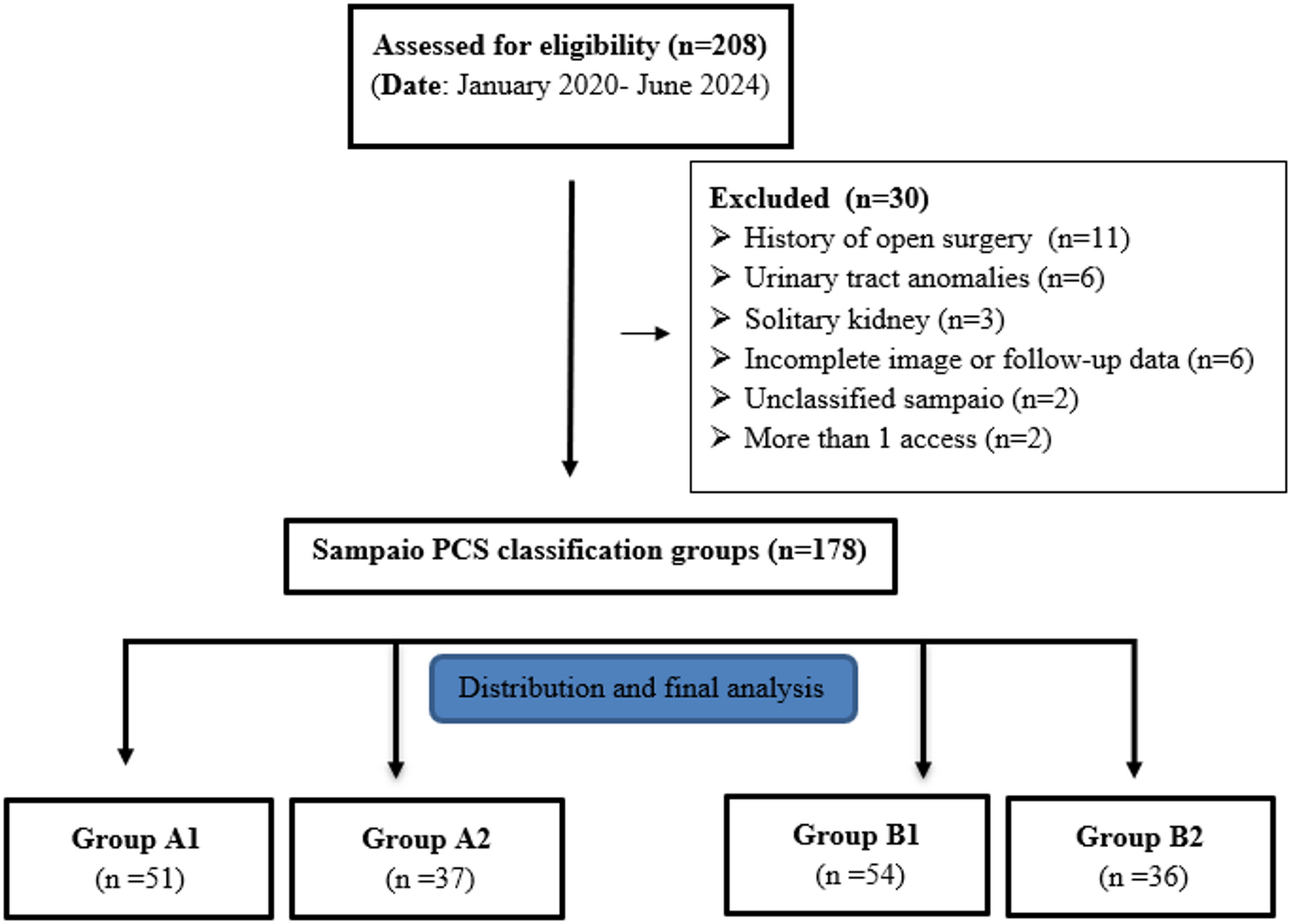
Certain anatomical subtypes are associated with more favorable surgical outcomes, highlighting the importance of routine preoperative assessment of the pelvicalyceal system (PCS) in percutaneous nephrolithotomy (PNL). Considering that PNL performed in the supine position can be more technically challenging than in the prone position, the influence of PCS type may be even more pronounced. In this context, we aimed to evaluate the impact of different Sampaio PCS types on the perioperative and postoperative outcomes of supine mini-PNL. Patients aged 18 years or older who underwent supine mini-PNL between January 2020 and June 2024 were included in this analytical cross-sectional study. After applying the exclusion criteria, the remaining patients were classified into four groups according to the Sampaio PCS classification: Type A1 (n = 51 ), Type A2 (n = 37), Type B1 (n = 54), and Type B2 (n = 36). Demographic data, stone characteristics, surgical metrics, success, and complications were evaluated comparatively between the groups. Statistical analyses included the Shapiro–Wilk test for normality; one-way ANOVA or Kruskal–Wallis tests for continuous variables; chi-square or Fisher’s exact tests for categorical variables; and Dunn’s test for post-hoc pairwise comparisons. A multivariable logistic regression analysis was performed to determine whether the association between Sampaio PCS configuration and access time was independent of stone-related variables. Demographic variables, comorbidity profiles, ASA scores, and baseline stone characteristics were comparable across groups. Operative parameters demonstrated that access location distribution was similar among PCS subtypes; however, access time differed significantly (p < 0.001). Type A2 demonstrated the longest access time (median 10 min), significantly higher than A1 (p = 0.0296), B1 (p < 0.001), and B2 (p < 0.001), while B2 showed the shortest duration (median 7 min). No significant differences were observed in active fragmentation time, total operative time, or fluoroscopy duration. Laboratory outcomes, including postoperative hematocrit decrease and changes in serum creatinine, were also comparable between groups. The overall 3-month stone-free rate had no statistically significant variation across PCS types. Perioperative and postoperative complications were infrequent and predominantly minor (Clavien-Dindo grades I–II) complications. Sampaio PCS types did not significantly affect stone-free rates or complications in supine mini-PNL; however, Type A2 was associated with markedly longer access times. Routine preoperative identification of PCS anatomy may therefore help optimize access planning, particularly in anatomically complex cases.

Comments (0)